A roofer's basic visual check is often free or low cost when tied to a quote for repairs. If you need a written survey with photographs, you will typically pay a few hundred pounds, while a full structural report from a chartered surveyor costs more. The right choice depends entirely on the question you need answered and who is asking for the report.
When a roof survey is worth paying for
Most homeowners have never hired a roofer before and cannot see their own roof properly. You have to take a stranger's word for what is wrong and what it should cost. You might be worried about being overcharged, being talked into a full re-roof when a repair would do, or a leak getting worse while you wait. A proper survey gives you the facts before you spend any money.
You usually need a survey before buying an older property, after a severe storm, for an insurance claim, or before committing to a large and expensive repair. Knowing exactly what is failing helps you avoid paying for unnecessary work. You will likely need an inspection if you notice damp on upstairs ceilings, slipped tiles after a storm, overflowing gutters, or daylight showing in the loft. If you spot these issues, you will want to know why your roof is leaking and what to do next.
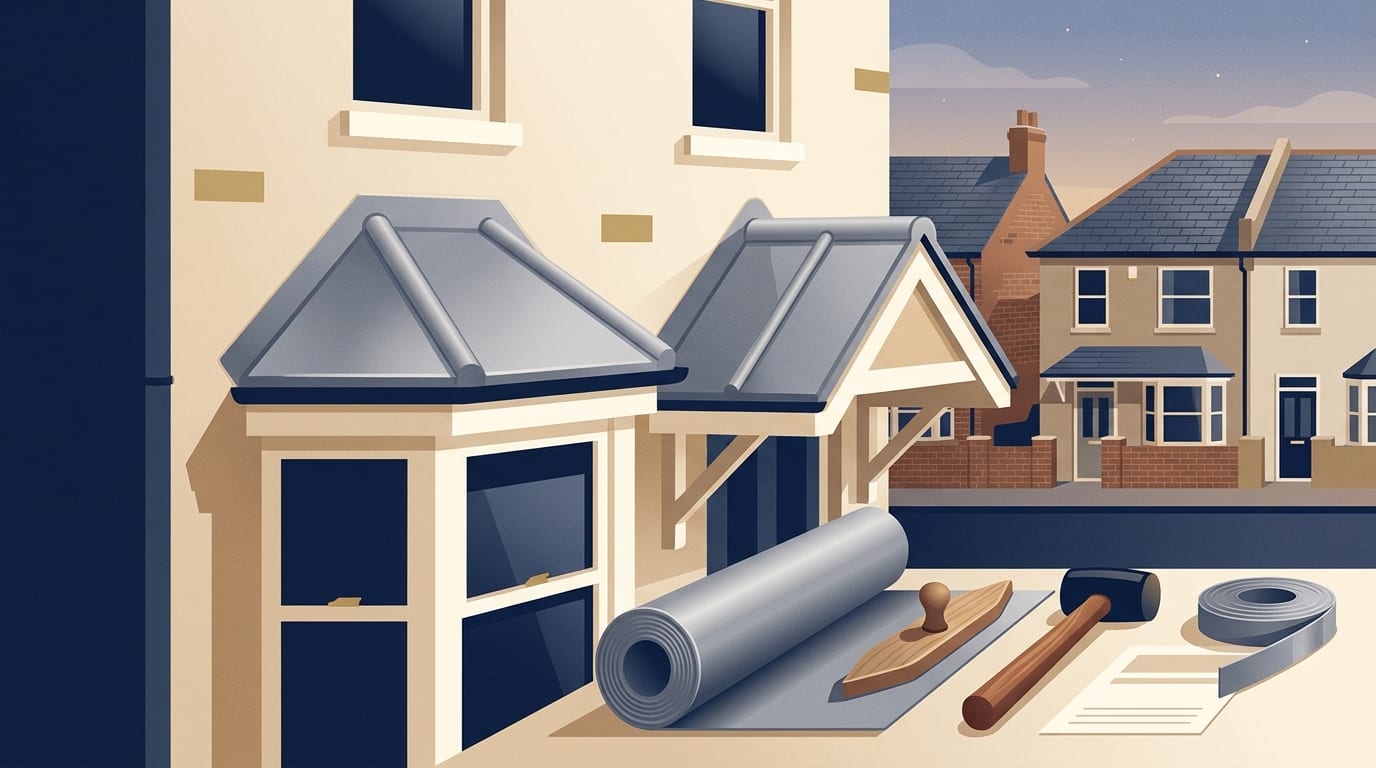
To understand what a survey covers, you need to know the basic parts of your roof. Pitched roofs slope downwards and are usually covered with concrete and clay tiles, or natural and fibre cement slate. The ridge is the peak of the roof, while the hip is the sloping external corner. The valley is the internal corner where two sections meet. The verge is the outer edge at the gable end, and the eaves are the lower edges where water runs off into the guttering. Lead flashing seals the joints between the roof covering and the brickwork.
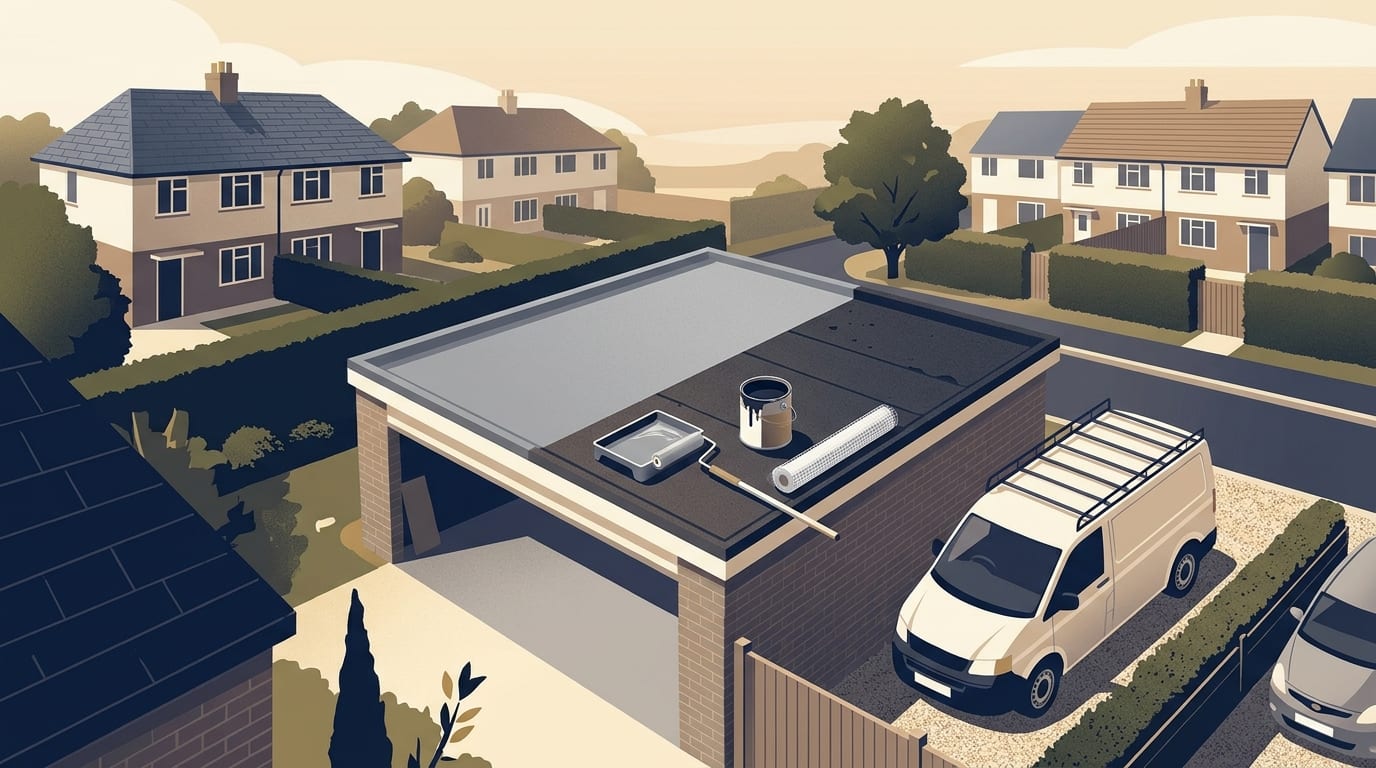
Flat roofs are built differently. The timber deck is the structural base of a flat roof. A flat roof is typically covered with built-up felt, which is usually torch-on, EPDM rubber, GRP fibreglass, single-ply or liquid coatings. A survey will identify exactly which of these materials is failing and whether it is a local fault or a widespread problem.
The main types of roof survey
There are several ways to inspect a roof and each serves a different purpose. The options range from a quick look to a detailed structural assessment.
- Basic visual inspection from the ground or a ladder
- Close inspection with access equipment and a written report
- Drone survey using a camera to record the covering
- Thermal or moisture scan to find hidden leaks
- Emergency inspection after storm damage to assess what has happened
- Full structural survey by a chartered surveyor
What each type of roof survey costs
This table shows the main survey options and what you can expect to pay for each one.
|
Survey type |
What it tells you |
Typical 2026 price |
|---|---|---|
|
Basic visual inspection |
Identifies obvious defects from the ground or a ladder |
Free to £350 |
|
Close inspection with written report |
Detailed condition check with roof access and photographs |
£200 to £600 |
|
Drone survey with photos |
Fast visual record of the covering for steep or tall roofs |
£200 to £500 |
|
Thermal or moisture scan |
Detects hidden leaks and is often used on flat roofs |
£300 to £600 |
|
Emergency inspection after storm damage |
Urgent assessment of recent weather damage |
£250 to £450 |
|
Full structural survey by a chartered surveyor |
Assesses sagging rafters, purlins, spread and loading |
£500 to £1,000+ |
These are typical published prices for 2026 and local quotes will differ.
A basic visual inspection takes 30 to 60 minutes. A full close inspection takes two to four hours. A drone survey or an emergency inspection will typically take one to three hours. A thermal or moisture scan takes two to three hours and is often used on flat roofs with difficult to find leaks. If you want a drone photography upgrade, such as a 3D model of your property, this usually costs £400 to £500.
Small repairs are usually a fixed price or a day rate, but larger work is priced per square metre plus access. Getting safely up to the roof for a close inspection adds to the bill. Where scaffolding is needed it typically costs £640 to £1,200, while cherry picker hire costs £150 to £300 a day. If you need a same-day call-out for an emergency, expect to pay £200 to £350. Scaffolding is often a separate and significant line on a quote. Waste removal and VAT may or may not be included, so you must always ask.
Prices are generally higher in London and the South East. Many roofers inspect for free and rely on winning the repair job to make their money. Some charge a fee of £150 to £300 for a domestic survey, but they will deduct this from the final bill if you book the work with them.
What a drone survey can and cannot show
A drone provides a fast and safe visual record of the roof covering. It is especially good for steep or tall roofs that are difficult to reach with ladders or scaffolding. The operator flies the drone over the property and takes high resolution photographs and video of the tiles, ridge and chimney.
Drones have clear limits. They cannot fly in high wind or heavy rain. A camera also cannot assess the strength of the mortar or detect hairline cracks in slates. Crucially, a drone cannot see what is happening beneath the surface. Underlay is the waterproof layer beneath the tiles, often called felt or membrane. Battens are the wooden strips the tiles are fixed to. A drone cannot tell you if the underlay is torn or if the timber is rotting.
Insulation is another hidden factor. A warm roof has insulation above the deck, while a cold roof has it between the joists. A drone cannot check if your insulation is wet or failing. Because of these limits, the best condition reports combine a drone flight with a physical loft inspection or a close check from a tower. Any company using cameras commercially must be registered, so you should always ask whether the operator is registered with the Civil Aviation Authority.
Roofer, building surveyor or chartered surveyor
Choosing the right professional depends entirely on what you plan to do with the report. A roofer is the best person for a practical repair answer. They can tell you exactly how to stop a leak, what materials are needed, and what it will cost to fix. Knowing how to choose a roofing company you can trust ensures you get an honest assessment rather than a sales pitch for a whole new roof.
A chartered surveyor regulated by the Royal Institution of Chartered Surveyors provides an independent report. This is the type of document a mortgage lender, a solicitor or a court will rely on. Their survey carries professional indemnity backing and independence, which is vital during a property purchase or a legal dispute.
A structural engineer or a building surveyor is needed for sagging or structural concerns. They assess the wooden skeleton of the roof, including rafters, purlins, roof spread, loading and deflection. Nobody can see rotten timber until the old covering is off, so an expert opinion helps you budget for hidden damage. They will also understand the rules around building regulations.
In England, repairing or re-covering a roof does not normally need a building control application if less than 25 per cent of the building envelope and less than 50 per cent of the roof is affected. Above that, approval is needed and the insulation may have to be upgraded. Approval is also needed for structural alterations, where a new covering performs significantly differently in fire, or where it adds 15 per cent or more to the weight. Rules differ in Scotland and Northern Ireland, so you should check with your council rather than guessing.
CompetentRoofer is a government-authorised competent person scheme run by the National Federation of Roofing Contractors. Registered roofers can self-certify roof refurbishment in England and Wales, and you should receive a building regulations compliance certificate. Otherwise the work must go through council building control or a registered building control approver. TrustMark is the government-endorsed quality scheme for work in and around the home. Membership is a good sign, not a guarantee, and you should always check these details on the scheme's own register.
How a home survey covers the roof
An RICS Level 1 Home Survey describes the condition of the property, identifies risks and highlights urgent defects. It is aimed at conventional and newer homes in good condition, and costs start at a few hundred pounds. A Level 2 Home Survey includes all of Level 1 plus a more extensive roof space and drainage chamber inspection, alongside advice on defects and repairs. It can also include a valuation.
A Level 3 Home Survey is the most comprehensive option. It includes a more thorough consideration of the roof space and suits large, older, run-down, unusual or altered properties, or places where major works are planned. Some Level 3 services cost over £1,000.
The standard visual inspection for Levels 1 and 2 does not remove secured panels, inspection chamber covers or similar features. A homebuyer report checks the roof from ground level and from inside the loft, but not up close. Because a home survey looks at the whole property from a distance, a dedicated roof survey adds vital detail where the roof is your main worry.
Surveys for insurance claims
If your roof is damaged in a storm, your insurance provider will want proof of what happened before they pay out. The Financial Ombudsman Service points out that insurers usually have a report from a surveyor, and sometimes customers will have received their own report.
Clear and detailed reports explaining the expert's thinking, supported by photos of the damage, tend to be the most persuasive evidence. Where a roof has not been inspected properly and an insurer relies purely on an aerial photo, the Ombudsman may not be persuaded unless the photo clearly shows deterioration. A thorough inspection with photos gives you the evidence to put your case, and our guide on whether home insurance covers a leaking roof explains how claims work.
What a good written report includes
A proper written survey should give you all the facts you need to make a decision. A useful report contains the following details.
- Clear photographs of the entire roof and any specific problem areas
- A list of the defects found and exactly where they are located
- The likely cause of the damage or deterioration
- How urgent the problem is and what will happen if you wait
- Practical repair options with likely costs
- Estimates of the remaining life of the roof covering
- A clear statement of any areas that could not be inspected safely
Questions to ask before you book
Before you agree to a survey, you need to know exactly what you are paying for. Ask the company what access equipment will be used to reach the roof. Check whether the loft space is included in the inspection. Ask if you will receive a written report or just a verbal summary. Find out how many photographs will be taken and when the final report will arrive, which is usually a few days after the visit. You should also check what public liability insurance cover the company holds, and confirm whether the survey fee is deducted from the final bill if you book the repair.
Under the Consumer Rights Act 2015 work must be done with reasonable care and skill. If it is not, you can ask for it to be put right or for your money back. A quote is a fixed price, while an estimate is not. Contracts agreed at home, by phone or online normally carry a 14-day cooling-off period. If you ask for work to start inside that period you must pay for what has been done.
Citizens Advice recommends getting written quotes from at least three different traders. A quote should show a fixed total price, not a daily rate. It should include a breakdown of all the work and materials, how long the price is valid for, whether it includes VAT and when the price can go up. Do not agree to a deposit of more than 25 per cent. Avoid traders who only accept cash or want everything upfront. Paying by credit card for work costing between £100.01 and £30,000 can give you Section 75 protection if things go wrong.
You must also watch out for common mistakes and scams in this trade. Ignore cold callers who knock on your door claiming they have spotted a loose tile or moss from the street. Avoid anyone who pressures you to decide today. Be wary of cash only deals, big deposits and firms with no physical address. Vague one line quotes are a major warning sign. Be careful of being sold a whole new roof for a local fault. Ignore roof coating and painting claims, and pressure washing sold as maintenance. Remember that a guarantee that is not insurance-backed can be worthless if the firm folds. Finally, never go without the building regulations certificate if your project needs one.
Common questions
How long does a roof inspection take?
A basic visual inspection takes 30 to 60 minutes to complete. A drone survey or an emergency inspection usually takes one to three hours. A full close inspection or a thermal moisture scan will take between two and four hours depending on the size of your property.
Do I need scaffolding for a roof inspection?
Not always. A visual check from the ground or the loft, or a drone survey, needs no scaffolding. For a close inspection on the roof itself, the Health and Safety Executive says all work on roofs is highly dangerous, even if a job only takes a few minutes. Sloping roofs require scaffolding to prevent people or materials falling from the edge, with edge protection at the eaves. On terraced properties, edge protection is needed at the rear as well as the front. Where work is of short duration, which means tasks measured in minutes, properly secured ladders and proper roof ladders may be used.
Can I check my own roof?
You can look for obvious problems from the ground or check inside your loft for damp patches and daylight. You should never climb on a roof, use ladders at height, or attempt to carry out leadwork, torch-on felting, structural or electrical work yourself. Always hire a professional with the right access equipment.
Will a homebuyer report find roof problems?
A standard home survey checks the roof from ground level and from inside the loft. It will identify obvious risks and urgent defects, but it does not include a close physical inspection of the tiles, mortar or lead flashing. If the surveyor spots a potential issue, they may recommend booking a dedicated roof survey to get a more detailed answer.
Next steps
Booking the right survey protects your home and your budget. Follow these steps to get the answers you need.
- Take photographs of any damp patches or slipped tiles from the ground
- Decide whether you need a simple repair quote or a formal written report
- Check that any drone operator is registered with the Civil Aviation Authority
- Ask three local firms for a written quote that includes the cost of access equipment
- Confirm whether the inspection fee will be deducted if you book the repair work
Once you know what type of inspection you need, you can find a roofer near you to get the process started.
Find a top rated roofer near you
3,859 roofers across the UK, each ranked on their Google rating and the number of reviews behind it. Start with your county: