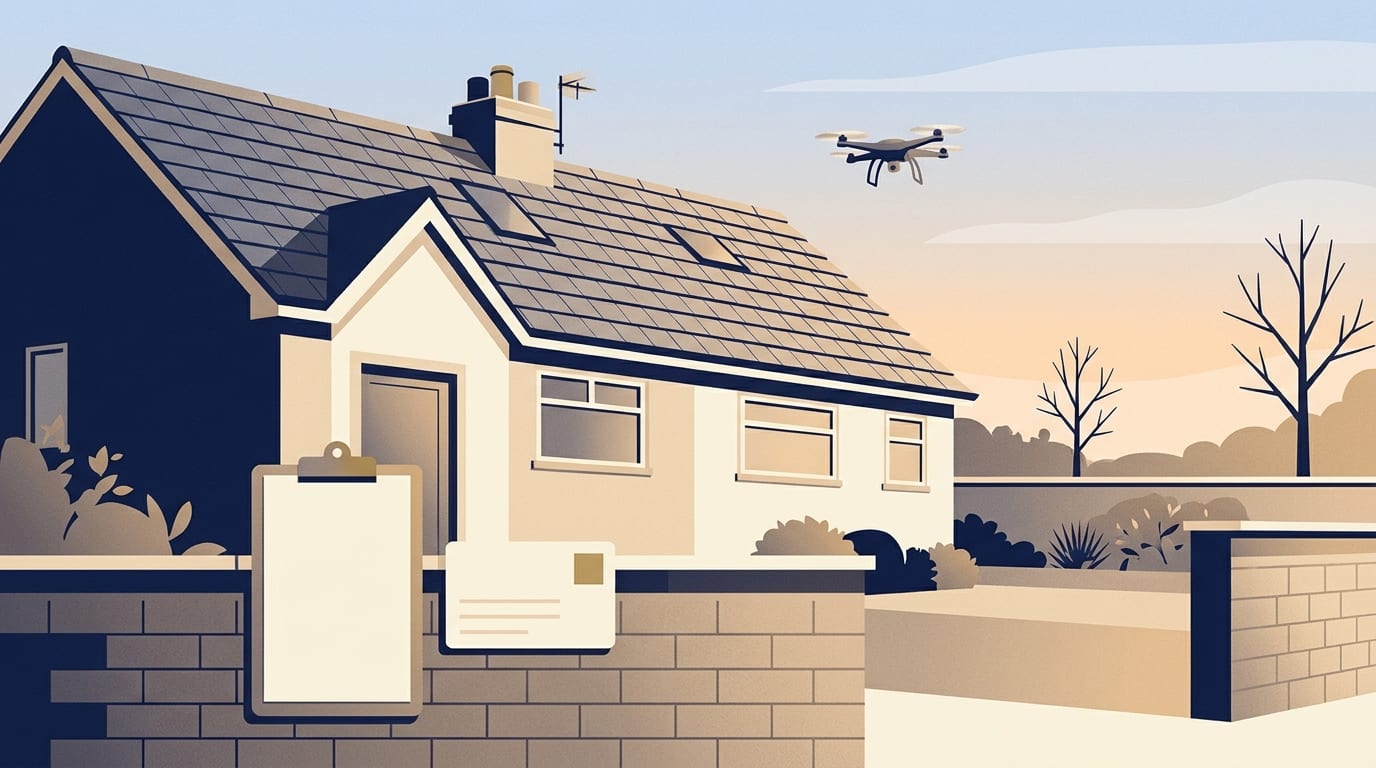
The Civil Aviation Authority (CAA) says that from 1 January 2026 anyone flying a drone of 100g or more must hold a Flyer ID, and that Operator ID rules apply depending on the drone's weight and camera. These IDs show that a pilot has passed a theory test and that the operator is registered, nothing more. If a roofer offers to inspect your property from the air, you can ask for these details before they start.
Why roofers use drones and why rules apply
When you are looking into roof survey types and costs, you may find that some roofers offer to fly a drone over the roof. A drone flight over your property for a survey is covered by the CAA's drone rules, which this guide sets out.
The CAA says you do not need either ID if you only fly indoors or where the aircraft cannot escape. A flight over a roof is outdoors, so the weight rules below are the ones to look at.
What changed on 1 January 2026
The CAA updated its rules for all UK drone users at the start of 2026. Its news page lists a requirement for anyone flying a drone over 100g to have a Flyer ID. Elsewhere the CAA says that anyone wanting to fly a drone that weighs 100g or more must pass its official test to get a Flyer ID.
The same update lists the introduction of Remote ID functionality. The changes apply to all drone users in the UK, and the CAA advises readers to review the updated guidance.
The CAA also says that any new model of drone or model aircraft placed on the market from 1 January 2026 must have a UK class mark. The UK0 mark means the drone is less than 250g, including its payload. The UK1 mark means the drone is less than 900g, including its payload. Both UK0 and UK1 aircraft fly in the Over People (A1) sub-category, along with European C0 and C1 aircraft.
What a Flyer ID is
A Flyer ID shows that a person has passed the CAA's theory test. The CAA says a pilot must pass its official theory test to get a Flyer ID before flying a drone or model aircraft covered by the regulations. It says the test is needed for drones or model aircraft of 100g or above.
The CAA's pages list this as the basic Flyer ID online theory test in the Open Category.
What an Operator ID is
The CAA says a person must be 18 or over to get an Operator ID, and that the Operator ID must be labelled on the drone or model aircraft. The Flyer ID is the pilot's theory test pass, while the Operator ID is the registration that goes on the aircraft.
The CAA says most people get their Flyer ID and Operator ID at the same time. It says the Operator ID must be labelled on every drone or model aircraft the operator is responsible for, and that the Operator ID, not the Flyer ID, is the one to use.
On the label itself, the CAA says the text must be clear and in block capitals taller than 3mm, on the main body of the aircraft, and visible from the outside or within a compartment that can easily be accessed without using a tool.
Because the rule covers every drone or model aircraft an operator is responsible for, a roofing firm that owns more than one drone needs its Operator ID labelled on each of them. A roofer can show a homeowner the label by pointing to the aircraft itself.
Which drones need which ID
The CAA's rules depend on how much the drone weighs and, for drones from 100g to less than 250g, on whether it has a camera.
The CAA says that if a drone weighs under 100g, a Flyer ID is not required, though it strongly recommends taking the test, and an Operator ID is optional. For 100g to less than 250g with a camera, an Operator ID is also needed. Without a camera in that weight range, an Operator ID is optional.
For a drone or model aircraft weighing from 250g to less than 25kg, the CAA says both a Flyer ID and an Operator ID are needed.
The table below shows which ID applies based on drone weight and camera.
|
Drone weight and camera |
Flyer ID |
Operator ID |
|---|---|---|
|
Under 100g |
Not required |
Optional |
|
100g to less than 250g without a camera |
Required |
Optional |
|
100g to less than 250g with a camera |
Required |
Required |
|
250g to less than 25kg |
Required |
Required |
What the IDs do not prove
A Flyer ID and an Operator ID only show that a pilot has passed a theory test and the operator is registered. They do not show insurance, a roofing qualification or competence at inspecting roofs. This site lists roofers and does not vet them, and it does not check whether any listed roofer holds either ID. It is not connected with the CAA.
The basic Flyer ID test is an Open Category test. The CAA says the A2 Certificate of Competency is a separate qualification that enables a pilot to fly in the Near People (A2) Category, and that a Flyer ID is needed before any other qualification.
The CAA does not recognise overseas registrations or qualifications, so an ID or qualification gained abroad is not one the CAA recognises.
|
What the CAA says |
Flyer ID |
Operator ID |
|---|---|---|
|
What it shows |
The person has passed the CAA's theory test |
The operator is registered |
|
Where it appears |
Held by the pilot |
Labelled on the drone |
|
What it does not show |
Insurance, a roofing qualification or competence at inspecting roofs |
The same limits apply |
Flying for work
The CAA's page on flying drones for work says the Permission for Commercial Operations (PfCO) was withdrawn when the UK moved to a new set of regulations, and that there is no direct replacement for a PfCO.
The CAA says an Operator ID is needed even where a pilot has a permission to fly from any other organisation, such as an airport. For flying for any reason other than recreation, sport or as a hobby, it says third party insurance is the minimum. Its examples include getting paid to take pictures or record video and getting paid to carry out surveys.
The CAA also says a sole trader should make sure the insurance policyholder name matches the name on the Operator ID.
For organisations, the CAA says a person must be named as accountable for the drones and model aircraft, and that operators must make sure only Remote Pilots with the appropriate qualifications use their drone. It says operations in the Specific Category need an Operational Authorisation.
Questions to ask a roofer using a drone
A homeowner who has been offered a drone survey can put these questions to the roofer.
- Can I see your Flyer ID?
- What is your Operator ID?
- Is it labelled on the drone?
- Do you have insurance for flying it?
Each question links to something the CAA says. The first two ask about the two IDs, and the table above shows which ID applies to which drone. The third ties to the CAA's labelling rule, which can be seen by looking at the drone. The fourth ties to the third party insurance minimum for flying for work. None of the answers shows roofing skill.
How to check what the CAA says
If a roofer gives an ID number, the CAA has a service to check whether a Flyer ID or Operator ID is valid. These are the steps.
- Ask the roofer for the ID numbers and the correct name.
- Open the CAA page for checking a Flyer ID or Operator ID.
- Enter the details. The CAA service shows the registration status of a person or organisation.
- You need the Flyer ID or Operator ID you want to check and the name of the person.
- For an organisation you need the name of its accountable manager.
A valid result confirms registration status. It does not show insurance, a roofing qualification or competence at inspecting roofs.
Common questions
Where does the CAA say Over People (A1) drones can be flown?
In the Over People (A1) sub-category the CAA says flying is allowed in residential, recreational, commercial or industrial areas. The same page says do not fly over crowds or above 120m (400ft). It adds, for both A1 and A3, that restricted airspace is off limits and that dangerous goods must not be carried or articles dropped.
What happens to European C class drones from 2028?
The CAA says that until 31 December 2027 a European C class aircraft can be flown as if it is the corresponding UK class. From 1 January 2028 that stops. It becomes a legacy aircraft and has to be flown in the appropriate Open sub-category according to its weight.
What does the CAA say about drones with no class mark?
The CAA calls an aircraft with no UK or European class mark a legacy aircraft. It says a legacy aircraft of less than 250g can be flown in Over People (A1), one of less than 2kg in Near People (A2) with an A2 Certificate of Competence, and one of less than 25kg in Far from People (A3). It adds that UK5 and UK6 class drones need an Operational Authorisation from the CAA. This guide does not say which category a particular roof survey falls into.
Does the CAA have a lighting rule for night flights?
The CAA says that from 1 January 2026 drones operated at night in the Open Category must be equipped with a green flashing light. The remote pilot is responsible for ensuring the light is activated at all times. If the light switches off for any reason, such as when recording, the pilot cannot continue to comply. The weight of an added light counts towards the overall weight of the aircraft.
Do drones under 100g have any rules?
The CAA says drones under 100g need neither ID, but the Drone Code must still be followed. For these drones it strongly recommends taking the Flyer ID test.
Is a Flyer ID the same as an A2 Certificate of Competency?
No. The A2 Certificate of Competency is a separate qualification that enables a pilot to fly in the Near People (A2) Category, and the CAA says a Flyer ID comes first.
Does a pilot with an airport permission still need an Operator ID?
The CAA says an Operator ID is needed even where the pilot holds a permission to fly from another organisation, such as an airport.
Next steps
These are checks a homeowner can make before agreeing to a drone survey.
- Ask the roofer for their Flyer ID and Operator ID.
- Check that the Operator ID is labelled on the drone in block capitals taller than 3mm.
- Ask whether they have insurance for flying the drone.
- Use the CAA website to verify their registration status.
The CAA's drone pages are the place to confirm the rules for a particular drone. You can find a roofer near you on this site. The site lists roofers and does not vet them, and listing says nothing about whether a roofer holds any ID.
Find a top rated roofer near you
3,860 roofers across the UK, each ranked on their Google rating and the number of reviews behind it. Start with your county: