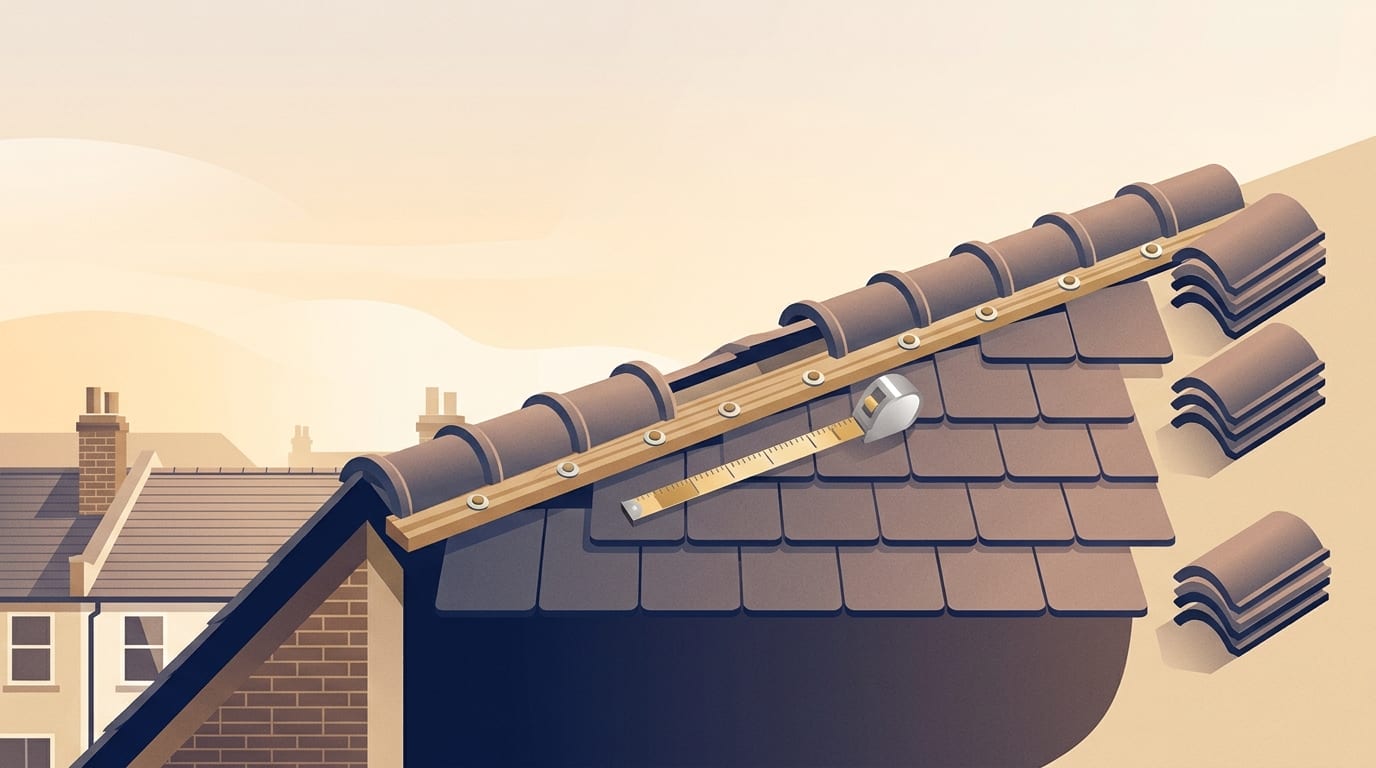
A dry ridge system replaces traditional mortar bedding with mechanically fixed ridge tiles, which are held on by fixings rather than by mortar alone. The current standard for slating and tiling, BS 5534, no longer accepts mortar as the only means of fixing ridge and hip tiles, meaning every new ridge needs mechanical fixing whether mortar is used alongside it or not. If you are hiring a roofer to fit a dry ridge system, typical 2026 prices run from £40 to £75 per linear metre installed.
What is a dry ridge system?
To understand how a dry ridge works, it helps to know the basic terminology of a pitched roof. The ridge is the horizontal peak at the very top of your roof where the two sloping sides meet. On roofs with more complex shapes, you will also have hips, which are the sloping external angles where adjacent roof sections join, and valleys, which are the internal angles where water runs down. At the lower edge are the eaves, where you will find the fascias, soffits and guttering that manage rainwater. A pitched roof sheds water using overlapping concrete and clay tiles, or natural and fibre cement slate.
Unlike pitched roofs, flat roofs rely on a timber deck covered by continuous waterproof materials. These flat roof systems are built-up felt (usually torch-on), EPDM rubber, GRP fibreglass, single-ply and liquid coatings. Inside the structure, the way the roof is insulated matters. A warm roof has insulation above the deck, while a cold roof has it between the joists. While dry ridge systems apply exclusively to pitched roofs, understanding these terms will help you make sense of any quote a roofer provides.
A dry ridge system uses mechanical fixings rather than wet mortar to hold the ridge tiles in place. The standard for these systems, BS 8612:2018, covers fixing security, weather-tightness, durability and ventilation. The roof underlay (often called felt or membrane) and the timber battens sit beneath the tiles, and the fitting itself is a job for a roofer.
Why ridge tiles must now be mechanically fixed
The rules on fixing ridge and hip tiles changed. According to Local Authority Building Control (LABC), changes made to British Standards in 2014 meant that mortar could no longer be relied upon as the only means of securing tiles.
The current standard, known as BS 5534, made it clear that single-lap roof tiles and hip and ridge tiles all had to be mechanically fixed regardless of the use of mortar. If a roofer uses mortar, the tiles still have to be mechanically fixed.
If a roofing contractor tells you they will simply bed your new ridge in mortar with no mechanical fixings at all, that does not match the current standard, so ask them to explain.
How dry ridge compares with mortar
When deciding how to repair or replace your ridge, the choice between traditional mortar and a modern dry ridge system often comes down to longevity versus initial expense. Mortar bedding usually has a lower initial cost, but it cracks and needs repointing.
A tile maker's support guidance describes ridge tiles being displaced in high winds as a very common issue that relates to the use of mortar. It says the mortar can be weakened or dislodged by several things.
- A poor original sand and cement mix.
- Building movement.
- Driving rain.
There is no easy way to retrospectively reinforce ridge and hip tiles that are already bedded in mortar. If your current ridge tiles have come loose, the same guidance suggests replacing them with a dry system, and a roofer should explain what your roof needs. Do not go on the roof to check or fix them yourself.
What BS 8612 means for dry ridge and dry verge
Following the 2014 changes to BS 5534, dry-fix products became more common. LABC notes that some dry-fixed systems did not provide sufficient mechanical restraint.
BS 5534 now refers to BS 8612:2018, which covers dry-fixed ridge, hip and verge systems, including fixing security, weather-tightness, durability and ventilation. It also defines tests for mechanical resistance to wind load.
When you are comparing quotes for a dry ridge or a dry verge, you should always ask the roofer whether the system they plan to use meets BS 8612. A good roofer should be able to answer this clearly.
Will a dry ridge suit an older roof?
Do not assume that every older roof suits a dry ridge system. Nothing in the standards says that it does, and it depends on your tiles and your roof.
Do not assume that an off-the-shelf dry ridge system will work for your specific roof. When you invite a roofer to inspect the job, ask them to confirm in writing that the proposed dry ridge system suits your exact tiles. If your roof has a non-standard pitch, unusual ridge tiles, or a historic covering, the roofer should specify exactly how they intend to achieve a secure, weatherproof finish without compromising the look or function of the roof.
What a dry ridge system typically costs
The price you pay for a dry ridge installation will depend on the size of your roof, how easy it is to access, and the current condition of your ridge tiles. Small repairs are usually charged at a fixed price or a day rate, while larger sections are priced per square metre or linear metre plus access. The table below shows typical 2026 prices for a dry ridge system.
|
Item |
Typical 2026 figure |
|---|---|
|
Dry ridge installation |
£40 to £75 per linear metre |
|
Standard semi-detached house |
£900 to £1,600 |
|
Replacing old ridge tiles with dry ridge (including removal of mortar and tiles) |
£900 to £1,900 |
|
Each hip |
Extra £300 to £400 |
These are typical 2026 prices, and local quotes will vary. Estimates vary. Some 2026 price lists put dry ridge installation at £40 to £75 per linear metre, others put a dry-fix ridge at £20 to £30 per metre run and a mortar re-ridge at £15 to £25 per metre run. Prices in London and the South East are generally higher than the national average.
When reviewing your quote, remember that scaffolding is often a separate and significant line. Working safely at the ridge usually requires proper access equipment rather than just a ladder. Nobody can see rotten timber battens until the old covering is off, so a good quote will state exactly how any extra timber work will be priced. Waste removal and VAT may or may not be included, so you must ask. If you are comparing a full replacement against patching up your existing roof, you can read more about ridge tiles and verges explained with repair costs to see which option makes the most financial sense.
Rules, schemes and consumer protection
When having significant work done on your roof, it helps to understand the rules and schemes that protect you. In England, repairing or re-covering a roof does not normally need a building control application if less than 25 per cent of the building envelope and less than 50 per cent of the roof is affected. Above that, approval is needed and the insulation may have to be upgraded. Approval is also needed for structural alterations, where a new covering performs significantly differently in fire, or where it adds 15 per cent or more to the weight. Replacing a glazed or polycarbonate conservatory roof with a solid one takes the conservatory out of its exemption, so building regulations apply to the new roof. Rules differ in Scotland and Northern Ireland, so you should check with your council rather than guessing.
CompetentRoofer is a government-authorised competent person scheme run by the National Federation of Roofing Contractors (NFRC). Registered roofers can self-certify roof refurbishment in England and Wales, and the customer should receive a building regulations compliance certificate. Otherwise the work goes through council building control or a registered building control approver. TrustMark is the government-endorsed quality scheme for work in and around the home. Membership of these schemes is a good sign, not a guarantee, and you should check the scheme's own register to confirm a firm is truly registered.
Under the Consumer Rights Act 2015, any roofing work must be done with reasonable care and skill. If it is not, the customer can ask for it to be put right or for money back. Contracts agreed at home, by phone or online normally carry a 14-day cooling-off period. However, if you ask for work to start inside that period, you must pay for what has been done. A quote is a fixed price, whereas an estimate is not. Paying by credit card gives Section 75 protection on purchases over £100 and up to £30,000, which can be extremely useful if the firm goes out of business before finishing the job. If you end up in a dispute, Citizens Advice is the place to seek independent guidance.
Common mistakes and scams in this trade
Roofing is an industry that unfortunately attracts scams and poor practice. A common mistake is falling for cold callers who knock on your door claiming they have spotted a loose tile or moss on your ridge from the street. They often apply pressure to decide today, ask for cash only, demand big deposits, and provide no physical business address. If a tradesperson cannot give you a physical address, think twice before letting them work on your home.
A genuine roofing firm will inspect the roof properly, perhaps from the ground using binoculars or from inside the loft, and provide a clear, written quote. Be wary of vague one-line quotes, or being pressured into buying a whole new roof when a local fault at the ridge could be repaired. You should also avoid roof coating and painting claims, or pressure washing sold as maintenance. Ask what any pressure washing or coating will achieve before you pay for it.
Guarantees are another area where homeowners get caught out. A guarantee from a roofing firm is worthless if the firm folds, unless it is an insurance-backed guarantee. Going without the building regulations certificate is also a major mistake, as ending up with no paperwork when you come to sell your home will cause delays and cost you money.
Problems to watch for and questions to ask
To make sure you are getting a complete and professional job, ask the roofer these questions before you agree to a quote.
- Are the hips included in the price, or just the main ridge?
- Does the quote include the cost of removing and disposing of the old mortar and tiles?
- Is the cost of scaffolding included in the final price?
- Does the dry-fix system meet the BS 8612 standard?
- What guarantee applies to the materials, and is the workmanship guaranteed?
Ensure the quote explicitly details waste removal and whether VAT is included, so there are no surprise costs at the end of the job. A professional quote will clearly itemise these points rather than grouping them into one vague figure.
Common questions
What is a dry verge?
A dry verge system protects the outer edges of a pitched roof, known as the verges, usually located at the gable ends of a house. Like a dry ridge, it is a mechanically fixed system rather than one bedded in mortar, and BS 8612:2018 covers dry-fixed verge systems.
Can you fit a dry ridge system on an old roof?
It depends on the type and condition of your existing roof. You should ask your roofer to check the compatibility and confirm in writing that a dry ridge will work with your specific roof covering.
Can a dry ridge system fail?
LABC notes that some dry-fixed systems did not provide sufficient mechanical restraint. That is why it is worth asking whether the system meets BS 8612 and asking the roofer to confirm in writing that it suits your tiles.
Is dry ridge better than mortar?
Mechanical fixing is now required, and mortar can no longer be relied on as the only means of fixing. Mortar bedding usually has a lower initial cost, but it cracks and needs repointing.
Next steps before you agree a quote
Before you commit to spending money on your roof, it is vital to get everything in writing and check the credentials of the person you are hiring. Follow these steps to protect yourself and ensure you get a fair price for a high-quality job.
- Take photos of your roof from the ground so you have a record of its current condition.
- Gather at least three written quotes from different roofing firms to compare prices and approaches.
- Check that each quote itemises the cost of scaffolding, waste removal and VAT.
- Ask for proof of the firm's public liability insurance.
- Agree a staged payment plan, ensuring you only make the final payment when the job is fully finished and you have the paperwork.
Taking the time to check these details will give you peace of mind and help you avoid costly mistakes. When you are ready to start gathering quotes, you can use our directory to find a roofer near you who can inspect your roof and provide a firm, itemised price.
Find a top rated roofer near you
3,860 roofers across the UK, each ranked on their Google rating and the number of reviews behind it. Start with your county: