A roof repair is usually the right choice while failures are isolated and the rest of the structure is sound. A full replacement becomes the honest answer when problems are widespread, timber is rotting, or leaks keep coming back. Making the right decision comes down to the age of the covering and whether you are paying for endless patch repairs.
The short answer
If a cold caller or a local roofer tells you that your roof needs work, it is normal to worry about being talked into a full replacement for a minor fault. Most homeowners cannot see their own roof properly, so you have to take a stranger's word for what is wrong. Published advice is that if your roof structure is sound, with no sagging or other issues, minor problems can probably just be repaired. Trade advice calls a third repair in about five years the classic tell that fixings or felt are failing across the roof, so widespread covering failure or repeated repairs are the point to look at a full replacement.
Before you can decide, it helps to know what a roofer is looking at. UK homes generally have either a pitched roof, which slopes downwards, or a flat roof. Pitched roofs are usually covered with concrete tiles, clay tiles, natural slate, or fibre cement slate. Underneath these coverings you will find wooden battens and a waterproof underlay, which is often called felt or a membrane. The peak where two slopes meet is the ridge, and the outside corners sloping down are the hips. The internal angles where two roof sections join are called valleys, and the edges overhanging your gable ends are the verges. The lowest edge of the roof is the eaves, where you will find the fascias, soffits and guttering that manage rainwater. Lead flashing is used to seal the gaps where the roof covering meets brickwork, such as around a chimney.
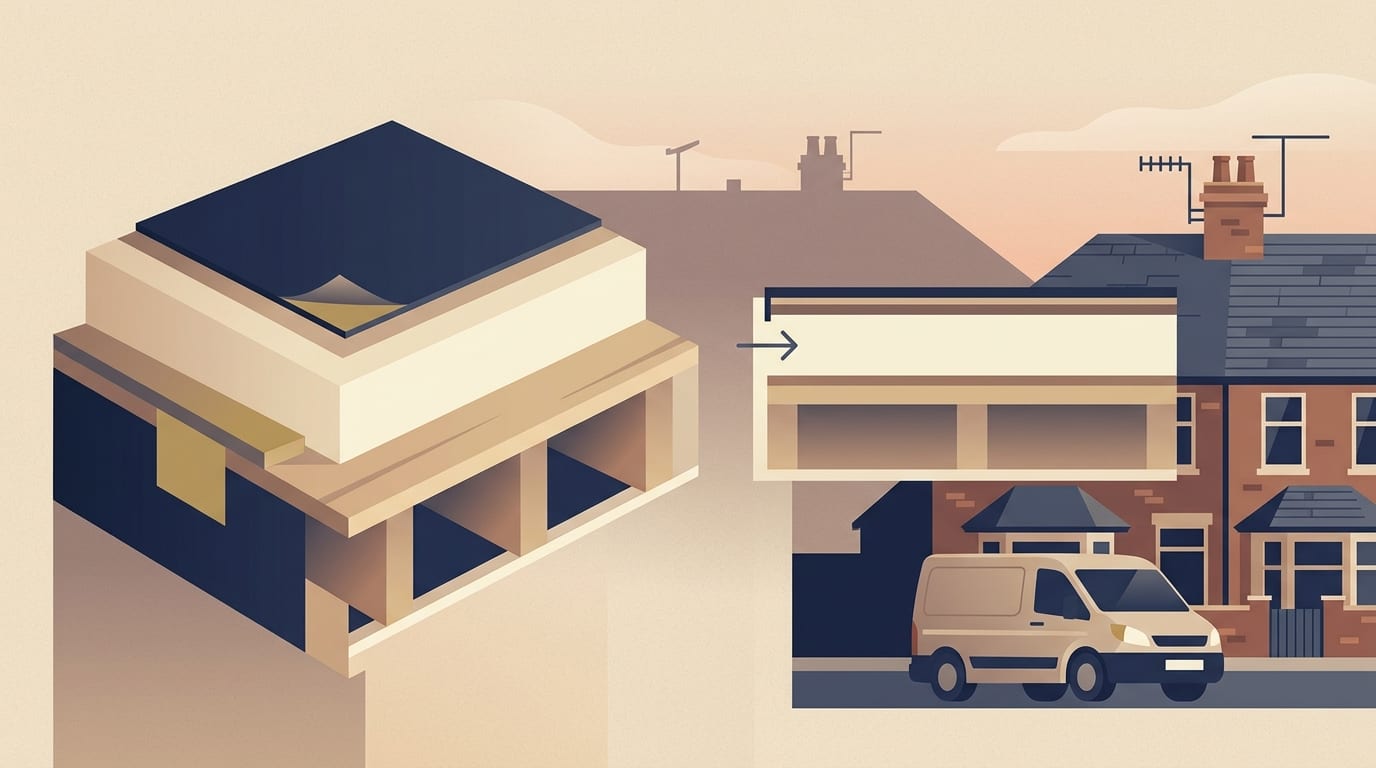
Flat roofs are built on a timber deck. A warm roof has its insulation placed above this deck, while a cold roof has the insulation placed between the joists underneath. Flat roof systems include built-up felt, which is usually applied with heat and known as torch-on felt. Other options include EPDM rubber, GRP fibreglass, single-ply membranes, and liquid coatings. A reputable roofer will always explain which part of the system has failed and show you the evidence before asking you to decide on a fix.
When a repair is enough
A repair makes sense when the damage is limited to a small area on an otherwise healthy roof. Good roofers will suggest a repair if the underlying timber and the waterproof underlay are still doing their job. A repair is usually enough in these situations:
- Isolated slipped or cracked tiles on a roof that is not nearing the end of its life
- Small leaks around the lead flashing that joins the roof to the chimney or brickwork
- Loose or open-jointed ridge tiles, which do not by themselves indicate a failing roof covering
- Isolated damage on a younger roof caused by a specific storm or impact
If the fault is local, fixing it quickly stops water finding its way into your home. A leak left untreated can damage the roof timbers, so a local fault is worth fixing promptly.
When replacement is the honest answer
A reputable roofer will advise replacing the covering when patching it up is no longer safe or cost effective. This involves stripping away the old concrete or clay tiles, or the natural or fibre cement slates, and putting down new underlay and wooden battens. Replacement is the right answer in these situations:
- Widespread covering failure where the repair cost approaches the price of a full re-roof
- Structural problems such as rotten rafters underneath the covering
- Three or four separate repair visits in a period of about five years
- A roof approaching 30 years old with recurring problems
- An energy upgrade, as older roofs often lack roof void insulation
Published advice is that a roof over 20 years old may benefit from a professional inspection. That does not mean it needs replacing.
A roof approaching 30 years old with recurring problems is usually a better candidate for replacement than another patch repair, according to trade advice.
What repairs and replacement cost
Small repairs are usually charged at a fixed price or a day rate. Larger work is priced per square metre, plus the cost of access. It is vital to ask if the quote includes waste removal and VAT, as these can add a significant amount to the final bill. Prices are also generally higher in London and the South East. The table below shows what you can expect to pay for common repair jobs.
|
Repair job |
Typical cost |
|---|---|
|
Emergency tarpaulin or make safe |
£150 to £400 |
|
A few slipped or cracked tiles |
£100 to £400 |
|
Flat roof patch repair (felt or EPDM rubber) |
£150 to £500 |
|
Chimney flashing repair |
£200 to £500 |
|
Ridge or hip repointing |
£250 to £600 |
|
Valley repair |
£300 to £800 |
|
Larger section re-tile |
£400 to £1,000 |
These are typical published prices for 2026, but local quotes will differ based on where you live and how hard your roof is to reach. You can find more detail in our guide to roof repair costs.
When a repair is no longer an option, you will need to pay for a full replacement. The table below outlines typical costs for a new roof based on property size.
|
Property type |
Typical replacement cost |
|---|---|
|
Terraced house |
£4,000 to £8,000 |
|
Semi-detached house |
£6,000 to £12,000 |
|
Detached house |
£10,000 to £20,000 or more |
These figures are typical published prices for 2026 and local quotes will differ. A wider £6,500 to £18,500 is published for a full replacement of a typical semi, so figures vary. Choosing natural slate adds £2,000 to £5,000 to the bill. Scaffolding is often a separate and significant line on your quote. Scaffolding for a full semi-detached or detached re-roof costs £1,000 to £2,000, and it should be itemised separately so you know exactly what you are paying for.
It can be tempting to keep paying for small patch repairs rather than facing the cost of a new roof. However, repeated patch repairs can add up to more than a full replacement over time. A third repair in about five years is the classic tell that fixings or felt are failing across the roof. Repairs are generally worth doing while failures are isolated, but once you are spending several hundred pounds a year on an old covering, treat that money as a deposit on a replacement. If you are reaching this point, checking how much a new roof costs will help you plan ahead.
Building regulations when you re-roof
In England, repairing or re-covering a roof does not normally need a building control application if less than 25 per cent of the total building envelope and less than 50 per cent of the roof is affected. You can read the exact limits on the Planning Portal. If you exceed those limits, you must apply for approval.
Approval is also needed if you make structural alterations, change the fire performance of the covering, or use a new covering material which increases the weight of the roof covering by 15 per cent or more. Replacing a glazed or polycarbonate conservatory roof with a solid one takes the conservatory out of its exemption, so building regulations apply to the new roof.
In most situations, re-roofing work will need building regulations approval, and approval is likely to be needed when the covering changes material from the original. A roof counts as a thermal element, so the Planning Portal states that re-covering should include improving its insulation. Rules differ in Scotland and Northern Ireland, so you should check with your council rather than guessing.
CompetentRoofer is a government-authorised competent person scheme run by the National Federation of Roofing Contractors. Registered roofers can self-certify roof refurbishment in England and Wales, meaning the customer should receive a building regulations compliance certificate directly. You should always check a roofer is actually registered on the scheme's own register. Otherwise, the work goes through council building control or a registered building control approver.
Getting a second opinion
The roofing industry suffers from rogue traders who use high pressure sales tactics. Never agree to work with cold callers who knock on your door claiming they have spotted a loose tile or moss on your roof from the street. This is a common scam to manufacture an emergency and pressure you to decide today. They often demand cash only, ask for big deposits upfront, and provide no physical trading address.
Be very wary of being sold a whole new roof for a local fault that could easily be repaired. You should also be wary of roof coating and painting claims, and of pressure washing sold as maintenance. Guarantees are worthless if the firm folds unless they are insurance-backed, so always ask whether a guarantee is insurance-backed.
Always get three written, itemised quotes from different roofing firms before you agree to any work. Ask the roofer to take photos of the defect so you can see the problem for yourself. You should never climb on a roof, use ladders at height, or carry out leadwork or torch-on felting yourself, but checking the damage from the ground or looking for daylight from inside the loft is fine. A good roofer will gladly show you the cracked tile, the damaged lead flashing, or the rotten timber on a flat roof.
A proper quote is a fixed price, whereas an estimate is not. Nobody can see rotten timber until the old covering is off, so a good quote says exactly how extras will be priced if they find underlying damage once the work begins. Going without the building regulations certificate is another mistake, so make sure your quote includes compliance.
Questions to ask your roofer
Before you hire anyone, you need to ask a few plain questions to protect yourself and your home. Getting the right answers means you are less likely to face surprise bills or poor workmanship. Ask your roofer the following questions:
- Is scaffolding included in the total price, or is it billed separately?
- Does the quote include waste removal and VAT?
- Will you take photos of the damage before you start and after you finish?
- How will you price any rotten timber you find once the roof is open?
- Are you registered with CompetentRoofer, or will I need to apply to building control myself?
- Do you have a physical trading address and proof of employers liability insurance?
- Are your guarantees insurance-backed so they still matter if your firm folds?
TrustMark is the government-endorsed quality scheme for work in and around the home. Membership is a good sign, not a guarantee, but it is worth checking the TrustMark register. If things go wrong, under the Consumer Rights Act 2015 work must be done with reasonable care and skill. If it is not, the customer can ask for it to be put right or for money back. Citizens Advice is the best place to go if you end up in a dispute.
Common questions
Can you repair a roof without scaffolding?
Access is for the roofer to judge, and you should never climb up or use ladders at height yourself. Scaffolding is often a separate and significant line, so ask for it to be itemised in the quote.
Do I have to pay upfront for roof repairs?
You should never pay 100 per cent upfront for roofing work. Published advice says a deposit of 10 to 25 per cent is typical, with stage payments agreed for larger jobs. Paying by credit card gives Section 75 protection on purchases over £100 and up to £30,000.
What happens if I change my mind after booking a roofer?
Contracts agreed at home, by phone or online normally carry a 14-day cooling-off period. If you ask for the work to start inside that period because you have an emergency leak, you must pay for what has been done up to the point you cancel.
Does a new roof need building regulations approval?
Most full roof replacements do require approval, especially if you are changing the type of covering, adding weight, or if the roof needs an insulation upgrade. You can learn more about this in our guide to building regulations for a new roof.
Next steps before you hire
Making the final decision between a repair and a replacement requires a clear head and the right paperwork. Take these steps before you hand over any money:
- Ask for photos of the exact damage to your pitched or flat roof.
- Get three itemised written quotes that separate the scaffolding costs from the labour and materials.
- Check that the roofing firm has a physical address and is not demanding cash only.
- Ask how extra costs for rotten timber will be calculated if discovered during the job.
- Agree a staged payment plan and only make the final payment when the job is completely finished.
Taking the time to check these details will protect your home and your bank balance. When you are ready to get those quotes and compare your options, you can find a roofer near you to inspect the damage and give you a firm price.
Find a top rated roofer near you
3,861 roofers across the UK, each ranked on their Google rating and the number of reviews behind it. Start with your county: