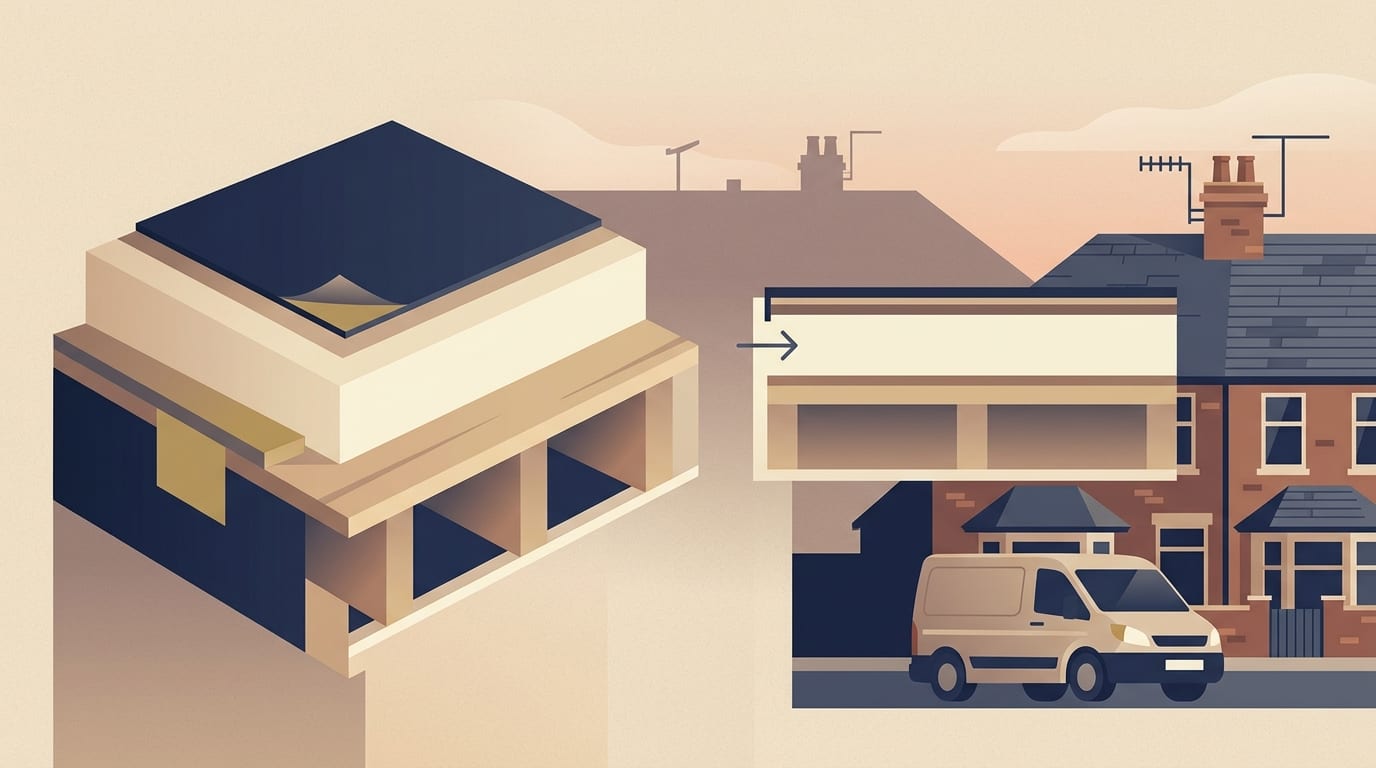
A warm roof has the insulation placed above the timber deck and needs no ventilation of the roof void. A cold roof has the insulation placed between the joists and requires a clear ventilation path to prevent condensation. When a flat roof is renewed today, the usual modern choice is a warm roof system. The Planning Portal states that re-covering a roof with integral insulation may require the insulation to be upgraded.
What a warm roof and a cold roof are
Understanding the difference between a warm roof and a cold roof starts with knowing how a flat roof is built. A flat roof sits on timber joists, which are the structural beams running across your ceiling. Over these joists sits a timber deck, which is the flat surface usually made from plywood or oriented strand board. The final waterproof covering is then applied on top to keep the rain out.
While pitched roofs feature a ridge, hip, valley, verge and eaves, and are normally covered in concrete and clay tiles, or natural and fibre cement slate, flat roofs require sealed continuous systems. Flat roof systems are built-up felt (usually torch-on), EPDM rubber, GRP fibreglass, single-ply and liquid coatings. The edges of the flat roof are finished with fascias, soffits, guttering and lead flashing to direct rainwater away from the building. Underlay, often called felt or membrane, and timber battens are typically used on pitched roofs rather than flat roofs.
The terms warm and cold simply describe where the insulation is installed. In a cold roof, the insulation is placed between the timber joists, leaving the timber deck above it cold. In a warm roof, the insulation is laid entirely on top of the timber deck, keeping the timber joists and the deck warm inside the insulated envelope of your home.
How a cold flat roof works and where it goes wrong
A cold roof system works by placing the insulation at ceiling level so the roof void stays unheated. Because warm air from your living space naturally rises, it passes through the ceiling and hits the cold void above the insulation. When warm, moist air meets a cold surface, it turns into condensation.
To stop this moisture rotting the timber joists and the deck, a cold roof needs a continuous flow of fresh air. This requires a ventilation path through the roof void. The ventilation has to work for the build-up to work.
Where a cold roof goes wrong is when this ventilation path fails. If the air cannot move, moisture can build up in the roof. Because you cannot see your own roof properly from the inside or the outside, hidden damage can go unnoticed.
How a warm flat roof works
A warm roof system solves the condensation problem by moving the insulation above the timber joists and the deck. The insulation layer is fixed over the timber structure. The final waterproof covering, such as EPDM rubber or torch-on felt, is then applied over the insulation.
The timber structure is kept warm beneath the insulation. The Planning Portal guidance for new roofs confirms that ventilation is not required to a warm roof system, which is where the insulation is placed above the joists or rafters. It also notes that a roof that is not a warm roof requires ventilation, and this is known as a cold roof system. Not all roofs need to be ventilated.
A warm roof needs no ventilation of the roof void. It is the usual modern choice when a flat roof is renewed.
What the Building Regulations say
Building regulations in England exist to ensure homes are safe, structurally sound and energy efficient. The rules state that a new roof must provide resistance to heat loss through proper insulation. Full details of the new roof will be needed by building control to show that it complies with these standards.
When you are repairing or replacing an existing flat roof, the rules depend on how much of the roof is being altered. The Planning Portal rules for work to an existing roof state that repairs or re-covering do not normally need a building control application if less than 25 per cent of the total building envelope and less than 50 per cent of the roof is affected. Approval is needed if you exceed those limits, carry out structural alterations, use a covering that performs very differently in a fire, or use one that increases the roof's weight by 15 per cent or more.
If your flat roof already has integral insulation inside it, upgrading the covering brings additional rules into play. The Planning Portal guidance on re-roofing states that if a roof with integral insulation is replaced, you may be required to upgrade this thermal element of the structure. The re-covering work should also include for improving the thermal insulation properties of the roof. Rules differ in Scotland and Northern Ireland, so readers there should check with their local council rather than guessing.
Replacing a glazed or polycarbonate conservatory roof with a solid one takes the conservatory out of its exemption. This means building regulations apply to the new solid roof.
Which is usually right when you renew a flat roof
When you hire a roofer to renew a flat roof, you are making a long-term investment in your property. While there are uses for both systems, one publisher's view is that a cold roof is suggested for cost effective upgrades where the loft or void is only used for storage.
That same publisher's view suggests a warm roof is the correct choice for loft conversions, flat roof replacements, persistent condensation problems and high performance retrofits. The Planning Portal says a new roof must provide resistance to heat loss, so ask your roofer how their build-up will do that.
If you are converting a garage into a living space, or putting a new covering on a home extension, a warm roof is the choice that one publisher suggests for loft conversions and flat roof replacements. A warm roof does not need ventilation of the roof void, but a guarantee of protection depends on the whole job being done well. You can read more about upgrading your insulation in the guide on do you have to insulate a roof when you replace it?
Why quotes for the same roof differ
If you ask three roofing firms to quote for replacing a flat roof, the prices can differ a lot. This usually happens because the roofers are assuming different build-ups. One may have quoted for a basic cold roof repair, meaning they will just strip off the old felt and put down new felt without upgrading the insulation. Another may have quoted for a full warm roof installation, which adds the cost of insulation above the deck.
The condition of the timber beneath the covering is another major variable. Nobody can see rotten timber until the old covering is off. Deck condition is the single biggest source of cost surprises on a flat roof job. A reliable, honest quote will always state exactly how extras will be priced if the plywood deck or the timber joists need replacing.
You must also be wary of common mistakes and scams in the roofing trade. Beware of cold callers who claim to have spotted a loose tile, moss or a flat roof defect from the street. They will often apply pressure to decide today, ask for a big deposit in cash, and provide only a vague one-line quote with no address. You should also be highly suspicious of roof coating and painting claims, or pressure washing sold as maintenance, so treat them with caution. A dishonest cold caller may try selling you a whole new roof for a minor local fault.
Typical extra cost for insulation above the deck
Adding insulation to create a warm roof increases the overall cost of the project. Typical 2026 figures show that warm roof insulation adds £15 to £35 per square metre to the cost of a flat roof replacement.
The final price of your warm roof will depend heavily on the waterproof covering you select. Traditional built-up felt is generally the most affordable, while EPDM rubber, fibreglass and liquid coatings command higher prices. You can read more about these choices in the guide on how much does a flat roof replacement cost?
This table shows typical supply and fit costs per square metre for different warm roof coverings.
|
Warm roof covering material |
Supply and fit cost per square metre |
|---|---|
|
Built-up felt |
£50 to £90 |
|
EPDM rubber |
£80 to £120 |
|
GRP fibreglass |
£90 to £140 |
|
Single-ply membrane |
£100 to £150 |
|
Liquid coatings |
£90 to £160 |
These are typical 2026 prices, and your local quotes will differ based on your location.
When pricing a whole roof, you must remember that very small roofs cost more per square metre than the headline rate suggests. The roofing contractor still has to pay for their travel, setup time and basic material minimum orders.
This table shows typical supply and fit costs for an 18 square metre garage or small extension, assuming a warm roof build-up with modest deck repairs.
|
Roof covering material |
Total cost for 18 square metres |
|---|---|
|
Built-up felt |
£1,200 to £1,900 |
|
EPDM rubber |
£1,700 to £2,600 |
|
GRP fibreglass |
£1,900 to £2,900 |
These are typical 2026 prices, and local quotes will differ. Prices are higher in London and the South East.
If the timber deck beneath the covering is completely ruined and needs replacing, ask how it will be priced. Separately, a typical figure for 2025 puts a flat roof warm deck system at £80 to £140 per square metre, which is a different measure from the 2026 prices above and should not be added to them. Scaffolding is often a separate and significant line on your quote, and is essential for working safely at height on extensions. You must also check if waste removal and VAT are included, as these can change the final bill.
What to ask your roofer
To avoid being overcharged or ending up with no paperwork when you come to sell, you must ask specific questions before work begins. A reputable roofer will be happy to explain their chosen build-up and provide a detailed breakdown of the costs. A proper quote is a fixed price, whereas an estimate is not.
Ask your roofer these questions:
- Are you quoting for a warm roof or a cold roof system?
- What type and thickness of insulation will you use?
- Will you be installing a vapour control layer?
- Who is responsible for handling building control approval?
- Is the price per square metre including deck repairs if you find rotten timber?
- Does this final price include scaffolding, waste removal and VAT?
Under the Consumer Rights Act 2015, all roofing work must be done with reasonable care and skill. If it is not, you can ask for it to be put right or for your money back. Contracts agreed at home, by phone or online normally carry a 14-day cooling-off period. However, if you ask for work to start inside that period, you must pay for what has been done.
Paying by credit card gives you Section 75 protection on purchases over £100 and up to £30,000. If you ever find yourself in a serious dispute with a tradesperson, Citizens Advice is the best place to seek guidance. Be cautious of roofing guarantees that are not insurance-backed, as they are completely worthless if the firm folds.
When to get building control involved
Re-covering a flat roof may need building control approval if the work goes beyond the 25 per cent and 50 per cent limits above, and the insulation may have to be upgraded. You have two main routes to ensure the work is signed off legally.
The simplest route is to hire a roofer who is registered with CompetentRoofer. This is a government-authorised competent person scheme run by the National Federation of Roofing Contractors (NFRC). Registered roofers can self-certify their roof refurbishment work in England and Wales. Once the job is finished, you should receive a building regulations compliance certificate without having to deal with the council directly.
If your chosen roofer is not a member of a competent person scheme, the work must go through your local council building control department or a registered building control approver. They will check the plans and inspect the work to ensure it meets the legal standards for heat loss and structural integrity. Going without the building regulations certificate is a common mistake and can cause problems when you sell your home.
Common questions
Can you put a warm roof over an existing cold roof?
A roofer has to assess this on site, because it depends on the existing build-up and the deck. Ask what insulation they propose, who handles building control and how they will deal with the edges and flashings.
Does a warm roof need ventilation?
No, a warm roof does not need ventilation. The Planning Portal says ventilation is not required to a warm roof system, where the insulation is placed above the joists or rafters. The structure stays within the insulated envelope of the home.
Why is my flat roof suffering from condensation?
Condensation usually happens in a cold flat roof when the ventilation path is blocked, poorly designed, or missing entirely. Warm, moist air from your home rises into the cold roof void and turns into water drops on the underside of the cold timber deck. Ask a roofer whether a warm roof build-up suits your roof, since a warm roof needs no ventilation of the roof void.
How long does a flat roof replacement take?
The time depends on the size of the roof, access, the weather and the condition of the deck. Ask your roofer how long they expect the job to take and put it in the written quote.
Next steps
Before you hire a roofer to replace or upgrade your flat roof, make sure you understand exactly what build-up they are proposing. Taking a few sensible precautions will protect you from poor workmanship and unexpected bills.
Follow this checklist before you agree to any work:
- Take photos of the flat roof defect from the ground or from an inside window.
- Get three written quotes and ask each firm to specify if they are pricing for a warm or cold roof.
- Ensure the quote itemises the cost of the covering, the insulation, scaffolding and waste removal.
- Ask for a clear price per square metre for repairing the timber deck if it turns out to be rotten.
- Check the scheme's own register to see if the roofer is a member of TrustMark or CompetentRoofer. Membership is a good sign, not a guarantee.
- Ask for proof of insurance and check that any guarantee is insurance-backed.
- Agree a staged payment plan and only make the final payment when the job is entirely finished.
If you are ready to start gathering quotes and comparing prices, you can use our directory to find a roofer near you who can assess your roof and recommend the right insulation system.
Find a top rated roofer near you
3,861 roofers across the UK, each ranked on their Google rating and the number of reviews behind it. Start with your county: