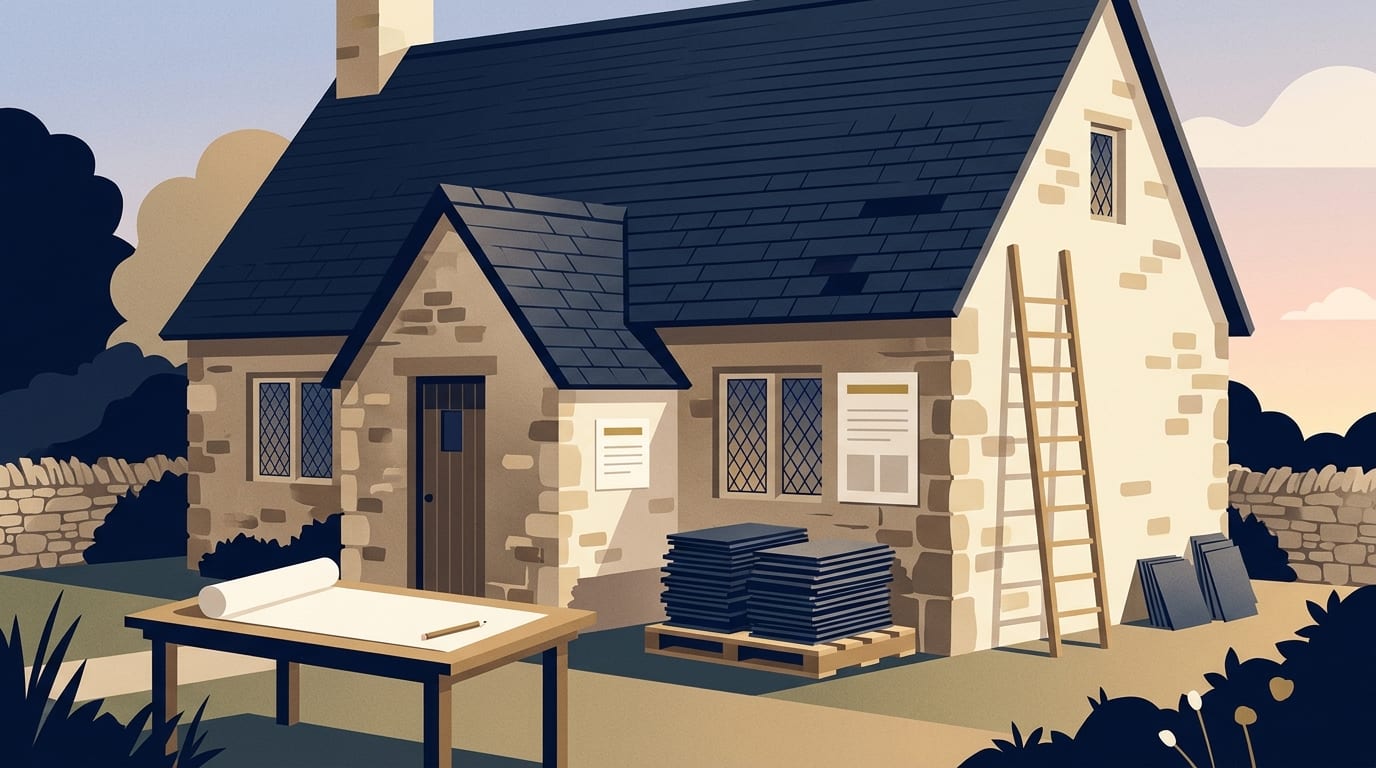
There is no single rule that dictates who pays for a shared roof repair, as it can depend on your title deeds and exactly where the fault lies. The first step is always a friendly talk with your neighbour over a photograph of the damage, because most things are settled by a simple agreement. The law mainly exists to set out how you give notice and secure access if the situation becomes difficult.
Living in a semi-detached or terraced house means your home is physically tied to the one next door. When you look at a pitched roof, which is a standard sloping roof, you will see an outer covering of concrete and clay tiles, or perhaps natural and fibre cement slate. Beneath these tiles sit the battens, which are the horizontal timber strips the tiles rest on. Under the battens is the underlay, which is often called felt or a membrane, designed to catch wind-blown rain.
Because water can travel a long way down the underlay or along the battens before it drips through your ceiling, a leak on your side of the bedroom might actually originate from a slipped slate on your neighbour's side of the boundary. You might also share specific junctions. The ridge is the horizontal peak of the roof, and it may run across both homes. You might share a hip, which is a sloping external corner, or a valley, which is the internal angle where two roof slopes meet. You will also have a verge at the outer edge of the roof at a gable end, and the eaves at the lowest edge where the gutters sit.
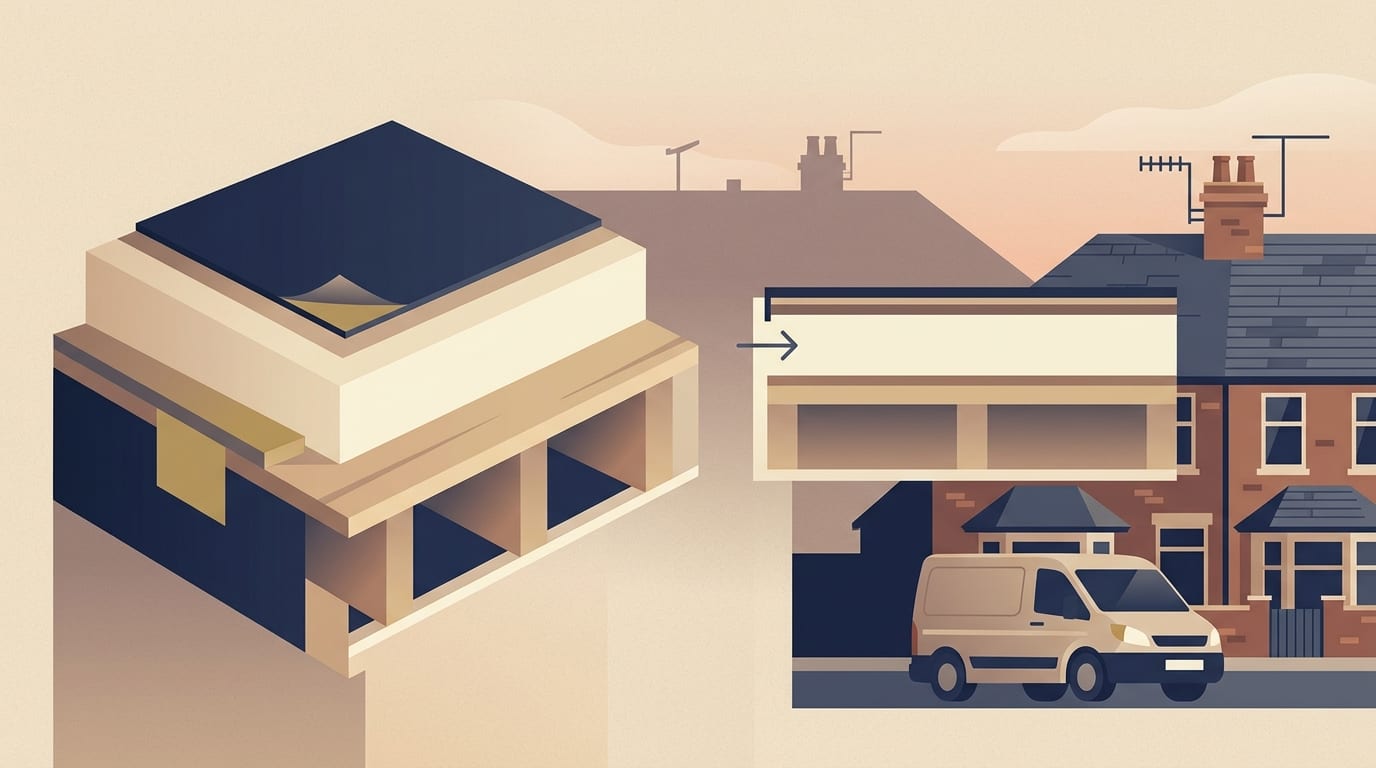
If you have a shared extension, you might be dealing with a flat roof. A flat roof consists of a timber deck, which is the structural wooden base, covered by a waterproof layer. Common flat roof systems include built-up felt which is usually torch-on, EPDM rubber, GRP fibreglass, single-ply membranes, and liquid coatings. A flat roof can be a warm roof with the insulation above the timber deck, or a cold roof with the insulation between the joists. Just like on a pitched roof, water on a flat roof can easily cross the boundary line unnoticed.
Which parts are usually shared and which are not
Many homeowners assume the dividing line between their property and the neighbour's property is perfectly clear from the street. In reality, the legal boundary is not always obvious. A party structure is a wall, floor partition, or other structure separating buildings or parts of buildings in different ownership. The official guidance does not list specific roof parts as shared, so you cannot simply guess based on looking at the tiles.
To find out exactly where your responsibility ends, you need to check your title deeds or ask a surveyor. The deeds will often show if a chimney stack, a central dividing wall or a boundary gutter is jointly owned. Joints against brickwork are sealed with lead flashing, and the deeds may specify who maintains this. You must not assume that a roof is or is not a party structure without checking the paperwork first.
Fascias, soffits and guttering are the boards and pipes that close the eaves and carry water away. These often run continuously across terraced houses, so check your deeds for who maintains them. Property and boundary laws differ in Scotland and Northern Ireland, so if you live there you must ask a local solicitor or your local council for guidance rather than guessing.
Talking to your neighbour first
The cheapest and fastest way to resolve a roof problem is to talk to your neighbour before you hire anyone. Knock on their door and explain the issue calmly, focusing on the fact that a roof leak left untreated will eventually damage both properties. Take photographs of the defect from the ground or from inside your loft to show them what is wrong. Never climb onto the roof yourself, use ladders at height, or ask to go into their property to investigate.
Keep things practical and offer to take the lead on gathering information. You can follow these steps to keep the process moving smoothly:
- Write a short and friendly note summarising what you discussed and drop it through their letterbox.
- Ask two local roofing firms to visit and assess the problem from your side of the boundary.
- Get written and itemised quotes from both roofers showing exactly what needs fixing.
- Share a copy of one quote with your neighbour so they can see the breakdown of the work.
- Avoid making any promises about who will pay the final bill until the cause is confirmed.
When you are looking for a roofer to assess the damage, you must be wary of cold callers who knock on your door because they have spotted a loose tile or moss from the street. These traders often use high pressure tactics to force you to decide today. They typically ask for cash only, demand big upfront deposits, and fail to provide a physical business address. A common scam is being sold a whole new roof for a minor local fault, or being pressured into roof coating and painting claims. Pressure washing is sometimes sold as essential maintenance, so treat that claim with caution.
What the Party Wall etc Act 1996 covers
If you live in England and Wales, certain types of building work are governed by the Party Wall etc. Act 1996. Government guidance states that the Act covers new building on or at the boundary of two properties, work to an existing party wall or party structure, and excavation near and below the foundation level of neighbouring buildings. The Act is entirely separate from planning permission and building regulations approval.
If your planned roof repair falls under the Act, you are classed as the building owner and you must give the adjoining owner formal written notice. Under section 3 of the Act, you must serve this notice on each adjoining owner, giving details of the proposed work and the start date, at least two months before the date on which the proposed work will begin. The notice stops having effect if work has not begun within 12 months of service. You do not need to serve this notice if the adjoining owners and occupiers consent in writing.
The government guidance does not explicitly state whether standard roof repairs fall under the Act. Because of this, you should ask a party wall surveyor or your local council whether your specific job requires formal notice. The adjoining owner can agree or disagree with what is proposed, and the Act provides a dispute resolution mechanism if they object.
How costs are split under the Act
When work is carried out under the Party Wall Act, the expenses are normally paid by the building owner who requested the work. However, the rules change when the work is to fix a defect or a want of repair. Section 2 of the Act gives the building owner a right to make good, repair, or demolish and rebuild a party structure or party fence wall where the work is necessary on account of defect or want of repair.
In these cases, section 11 sets out that the costs are split between both owners. The split is based on how much each owner uses the structure and who is responsible for the defect. If there is a disagreement over who pays or how the cost is divided, the dispute is settled under section 10 of the Act. This is a summary of the statute, not legal advice, and a surveyor can explain exactly how it applies to your roof.
If the neighbour will not let you in
Sometimes a neighbour will simply ignore your letters or refuse to let a roofer put up scaffolding on their land. If talking fails and they will not consent, you have legal options in England and Wales. Under the Access to Neighbouring Land Act 1992, a person who needs to enter neighbouring land to carry out works to their own land, and lacks the neighbour's consent, may apply to the court for an access order.
To get this order, the work must count as basic preservation works. The legislation states that maintaining or repairing a structure on your own land qualifies as basic preservation. Whether your job counts is for the court to decide.
The court does not hand out access orders automatically. They must refuse the order if entry would cause unreasonable interference, disturbance or hardship to the respondent or others in occupation. Going to court takes time and costs money, so this should always be your last resort after you have tried to reach an agreement.
Insurance and getting evidence
If the roof damage is causing a leak inside your home, you must protect your belongings and document the problem. Take clear photographs of the damp patches, the damaged ceiling and any water pooling in your loft. You can also safely take pictures of the roof from the street. This evidence is vital if the dispute drags on or if you need to prove when the problem started to your insurance provider.
You should tell your home insurer about the damage as soon as possible. Explain that the fault might sit on a shared boundary and ask how they want you to proceed. They might send their own assessor to look at the roof and determine exactly why your roof is leaking. Never attempt to carry out leadwork or torch-on felting yourself, and speak to your insurer before you start major repair work.
Getting one roofer to quote for both sides
When a shared roof feature needs fixing, it may be cheaper for one roofer to do both sides at the same time. Small repairs are usually charged at a fixed price or a day rate. Larger work is priced per square metre, plus the cost of access. Scaffolding is often a separate and significant line on the bill. If you and your neighbour hire different firms on different days, scaffolding may need to be erected twice.
Ask your chosen roofing firm if they are willing to provide a joint quote that clearly splits the costs. A proper written quote will itemise the materials, the labour and the access equipment. Waste removal and VAT may or may not be included, so you must ask the roofer to clarify. Prices are generally higher in London and the South East. Nobody can see rotten timber until the old covering is off, so what a good roofing quote should include is a clear statement on how extra materials and labour will be priced if hidden damage is found.
Under the Consumer Rights Act 2015, all work must be done with reasonable care and skill. If it is not, you can ask the roofer to put it right or ask for your money back. A quote is a fixed price, whereas an estimate is not. Contracts agreed at home, by phone or online normally carry a 14-day cooling-off period. If you ask for the work to start inside that period, you must pay for what has been done. Paying by credit card gives you Section 75 protection on purchases over £100 and up to £30,000. If you have a dispute with a trader you cannot resolve, Citizens Advice is the place to go.
When to get a party wall surveyor
If communication breaks down completely, or if your planned work is extensive, you may need professional help. A party wall surveyor is a specialist who understands property boundaries and the legal notices required. The government has published a revised explanatory booklet on the Party Wall Act which answers frequently asked questions such as what a party wall award can cover, what to do if a building becomes unsafe, how to handle excessive noise and the surveyor's role.
When hiring a professional for the repair, you must consider building regulations. In England, repairing or re-covering a roof does not normally need a building control application if less than 25 per cent of the building envelope and less than 50 per cent of the roof is affected. Above that, approval is needed and the insulation may have to be upgraded. Approval is also needed for structural alterations, where a new covering performs significantly differently in fire, or where it adds 15 per cent or more to the weight. Replacing a glazed or polycarbonate conservatory roof with a solid one takes the conservatory out of its exemption, so building regulations apply to the new roof.
CompetentRoofer is a government-authorised competent person scheme run by the National Federation of Roofing Contractors (NFRC). Registered roofers can self-certify roof refurbishment in England and Wales, and the customer should receive a building regulations compliance certificate. Otherwise the work goes through council building control or a registered building control approver. Going without the building regulations certificate is a common mistake that causes problems when you sell. TrustMark is the government-endorsed quality scheme for work in and around the home. You should check these on the scheme's own register. Membership is a good sign, not a guarantee.
Common questions
Can my neighbour force me to pay for a new roof?
There is no single rule on who pays. If the work is carried out under the Party Wall etc. Act 1996, section 11 splits the cost of defect or disrepair work between both owners based on how each uses the structure and who is responsible for the defect, and disputes are settled under section 10. This is a summary of the statute, not legal advice, so ask a party wall surveyor how it applies to your job.
What happens if a shared chimney needs repairing?
Whether a chimney stack is a party structure depends on your building, so check your title deeds or ask a party wall surveyor. The Party Wall etc. Act 1996 says disputes about flue and chimney stack work are determined under section 10 of the Act. You should check your title deeds to see who owns the stack and talk to your neighbour before hiring a roofer.
Do I need scaffolding on my neighbour's land?
Roofers need a safe, stable platform to work from, and fixing a shared structure often requires scaffolding that crosses the boundary line. Ask your neighbour first, because the scaffolding would stand on their property. If they refuse, the Access to Neighbouring Land Act 1992 may let you apply to the court for an access order, and the court decides whether the work counts as basic preservation works.
Can I fix my side of a shared valley without telling them?
A roof valley is the internal angle where two sloping roofs meet, and if it sits on the boundary, water from both roofs runs into it. A roofer can tell you whether repairing just your half is sensible. Talk to your neighbour first, and ask the roofer about a joint repair. Our guide to roof valleys explained shows what to ask.
Your next steps
If you have a problem on a shared roof, take these practical steps to get it sorted smoothly:
- Check your title deeds to see if the boundary lines and shared structures are clearly defined.
- Take clear photographs of any damp patches inside your home and the roof from street level.
- Talk to your neighbour calmly, show them the photos, and follow up with a friendly written note.
- Ask two local roofing firms to assess the problem and provide itemised written quotes.
- Speak to a party wall surveyor or your local council if you are unsure whether your work requires formal notice.
- Contact your home insurance provider to report the damage and ask for their guidance.
- Ask your chosen roofer whether any guarantee is insurance-backed, because a guarantee that is not insurance-backed is worthless if the firm folds.
Finding a reliable tradesperson is the best way to get a clear answer on what is causing the leak and how much it will cost to fix. A good roofer will give you a detailed breakdown of the work required, which makes it much easier to discuss splitting the bill with your neighbour. When you are ready to get those quotes, you can find a roofer near you to inspect the roof and explain your options.
Find a top rated roofer near you
3,861 roofers across the UK, each ranked on their Google rating and the number of reviews behind it. Start with your county: