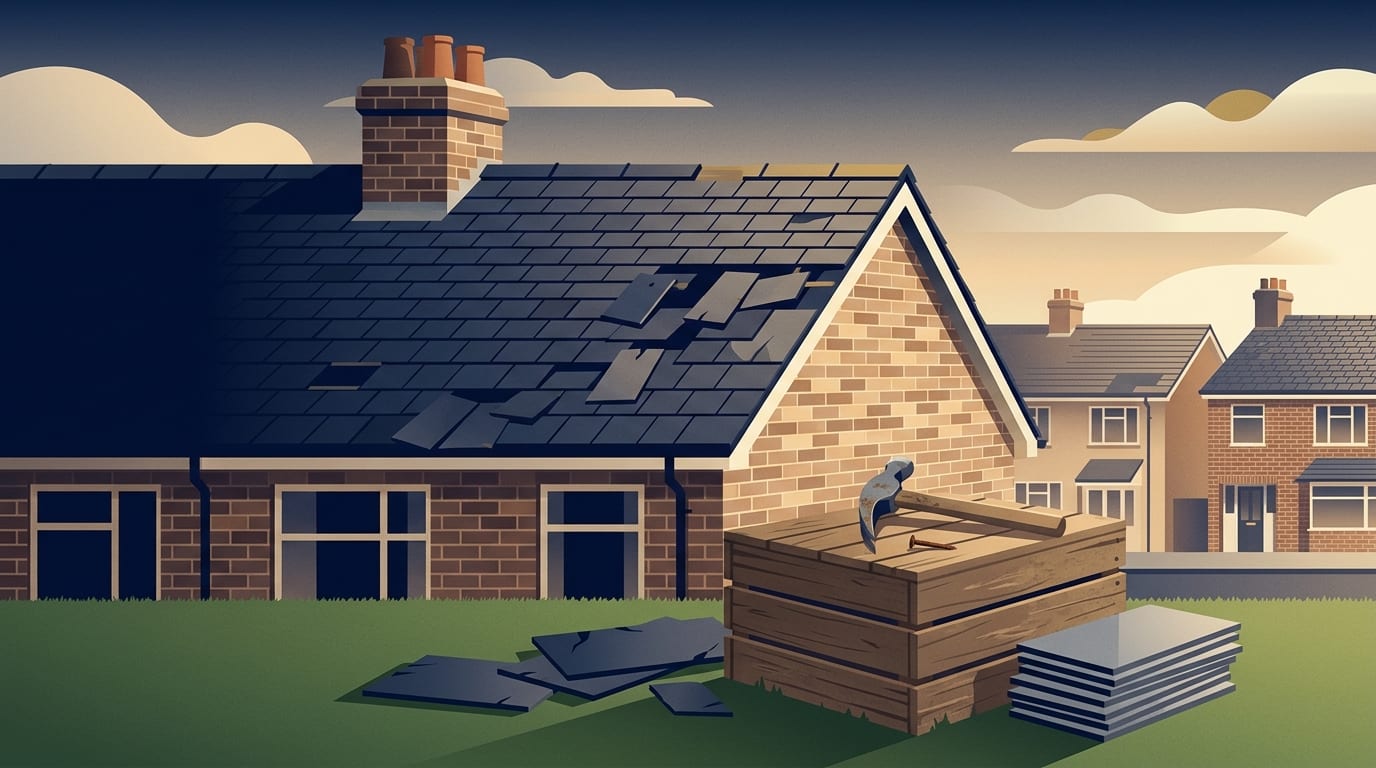
A valley gutter is the internal V-shaped angle where two roof slopes meet. It handles a larger volume of rainwater than any other part of your roof, which makes it a very common place for a leak to begin. A typical valley replacement costs around £540, but the exact price depends on the lining material your roofer uses and how difficult the job is to reach.
What a roof valley is
A pitched roof is a sloping roof. Most houses in the UK have pitched roofs covered in concrete and clay tiles, or natural and fibre cement slate. These heavy coverings are fixed to horizontal timber strips called battens. Beneath the battens sits a waterproof underlay, which is often called felt or a membrane.
The highest point of this roof is the ridge, and the external sloping corners are called hips. The outer edges of the roof are the verges, and the bottom edge where the water runs off is the eaves. At the eaves, you will find the roofline boards known as fascias and soffits, along with your guttering.
The valley is the internal angle where two pitched slopes join. Because it gathers rain from both sides, it acts as a funnel to carry water down to the eaves and into the guttering. To stop water getting inside the house, this channel must be lined with a waterproof material that sits underneath the edges of the tiles or slates.
The main types of valley
Lead-lined valleys are the traditional method and remain very common. A roofer shapes lengths of lead into the valley channel. The metal is tucked under the tiles on both sides. Lead flashing is also used to waterproof the joints around chimneys and walls. Roofers use Code 4 and Code 5 lead for valleys. Code 5 is heavier, more expensive and longer lasting.
GRP fibreglass valleys are made from glass reinforced plastic. They are pre-formed in a factory as long, rigid strips and fitted on site. Fibreglass is lighter and cheaper than lead, making it a popular modern alternative.
Mortar-bedded or cement valleys use a mix of sand and cement to seal the gap between the cut edges of the tiles and the valley lining. This mortar bed stops wind and rain blowing sideways under the tiles. It is often used alongside a lead or fibreglass lining.
Dry valley systems use preformed sections that interlock or sit snugly under the tiles instead of relying on mortar. Because there is no mortar involved, dry systems avoid the cracked bedding that affects mortar valleys.
Laced or swept tile valleys are mostly found on older or listed buildings. You will not see a metal or plastic lining. The tiles or slates are carefully cut and angled to form a continuous curved valley that guides the water down.
Why valleys leak
Cracked or hollow mortar is a common cause of trouble. Mortar naturally degrades over time due to rain and frost. Once the cement cracks or falls out, rainwater easily blows behind it and gets underneath the tiles.
Perished or split lead is another common failure. Lead expands in the heat of the sun and contracts when it gets cold. After decades of this daily movement, the metal can split. Water will seep through these splits every time it rains.
Failed felt or fibreglass will also let water in. Older underlay can become brittle and tear, while poorly fitted GRP valleys can snap if the roof structure moves slightly.
Debris build-up acts like a dam. Leaves, twigs and dirt slide down the roof and gather in the valley channel. Heavy rain then backs up behind this blockage and flows sideways over the edge of the valley lining.
Poor original detailing means the valley was never installed correctly. If the channel was not made wide enough, or the tiles were cut too close together, heavy rain will wash over the edges rather than flowing down the middle.
Signs of a valley problem
You can spot most valley issues without ever climbing a ladder. A visual check from the ground or from inside your loft is usually enough to tell you if something is wrong. Be wary of cold callers who knock on your door claiming they have spotted a loose tile or moss from the street and pressuring you to decide on a repair today.
Look out for these signs:
- Staining on your ceiling or walls directly below the point where two roof slopes meet.
- Damp patches on the loft timbers located under the valley line.
- Moss, leaves or dirt visibly packed into the valley channel when looking up from the street.
- Cracked mortar or missing chunks of cement visible from a bedroom window.
- Water dripping from the underside of the eaves rather than flowing neatly into the main guttering.
Repair or replace
Clearing debris and re-pointing cracked mortar is the cheaper first step when the underlying lining is still sound. A minor repair of this kind usually takes four to six hours and can solve the problem if the lead or fibreglass beneath the mortar is intact. Re-sealing joints is also a practical option for small leaks. You can read more about what to expect from a roof repair to understand the process.
Replacement makes sense when lead has perished or mortar keeps failing. If a lead valley has multiple splits, patching it is usually only a temporary fix. If the mortar keeps cracking, replacing it with a dry valley system or a new lining is often the better answer.
A full valley replacement takes six to eight hours. Nobody can see rotten timber until the old covering is off, so a good quote will always say how extra work will be priced if the roofer finds damp battens underneath.
In England, repairing or re-covering a pitched roof does not normally need a building control application if less than 25 per cent of the total building envelope and less than 50 per cent of the roof is affected. Approval is needed above those limits, which might mean you have to upgrade your insulation. Approval is also needed for structural alterations, where a new covering performs significantly differently in a fire, or where it adds 15 per cent or more to the weight of the roof. Rules differ in Scotland and Northern Ireland, so you should check with your council rather than guessing.
What valley work costs
The table below shows typical prices for repairing or replacing a single roof valley. The ranges combine published 2026 prices. A minor repair usually covers re-pointing mortar, re-sealing joints or clearing a blockage.
|
Valley type |
Minor repair |
Full replacement |
|---|---|---|
|
Lead-lined valley |
£90 to £400 |
£550 to £1,200 |
|
GRP fibreglass valley |
£60 to £400 |
£400 to £800 |
|
Dry valley system |
£85 to £400 |
£350 to £750 |
|
Mortar-bedded valley |
£150 to £400 |
£200 to £500 |
|
Laced or swept tile valley |
£150 to £400 |
£400 to £1,500 |
These are typical published prices for 2026. Local quotes will vary, and prices are generally higher in London and the South East. Small repairs are usually charged at a fixed price or a day rate, while larger work is priced per square metre plus access costs. Re-lining an existing lead valley without a full strip-out typically costs £500 to £900. If you have a severe leak and need an emergency make-safe on a first visit, expect to pay £150 to £400.
Access and scaffolding
Working at height is dangerous. The Health and Safety Executive notes that almost one in five deaths in construction work involve roof work. Sloping roofs require scaffolding to prevent people or materials falling from the edge, with edge protection at the eaves. On terraced properties, this protection is needed at the rear as well as the front.
Where work is of a short duration, which means tasks measured in minutes rather than hours, properly secured ladders and proper roof ladders may be used. You should never climb on a roof or use ladders at height yourself.
Because safety equipment is essential, scaffolding costs for roof work are often a separate and significant line on your quote. Hiring a mobile tower for a short job costs £150 to £350. Scaffolding to one elevation costs £400 to £900. Erecting a full scaffold around a two-storey semi-detached house costs £800 to £1,500. Hiring a cherry picker for half a day costs £300 to £600.
How long each type lasts
Different materials wear out at different rates. If you are paying for a full replacement, it helps to know how many years of service you are buying.
|
Valley type |
Typical lifespan |
|---|---|
|
Lead-lined valley |
50 years or more |
|
GRP fibreglass valley |
25 to 40 years |
|
Mortar-bedded valley |
15 to 25 years |
These are typical published figures for 2026. Some published figures go further, with lead valleys lasting more than 80 years and over 100 years in heavier grades of lead.
Keeping valleys clear
Because valleys funnel so much water, they must be kept clear of blockages. Moss and debris that wash down into the valley channel can hold back water.
The National Federation of Roofing Contractors states that moss on roof tiles is rarely a problem in itself. It only needs to be removed if it is blocking gutters, outlets and other drainage points. Violent removal such as pressure washing, especially with unnecessary foot traffic, can damage the roof and crack the tiles. You should get a reputable roofing contractor to assess the moss and obtain at least three quotes.
Questions to ask your roofer
Before you agree to any work, ask the roofer to explain exactly what they plan to do. A good tradesperson will be happy to answer these questions clearly.
- Which valley type do you propose using and why is it best for my roof?
- What lead code will you use if you are fitting a new lead valley?
- Are waste removal and VAT included in this fixed price?
- How will extras be priced if you find rotten timber when the old valley is removed?
- Will you use scaffolding or a mobile tower to reach the roof safely?
You should also ask to see proof of their public liability insurance. If the roofing firm employs staff, they must also have employers' liability insurance.
Common questions
What is a valley gutter?
A valley gutter is the V-shaped internal angle where two sloping roof sections meet. It is designed to catch rainwater from both slopes and funnel it safely down into your main guttering at the edge of the roof.
Can you patch a lead valley?
A roofer can patch a minor hole or a small split in a lead valley as a temporary fix. However, if the lead has perished and split because of age and temperature changes, patching it is rarely a long-term solution and the valley will need replacing.
Do dry valleys leak?
Dry valleys do not rely on mortar, so they avoid the cracked bedding that affects mortar valleys. They can still leak if they are installed poorly or if they become completely blocked with leaves and moss.
How long does it take to replace a roof valley?
A full valley replacement typically takes between six and eight hours. A minor repair, such as clearing out debris and re-pointing cracked mortar, usually takes between four and six hours.
Next steps before you hire
Under the Consumer Rights Act 2015, all work must be done with reasonable care and skill. If it is not, you can ask for it to be put right or for your money back. Contracts agreed at home, by phone or online normally carry a 14-day cooling-off period. If you ask for the work to start inside that period, you must pay for what has been done.
To protect yourself and get a fair price, follow these steps:
- Take photos of any damp patches or cracked mortar from the ground or inside the loft to show the roofer.
- Get written quotes from at least three different traders as recommended by Citizens Advice.
- Make sure the quote shows a fixed total price, a breakdown of the work, and how long it is valid. An estimate is just a rough guess.
- Keep any deposit as low as possible and do not agree to pay more than 25 per cent upfront.
- Pay by credit card if you can, as this gives you Section 75 protection on purchases between £100.01 and £30,000. Never pay in cash.
- Tell your home insurer about the planned work before the roofer starts.
If you are ready to get quotes for your repair, you can find a roofer near you to assess the problem and explain your options.
Find a top rated roofer near you
3,859 roofers across the UK, each ranked on their Google rating and the number of reviews behind it. Start with your county: