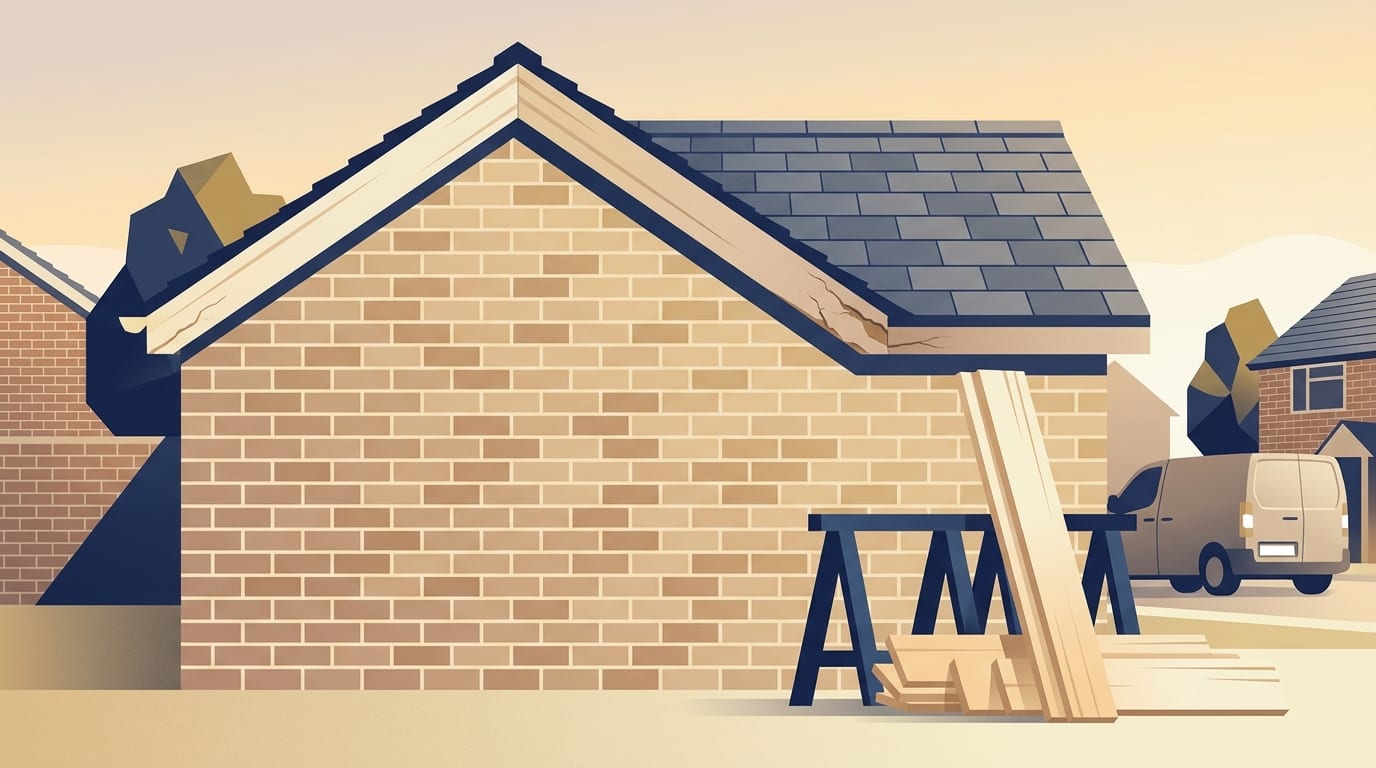
A barge board, also called a rake fascia, is the board fixed along the sloping edge of a gable that protects the gable edge and hides the exposed ends of your roof timbers. Because they face the worst of the weather, these boards eventually rot, peel or pull away from the wall. If you are looking at a sagging gable edge right now, roofers' replies in September 2026 put a uPVC replacement on a typical gable end at roughly £600 to £1,200, though these are individual answers, not a price list. This guide explains exactly what a barge board does, how to spot the signs of failure from the ground, and what your replacement options involve.
What a barge board is
A barge board is fastened to each projecting gable of a roof. Its main job is to strengthen and protect the gable edge from wind and rain. It also hides the exposed end grain of the roof's horizontal timbers, which are known as purlins. An older name for it is the vergeboard, which is an obsolete synonym.
Modern residential bargeboards are usually made of dimensional timber, with trim added later for decoration or weatherproofing. Historical examples were often moulded or carved wood.
Roofline fashion has changed significantly over the centuries. Medieval examples were often cusped along the lower edge, and late Victorian houses often had frilly bargeboards.
Barge board or fascia and where each sits
It is easy to get roofline terms mixed up when you are trying to explain a problem to a tradesperson. You can avoid confusion by understanding exactly where each board sits on your house. A barge board sits specifically on the gable end and the verge. It runs up the sloping edge of the roof, following the angle of the pitch from the bottom corner up to the top ridge.
At the bottom of that slope, the barge board sits against the eaves fascia. The board along the lower roof edge, at the eaves, is the fascia. If the sloping board is rotten, you need barge board work, and the board along the eaves is a different job.
Keeping this distinction clear helps you get an accurate quote and stops you paying for work you do not need. For a broader look at roof structures, you can read more about the parts of a roof explained in plain English.
Signs your barge boards are failing
Wet rot is commonly seen on untreated wood exposed to the elements. The Property Care Association lists typical signs of wet rot that you can often spot from the ground. Look out for discoloured timber, which might look bleached or darkened. You might also notice cracking and softening of the timber, or peeling paint.
As the damage worsens, the timber becomes distorted and starts losing strength. You might see the board pulling away from the gable wall or sagging out of line. You may sometimes see fungal growth on the wood. Wet rots affect almost any wooden object that is allowed to become excessively wet for a reasonable period of time.
Wet rot is commonly seen on untreated wood exposed to the elements, such as window frames. However, the spread is usually limited to timber in contact with excessive water. Broken roof tiles, blocked gutters, leaking pipes and poor ventilation of timber can all provide sources of excess moisture. The Property Care Association advises that if rot is found, expert help should be sought as soon as possible.
Timber, uPVC capping and full replacement compared
If your boards are showing signs of failure, you have three main ways to fix the problem. You can replace the old boards with new timber, replace them entirely with uPVC, or cap over sound timber with uPVC.
Each option has trade-offs in appearance, upkeep and price, so ask your roofer to explain them for your house.
Capping is a different approach. Capping fascias and soffits with uPVC is described as prolonging their lifespan and making maintenance easier. It also costs less than the typical fascia and soffit replacement cost. Roofers also cap gable verges with uPVC, but there is a catch.
If your existing timber barge boards are rotten, roofers would normally recommend removing them completely rather than covering them with uPVC. Roofers warn that capping over rotten timber can hide further deterioration. Capping is only suited to timber that is sound.
What replacing barge boards involves
Replacing a high gable board is not a weekend DIY project. The law says you must organise and plan all roof work so it is carried out safely. The Health and Safety Executive states that all roofs should be treated as fragile until a competent person has confirmed they are not. They also warn that you should not trust any sheeted roof, whatever the material, to bear the weight of a person, and that all work on roofs is highly dangerous, even if a job only takes a few minutes.
Every year people die after falling when working at height and many more suffer life changing injuries. To do the job legally and safely, your roofer will use proper access equipment. Scaffolding with a handrail, mid rail and toe boards will help protect workers from falling, and official guidance notes this protection should extend to the gable end.
Once the scaffolding is up, a professional replacement involves the following, described here so you can judge a quote:
- The roofer takes off the old boards.
- They inspect the exposed verge and the structural timber behind to ensure no rot has spread.
- Any damage to the timber or roof verge behind is dealt with.
- The new timber or uPVC boards are fitted.
You should never attempt to climb a ladder to inspect or repair a barge board yourself. Checks from the ground or from inside the loft are fine, but the physical work must be left to a professional with scaffold access.
What barge board replacement costs
The price you pay to fix a gable end depends on several factors. Roofers say the price depends on access, scaffolding, the colour of the uPVC, the size of each gable and the condition of the existing boards. Because nobody can see rotten timber until the old covering is off, a reliable roofer will need a site visit to give you an accurate quote.
The table below shows what individual roofers replied to a homeowner in September 2026. These are individual roofers' rough guides, not a fixed price list.
|
Type of barge board work |
Roofer's reply, September 2026 |
|---|---|
|
Replacing with uPVC (labour and materials) |
£50 to £90 per metre |
|
New uPVC on a typical gable end |
£600 to £1,200 |
|
Capping sound timber with uPVC (with scaffolding) |
Roughly £900 |
|
Capping with uPVC where new wood is needed (with scaffolding) |
£1200 to £2000 |
These figures are individual roofers' rough answers from September 2026, and local quotes will differ. When looking at the cost of the whole job, replies from tradespeople varied widely. Some quotes for the whole job were around £740, while others were around £1250 including materials, access equipment and waste removal.
Larger jobs came in at around £2200 depending on how many sides of the house needed work and the size of the boards. At the top end, a roofer quoted about £3k for a semi-detached house covering fascias, soffits and gutter work. When you are looking at roof repair costs and what to expect, remember that scaffolding is often a separate and significant line on the bill.
Do you need permission to replace barge boards
In England, the Planning Portal states that work to the roof of a house, for example re-roofing, that does not materially affect its external appearance will usually not need planning permission.
Maintenance of a fascia, such as replacement or painting, generally does not require planning permission either. The page does not mention barge boards, so check with your local authority. If you live in a listed building or a designated area, you should check with your local planning authority before work begins to ensure you do not break conservation rules.
For building regulations, replacing a fascia board or soffit will not normally need building regulations approval. The official guidance page does not mention barge boards, so ask your local building control. If you live in Scotland or Northern Ireland, the rules differ, so you should check directly with your local council rather than guessing.
What to ask a roofer before you agree
Finding a reliable tradesperson is much easier when you know exactly what to ask. The National Federation of Roofing Contractors offers solid advice on choosing a roofing contractor. They recommend you select up to three roofing contractors to look at the job. When the quotes come in, do not automatically take the cheapest option.
Under the Consumer Rights Act 2015, all work must be done with reasonable care and skill. If it is not, you can ask for it to be put right or for your money back. To ensure you are protected, ask for everything in writing. A proper quote is a fixed price, whereas an estimate is not. The NFRC notes that estimates for refurbishment work can change once the main covering is removed to expose the structure underneath, so a good quote says exactly how any extras will be priced.
A trustworthy roofer will provide a written document that includes:
- A clear breakdown of the work, showing exactly what is being removed and replaced.
- The cost of scaffolding and safe access equipment.
- Whether waste removal is included in the final figure.
- A clear statement on whether VAT is included.
- Payment terms that you agree before work starts, such as staged payments with the final balance due only when the job is finished.
- A written guarantee for the materials and labour.
The NFRC recommends an Insurance-Backed Guarantee, which means you are still covered even if the roofing firm goes out of business. You can also check if the firm is registered with TrustMark, the government-endorsed quality scheme for work in and around the home. Membership of a scheme is a good sign of professionalism, though it is not a guarantee.
Be wary of common scams in the roofing trade. Never hire cold callers who knock on your door claiming they spotted a loose tile or moss from the street. Walk away from anyone who puts pressure on you to decide today, demands cash only, asks for a big deposit upfront, or cannot provide a physical trading address. If you agree to a contract at home, by phone or online, it normally carries a 14-day cooling-off period. However, if you ask for work to start inside that period, you must pay for what has been done. If you ever have a serious dispute with a tradesperson, Citizens Advice is the best place to get independent help.
Common questions
What is a uPVC bargeboard?
A uPVC bargeboard is a modern replacement for a traditional timber gable board. uPVC stands for unplasticised polyvinyl chloride. Roofers quote for uPVC replacement and for capping over sound timber.
Can a roofer just cap over my old boards?
If the wood is sound, a roofer can cap it with uPVC. If the timber is rotten, roofers would normally recommend removing it completely, because capping over rotten timber can hide further deterioration.
How long does it take to replace barge boards?
It depends on access, the size of each gable and the condition of the boards. Roofers say a site visit is needed for an accurate quote, so ask how long the job will take when they visit.
Is scaffolding always needed for gable end work?
The law says you must organise and plan all roof work so it is carried out safely, and scaffolding with a handrail, mid rail and toe boards will help protect people from falling. That protection should extend to the gable end. Ask your roofer how they will provide safe access.
How do I pay for a barge board replacement?
You should agree on the payment terms before the work starts and only make the final payment when the job is finished to your satisfaction. Paying by credit card gives you Section 75 protection on purchases over £100 and up to £30,000, which offers an extra layer of financial security if something goes wrong.
What to do next
If you suspect your gable boards are failing, dealing with the problem early will stop water spreading into your roof timbers. Use this checklist to get the work sorted safely and professionally:
- Check the gable edge from the ground for peeling paint, discolouration, cracking or sagging.
- Take clear photos of the defect to show to roofing contractors.
- Decide whether you want to fit traditional timber or upgrade to low maintenance uPVC.
- Contact three local roofers and ask them to assess the boards in person.
- Ask for a fully itemised written quote that includes scaffolding, waste removal and VAT.
- Check that the roofer offers an insurance-backed guarantee and has clear payment terms.
Taking your time to compare itemised quotes will protect you from being overcharged or sold a quick fix that hides deeper rot. Gather your three quotes, ask how the roofer handles hidden timber damage, and find a roofer near you who is happy to put everything in writing.
Find a top rated roofer near you
3,906 roofers across the UK, each ranked on their Google rating and the number of reviews behind it. Start with your county: