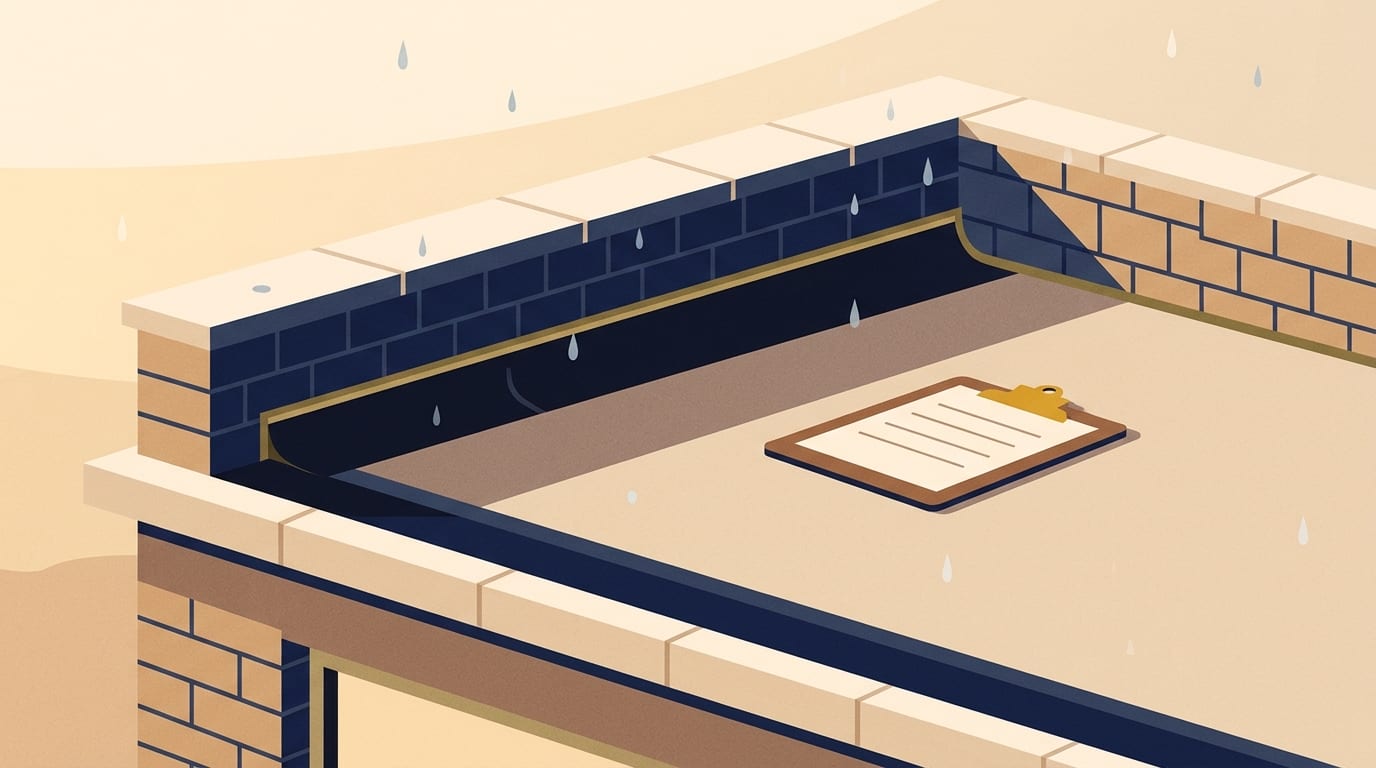
A parapet is a wall that continues above the edge of a flat roof, and leaks there usually start where the roof covering meets the wall. This joint relies on the coping on top, the flashing, and the upstand, which is the covering turned up the wall. If you have a damp patch on the ceiling below, damaged detailing at the wall can be the cause even when the main covering is in reasonable condition. Typical 2026 prices put a flashing or upstand repair at £200 to £500.
What a parapet wall is on a flat roof
A parapet is a barrier formed by a wall that continues upward past the edge of a roof, terrace, balcony or walkway. When you look at a flat roofed extension or a shop front, the parapet is the low wall that hides the roof behind it.
Where a parapet rises above a roof, it may simply be the exterior wall of the building extended higher. In other cases, it is a continuation of a fire wall or a party wall that divides two properties below the roof.
Parapets serve several practical purposes on modern flat roofs. They mainly act as guard rails to keep people safe near the edge, and they hide rooftop equipment. They also help to reduce wind loads on the roof and help prevent fire from spreading.
When you look at a plain parapet, you will sometimes see it topped with a protective layer called a coping. The parapet might also have a corbel below it.
Why parapets cause leaks on flat roofs
The main reason parapets cause leaks is that they create a vulnerable junction. A flat roof is designed to be watertight across its flat surface, but at the edge, the horizontal roof covering meets a vertical wall. This joint, along with the top of the wall itself, is highly exposed to the weather.
The joint depends on the flashing and upstand staying sealed.
Because this junction is so exposed, the detailing around the edge is usually the weak point. Damaged detailing at the parapet can cause leaks into the rooms below, even when the main felt covering of the flat roof remains in reasonable condition.
A leak at a parapet does not always mean the whole roof needs replacing. Ask the roofer to show you, in photographs, whether the fault is at the edge, the top of the wall or the flashing.
Copings and why they matter
A coping is the capping or covering of a wall. Its job is to protect the top of the parapet wall from the rain. Without it, water would soak straight down into the brickwork or masonry, eventually finding its way into the building and causing damp rooms below.
To do its job properly, a coping should have a weathered top surface. This means it is slanted or curved so that it sheds water quickly, rather than letting it sit in puddles on top of the wall.
In the UK, a proper coping overhangs the wall and features a drip groove on the underside of that overhang. This groove is a simple but vital detail. By contrast, a capping sits flush with the wall face.
Copings are made from a wide variety of materials to suit different buildings, including:
- Stone, brick, clay or terracotta
- Concrete or cast stone
- Tile, slate and wood
- Various metals such as aluminium, copper, stainless steel, steel and zinc
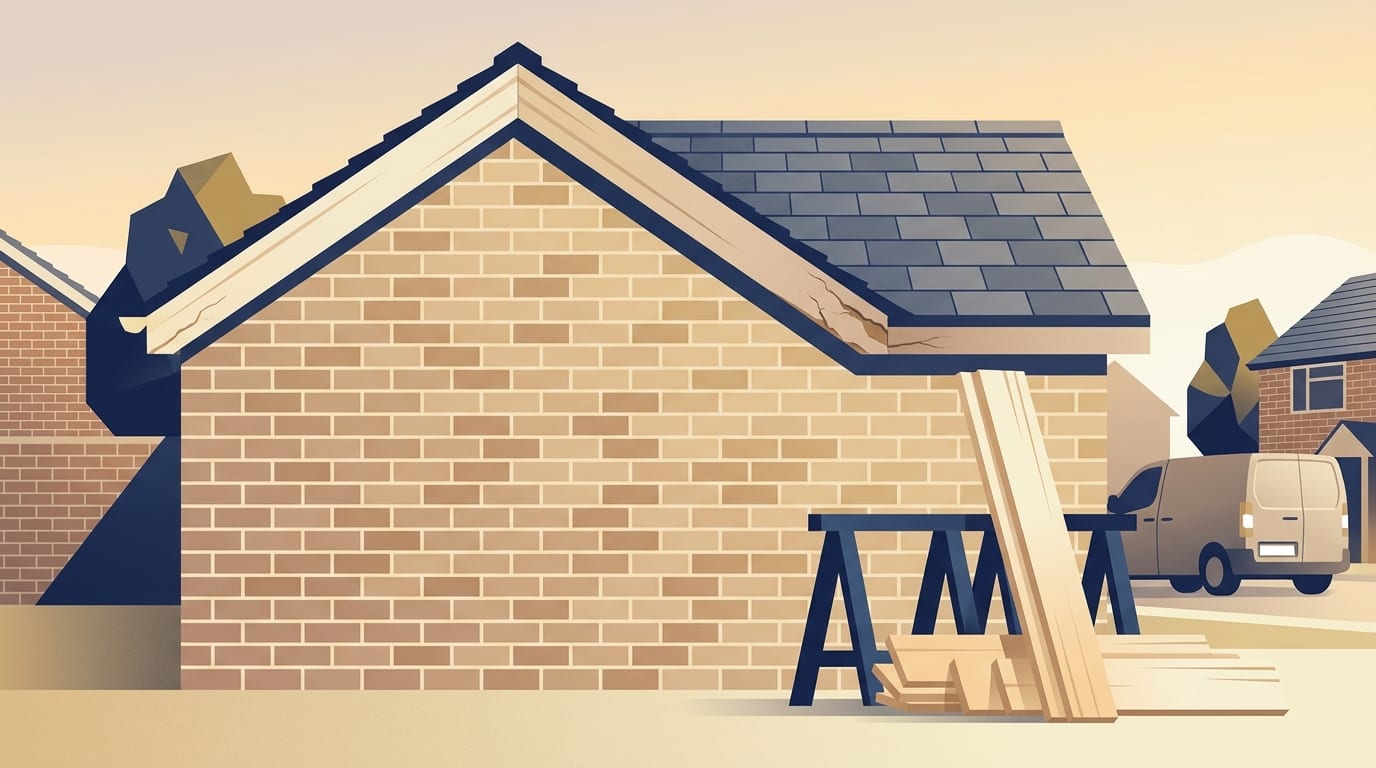
When a parapet leaks, the coping is one of the first things a roofer will check. A cracked coping, or one that has become loose because the mortar holding it has crumbled, lets water straight into the core of the wall.
Flashings and upstands at the parapet
The point where the flat roof meets the parapet wall is sealed using a combination of upstands and flashings. An upstand is simply the flat roof covering turned up the face of the wall. Flashing is a thin impervious material installed over the top of that upstand to prevent water passing into the structure from the joint.
Lead is common, but metal flashings also include aluminium, copper, stainless steel and zinc alloy used. Pieces of flashing overlap in steps, and counter-flashing covers base flashing.
The National Federation of Roofing Contractors (NFRC) provides guidance for its members covering common detailing topics with a reinforced bituminous membrane roof system. This guidance covers angle fillets, hard edges and upstands, and termination bars. The full note is for NFRC members, so ask your roofer how these details will be handled on your roof.
Flashings fail for several reasons, and a good roofer will look out for the following common mistakes:
- Improper installation that directs water into a building rather than away from it
- Incompatible metals in contact, which cause galvanic corrosion and premature failure
- Wet mortar left in contact with the metal, which damages aluminium
- Salt spray in coastal areas, which can accelerate the corrosion of the metal
- The use of adhesive-backed flexible flashing, which is not intended for long-term water resistance
Signs of a leaking parapet
Because you cannot easily see the top of a flat roof, a leaking parapet usually makes itself known inside the house first. The most common sign is damp patches or brown water staining on the ceiling below.
Outside, you might see signs of trouble from the ground. Look up at the top of the wall for cracks in the coping stones or missing mortar between them. You might also spot open joints or lifted flashing where the metal has pulled away from the brickwork.
You should only ever look for these signs from the ground or from an overlooking window. You must never climb up onto a flat roof to inspect a parapet yourself.
All work on roofs is highly dangerous, even if a job only takes a few minutes. The Health and Safety Executive (HSE) states that falls from flat roof edges can be prevented by simple edge protection arrangements, typically a secure double guardrail and toeboard. Work on or near fragile surfaces also needs a combination of stagings, guard rails and fall restraint. A professional roofer has the training and equipment to manage these risks safely.
What a roofer repairs and how it is described
When you hire a roofer to investigate a damp ceiling under a flat roof, they will start by inspecting the junction between the roof and the parapet wall. They are looking for splits in the upstand, flashing that has pulled loose, and coping stones that are cracked or rocking.
If the coping is the problem, the roofer can re-bond or replace it.
If the joint is failing, the roofer will repair or replace the flashing and the upstand. They will also repair the covering at the edge. If water has been entering for a long time, the roofer may need to check the timber deck and the insulation underneath for rot or waterlogging.
When you are ready to hire, you should select up to three roofing contractors to look at the job. Ask them for a written quote and make sure you understand what a roofing quote should include before you agree to proceed. The National Federation of Roofing Contractors (NFRC) advises that you do not automatically take the cheapest option.
You should also ask for a guarantee. The NFRC recommends getting an Insurance-Backed Guarantee, which protects you even if the roofing firm goes out of business. Always agree payment terms before work starts. Keep in mind that estimates for refurbishment work can change once the main covering is removed to expose the structure underneath, as nobody can see hidden rot until the roof is opened up.
Typical 2026 repair prices
When researching flat roof repair costs, keep in mind that small repairs to a parapet wall or flashing are usually charged at a fixed price or a day rate. Larger work is priced per square metre, plus the cost of access. Most components, such as the upstand material and lead flashing, are supplied and fitted as part of a full replacement quote.
The table below shows what you might expect to pay for specific repairs around a parapet and the edges of a flat roof.
|
Type of parapet or flat roof repair |
Typical 2026 price range |
|---|---|
|
Damaged flashing or upstand |
£200 to £500 |
|
Wall junction |
£200 to £500 |
|
Chimney flashing |
£400 to £600 |
|
Extension main property junction |
£500 to £1,000 |
|
Extension flashing or upstand |
£300 to £500 |
These figures are typical published prices for 2026, and your local quotes will vary. Prices are generally higher in London and the South East, and scaffolding is often a separate and significant line on the quote.
Rules and permission for parapet and flat roof work
In England, some flat roof repairs will not require an application for approval under the Building Regulations. Whether a particular repair needs approval depends on how much of the roof it affects.
However, the Planning Portal states that repairs or re-covering are only generally exempt where less than 25 per cent of the total building envelope and less than 50 per cent of the roof is affected. If your repair stays below those limits, you will not normally need to submit a building control application.
If your flat roof needs more extensive work, the rules change. NFRC guidance notes that flat roof overlays constitute building work and should be assessed against the relevant Building Regulations. When refurbishment work is carried out to 50 per cent or more of a roof's area, you must either employ a roofing contractor registered with the NFRC Competent Person Scheme, or you must contact Local Authority Building Control before work starts. This is to confirm whether the roof should be upgraded to meet the thermal requirements of Part L of the current Building Regulations.
The Planning Portal also notes that replacing a flat roof with integral insulation may require upgrading the insulation.
Building Regulations approval is also needed if you carry out structural alterations, if the performance of any new covering will be significantly different in a fire, or if a new covering material increases the weight of the roof covering by 15 per cent or more. Rules differ in Scotland and Northern Ireland, so always check with your local council if you live there.
Common questions
What is a parapet roof?
A parapet roof is simply a roof that has a low wall around its edge. The wall extends upward past the level of the roof covering. Parapets mainly act as guard rails, hide rooftop equipment, reduce wind loads and help prevent fire from spreading.
What is parapet wall coping?
Coping is the protective cap that sits on the very top of a parapet wall. It is slanted or curved to shed rainwater and usually overhangs the brickwork with a drip groove underneath to stop water running down the face of the wall.
What is parapet flashing?
Parapet flashing is the thin, waterproof material, usually made of metal like lead, that seals the joint where the flat roof covering meets the vertical wall. It is installed in overlapping steps to prevent rainwater from getting behind the roof covering and leaking into the building.
Can you fix a parapet flat roof leak from the inside?
A stain on the ceiling shows that water is getting in, but the cause is usually at the junction, the coping or the flashing. A roofer needs to inspect and repair those, and you should not go onto the roof to look yourself.
What to do next
If you suspect your parapet wall is leaking, taking the right steps early can save you from a much larger repair bill.
- Check the ceiling below the flat roof for damp patches, peeling paint or brown stains.
- Look at the top of the parapet wall from the ground to see if any coping stones look loose or if the flashing has pulled away.
- Do not climb onto the roof yourself, as flat roof edges are highly dangerous without proper guardrails.
- Contact three local roofing contractors to inspect the junction and provide a written quote.
- Ask the roofers to specify exactly how they will price any rotten timber they find once the old covering is removed.
- Check if your roofer is registered with a competent person scheme if the work covers half or more of the roof.
A leaking parapet does not fix itself, and nobody can see hidden rot until the roof is opened up. When you are ready to get the flashing, upstands and copings checked by a professional, you can find a roofer near you to inspect the wall safely and give you a straight answer on what it will cost to put right.
Find a top rated roofer near you
3,906 roofers across the UK, each ranked on their Google rating and the number of reviews behind it. Start with your county: