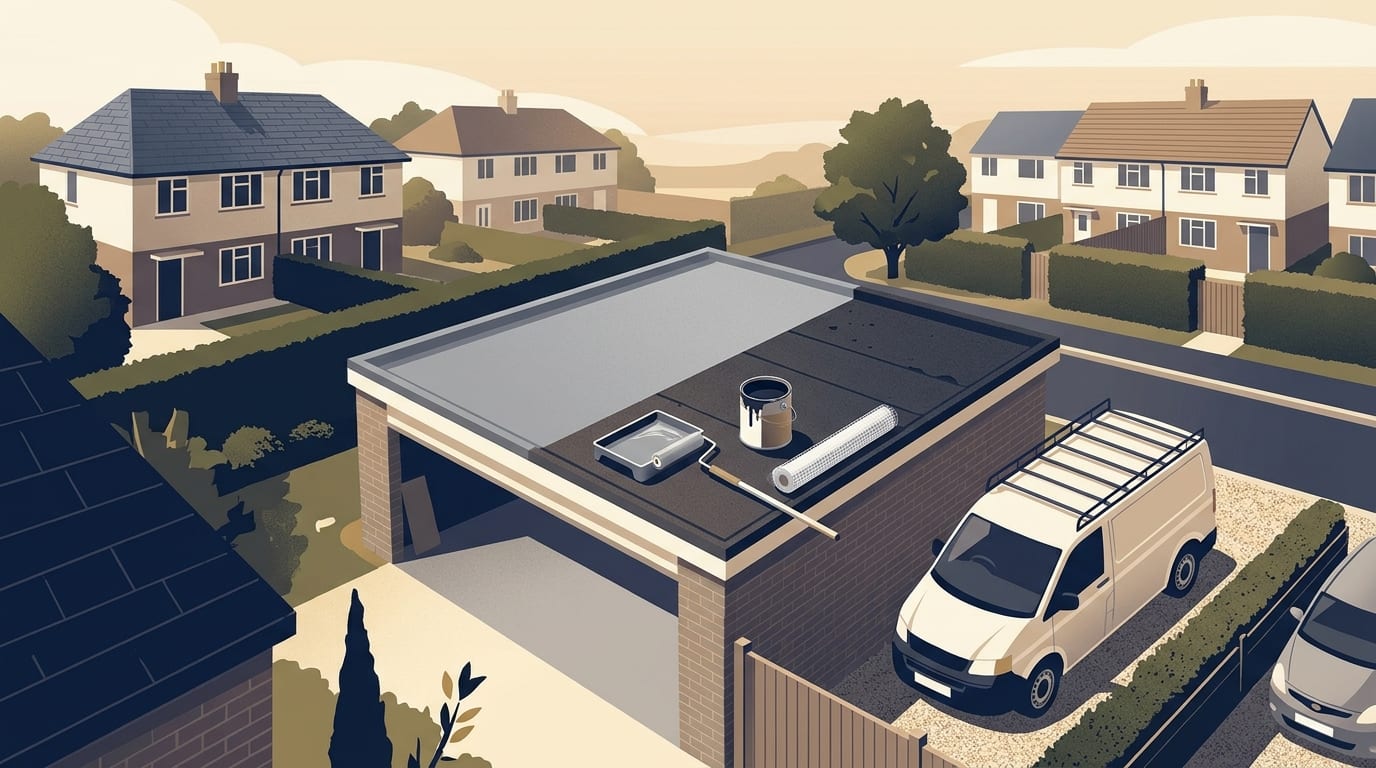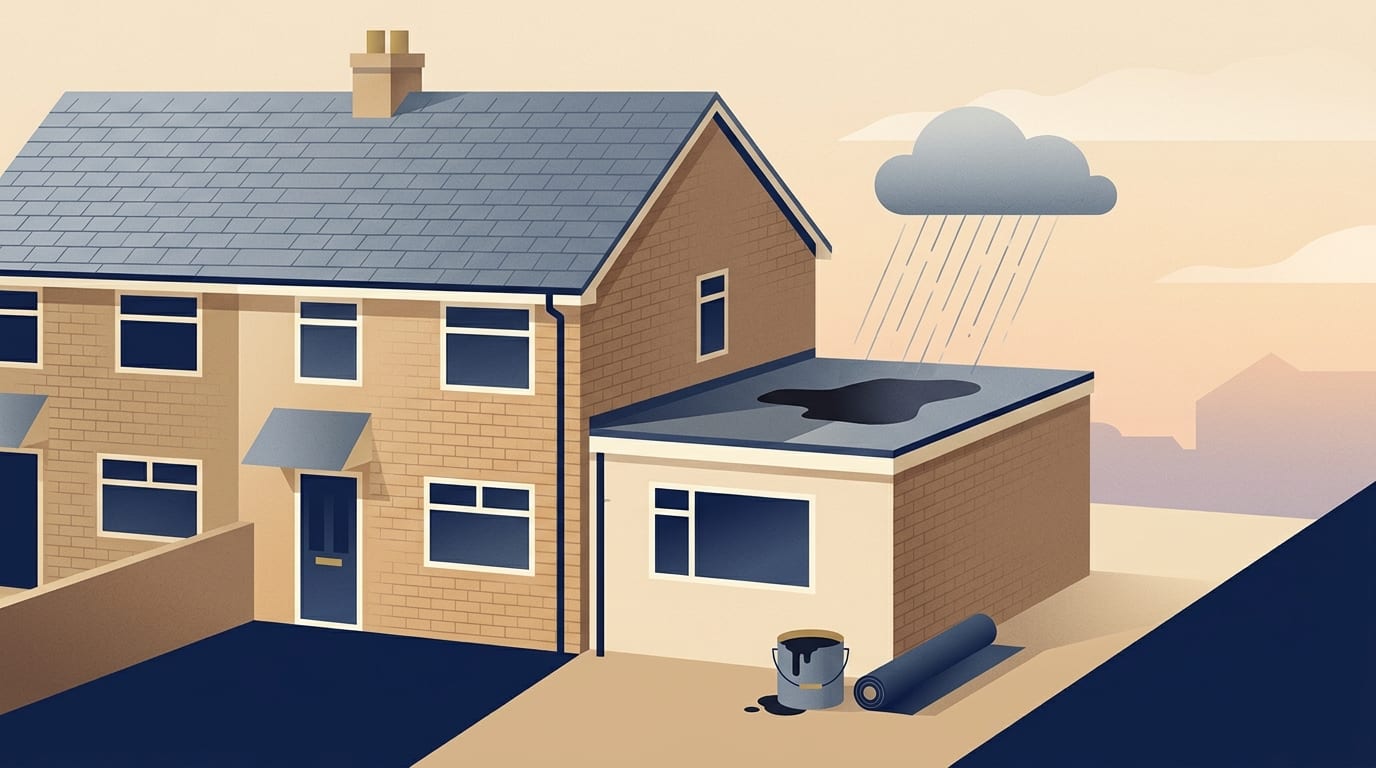
For localised damage on an otherwise sound roof, a flat roof repair is far cheaper than a full replacement. A simple patch can hold for several years and costs a fraction of the price of a new roof. However, if your roof has been patched repeatedly or is past 15 to 20 years old, it is usually better to have it re-covered.
The cost of your repair depends on the size of the damage and what needs fixing. Small patches are highly affordable, while replacing a whole section of felt runs higher. The table below shows typical published prices for flat roof repairs in 2026.
|
Type of repair |
Typical cost |
|---|---|
|
Minor patch or blister repair |
£150 to £400 |
|
Leak or flashing repair |
£200 to £600 |
|
Re-felt a small flat roof (garage or extension) |
£1,000 to £2,500 |
These figures are typical published 2026 prices across the UK, but local quotes will differ. Some other 2026 price lists do not match the table above and give a UK average of £200 to £700 for a flat roof patch repair using felt or EPDM. If you need a roofer urgently because water is pouring into your home, emergency call-outs add £150 to £300 to the final bill.
Prices are generally higher in London and the South East, where published patch repair prices run from £300 to £950. For a broader context, the average roof repair cost across all types of roof is £650, with a typical range of £150 to £3,000 or more depending on the scale of the damage.
What a patch repair can fix
Repairs suit a roof that is otherwise sound but has localised damage. A patch repair is a highly effective way to stop a leak without paying for a full replacement. Common faults that can be patched successfully include minor splits and blisters in the surface material.
Blisters and splits are the surface faults a patch repair is most often used for. A roofer can tell you whether the damage is local or the covering is failing more widely.
You should never climb on a roof or use ladders at height to look for damage yourself. Inspect your flat roof from a first floor window or stay on the ground and let a professional roofer do the climbing. You should also never attempt to use torch-on felting or GRP fibreglass resin yourself, as these require specialist training and insurance.
Common causes of flat roof leaks
A flat roof is completely, or almost, level. Nearly all are built with a slight incline so water drains to the lower edge. This incline is typically designed with a minimum fall of 1:40. When a flat roof leaks, the water often gets in at the edges or where something breaks the surface.
To understand what your roofer is talking about, it helps to know how roofs are built. Pitched roofs are angled and covered in concrete and clay tiles, or natural and fibre cement slate. They have specific parts like a ridge at the top, a hip on an outward corner, a valley on an inward corner, and eaves at the bottom edge. Battens support the tiles on these roofs.
Flat roofs are simpler but have their own specific terms. They rely on a solid timber deck to support the waterproof covering. Underlay, often called felt or membrane, provides a base layer. Lead flashing is the metal strip used to seal the joints against brickwork. The edges of the roof are finished with fascias, soffits and guttering to carry rainwater away.
Leaks usually start at these known weak points:
- Parapets, which are the low walls around the edge of some roofs
- Verges, which form the outer edges of the roof structure
- Penetrations for pipes, ducts or flues passing through the deck
- Joints and seams where sheets of roofing material overlap
- Splits and blisters in the main surface of the waterproof covering
What affects the price of a repair
Small repairs are usually a fixed price or a day rate. Larger work is priced per square metre, plus the cost of access. Scaffolding is often a separate and significant line on your quote. Waste removal and VAT may or may not be included in the price, so you must always ask the roofer to confirm.
The material your roof is made of also changes the per square metre repair price. The table below gives typical published 2026 figures for repair work priced per square metre, which is a different basis from the table above.
|
Repair material or size |
Cost per square metre |
|---|---|
|
Minor leak repair |
£100 to £180 |
|
Major leak repair |
£120 to £210 |
|
Bitumen repair |
£100 to £140 |
|
GRP (fibreglass) repair |
£130 to £180 |
These are typical published 2026 figures and your local quotes will vary. When getting a price, remember that nobody can see rotten timber until the old covering is off. A good quote always states how extras will be priced if structural damage is found beneath the leak.
How long a flat roof repair lasts
A patch repair on an otherwise good roof can last several years. The exact time depends on the material used, how well the patch bonds, and the weather it faces. While no repair is guaranteed to last forever, a proper fix gives you time to plan and save for future work.
The surrounding roof matters. A patch lasts several years on an otherwise good roof, which is why a roofer should check the wider roof as well as the leak.
When repeated repairs stop making sense
A full re-cover usually works out cheaper per year of life once the covering is past 15 to 20 years old. It also stops repeat call-outs. If your roof has been patched repeatedly, adding another patch is rarely the best use of your money.
Signs that replacement may be more cost-effective include recurring leaks, widespread damage across the surface, structural issues, and high repair costs. You should compare your repeated repair bills with the price of a new roof. If you are constantly paying for minor fixes, checking typical flat roof replacement costs will help you decide when to stop the cycle.
If the timber deck is sagging, a surface patch will not fix the structural problem. Water will continue to pool in the dip and eventually find a way inside. In these cases the deck may need attention as well as the covering, so ask the roofer to show you what they found.
Roof materials and how long they last
To understand if a repair is worthwhile, you need to know what material is on your roof and how long it typically lives. Flat roof systems include built-up felt, which is usually applied as torch-on sheets. Other common materials are EPDM rubber, GRP fibreglass, single-ply membranes and liquid coatings.
Felt has a lifespan of around 10 to 20 years depending on the quality of the material and the drainage. EPDM rubber and GRP fibreglass are more durable, generally lasting 20 to 30 years before they need replacing.
If you decide you need a full replacement, typical published 2026 figures per square metre are below, though local quotes will vary. Replacing a felt roof costs £40 to £80 per square metre. EPDM rubber costs £80 to £120 per square metre. GRP fibreglass is the most expensive option at £90 to £130 per square metre.
Building regulations and your consumer rights
In England, repairing or re-covering a roof does not normally need a building control application if less than 25 per cent of the building envelope and less than 50 per cent of the roof is affected.
If your repair affects more than 25 per cent of the envelope or 50 per cent of the roof, building regulations approval is needed. In these cases, the insulation may have to be upgraded. A warm roof has insulation above the timber deck, while a cold roof has it between the joists, so ask the roofer which applies to your roof.
Approval is also needed for structural alterations, where a new covering performs significantly differently in a fire, or where the new material adds 15 per cent or more to the weight of the structure. If you are replacing a glazed or polycarbonate conservatory roof with a solid one, this takes the conservatory out of its exemption, so building regulations apply to the new roof. The rules differ in Scotland and Northern Ireland, so you should check with your council rather than guessing.
CompetentRoofer is a government-authorised competent person scheme run by the National Federation of Roofing Contractors (NFRC). Registered roofers can self-certify roof refurbishment in England and Wales, and you should receive a building regulations compliance certificate. Otherwise, the work goes through council building control or a registered building control approver. TrustMark is the government-endorsed quality scheme for work in and around the home. You should check the scheme's own register to confirm a firm is listed, as membership is a good sign but not a guarantee.
Under the Consumer Rights Act 2015, work must be done with reasonable care and skill. If it is not, you can ask for it to be put right or for your money back. Contracts agreed at your home, by phone or online normally carry a 14-day cooling-off period. If you ask for work to start inside that period, you must pay for what has been done. Paying by credit card gives Section 75 protection on purchases over £100 and up to £30,000. If you have a dispute, Citizens Advice is the place to seek help.
Scams and bad practice to avoid
You should be highly suspicious of cold callers who knock on your door claiming they have spotted a loose tile or moss from the street. You should avoid anyone who pressures you to decide today, asks for cash only, or demands big deposits upfront. A firm with no physical address is also a strong warning sign.
A common tactic is being sold a whole new roof for a local fault that a simple patch would fix. You should never accept vague one-line quotes that lack detail. Some rogue traders make false roof coating and painting claims, or sell pressure washing as essential maintenance.
Be wary of long guarantees offered by unverified firms. These guarantees are worthless if the firm folds because they are not insurance-backed. Finally, letting a firm complete major work and going without the building regulations certificate will cause significant problems when you come to sell your house.
How to get a fair quote
You should always ask for three written quotes from different roofing companies. This helps you spot anyone who is overcharging or undercharging for the work. A quote is a fixed price, whereas an estimate is not fixed and can increase once the job begins.
A proper written quote contains itemised prices so you can see exactly what you are paying for. It should separate the cost of materials, labour, scaffolding, waste removal and VAT. You should ask for staged payments on larger jobs and only make the final payment when the job is completely finished.
Take photos of the defect from the ground or inside the loft if you can do so safely. Showing these to the roofer helps them understand the problem before they arrive. You should also ask for proof of their public liability insurance before they start any work.
Questions to ask your roofer
Asking the right questions shows the roofer you are paying attention and clarifies exactly what you are buying.
- What is the exact cause of the leak and how is water getting in?
- Is this proposed fix temporary or permanent?
- What guarantee do you provide and is it insurance-backed?
- Are access equipment and scaffolding included in this price?
- What is the price for a full re-cover if this patch fails again?
Common questions
Can you repair a flat roof in the rain?
Roofers generally cannot apply felt, fibreglass or rubber well in heavy rain because the materials bond poorly to a wet surface. Ask the roofer whether anything can be done to make the roof safe in the meantime, and when a permanent repair can be done.
Does home insurance cover a flat roof fix?
Cover varies between policies, so check your policy wording first. See whether home insurance covers a leaking roof before paying out of pocket.
How long does a flat roofing repair take?
The time depends on the damage and the access needed, so ask the roofer how long the job will take. Scaffolding, where needed, adds time at the start and end of the project.
Will a patch repair stop a sagging roof?
No. Sagging can point to a structural problem such as a failing deck or joists, and a surface patch will not fix that. Ask the roofer to explain the cause before agreeing to any repair.
Your next steps
Before you hire anyone to fix your flat roof, make sure you are prepared.
- Look at the roof from the ground or a window to spot obvious damage
- Check your home paperwork to find out how old the roof covering is
- Decide if repeated repairs are costing you more than a new roof would
- Get three written, itemised quotes from local roofing firms
- Confirm whether waste removal and VAT are included in the final price
Once you know what needs fixing and have checked the rules, you can find a roofer near you to inspect the damage and provide a firm price.
Find a top rated roofer near you
3,861 roofers across the UK, each ranked on their Google rating and the number of reviews behind it. Start with your county: