Liquid roofing is a seamless waterproof layer that cures directly on your roof, often applied over a sound existing covering to avoid a full replacement. Typical 2026 prices put the overall fitted cost at roughly £40 to £90 per square metre. For a straightforward flat roof with a warm roof build-up and new insulation, the price is £90 to £160 per square metre. It suits awkward shapes and complex details, but thorough preparation and the weather on the day decide how long it lasts.
What liquid roofing is
A liquid roof is a cold-applied system that turns from a liquid into a solid, flexible waterproof membrane once it cures. It is used primarily on flat roofs, garages and extensions. Unlike built-up felt roofs which are usually applied with a blowtorch, liquid systems require no heat. They are a distinct alternative to other common flat roof coverings such as EPDM rubber, GRP fibreglass and single-ply membranes.
Liquid systems are not the same as the roof paints or thin coatings sometimes sold by cold callers. A liquid roofing system involves a build-up of materials. Typical build-ups include a primer, one or more waterproofing coats, a reinforcing fibre layer and a protective top layer.
The structural base of your flat roof is called the timber deck. A liquid system can be applied directly to a new timber deck, but it is also commonly used for refurbishment. It can be applied directly over an existing covering of felt or asphalt, provided that the old surface is sound, dry and firmly attached to the deck below.
Insulation also plays a part in how the roof is constructed. A warm roof has its insulation installed above the timber deck, keeping the timber warm. A cold roof has the insulation placed between the joists under the deck. Ask your roofer what build-up your roof has and what it needs, because new insulation changes the price.
How a liquid roof is applied
Applying a liquid roof is a precise process. Manufacturers typically guarantee their products only when approved, trained installers apply them. The existing deck or covering must be completely dry, clean and free of grease before any work begins.
The standard sequence for applying a liquid roof is as follows:
- Clean and repair the roof surface to ensure it is structurally sound and completely dry.
- Apply reinforcement and sealant to all joints and upstands, which are the sections where the flat roof turns upwards to meet a wall.
- Apply a primer to the surface where the manufacturer specifies it is needed.
- Apply a first coat of the liquid roofing material over the prepared area.
- Apply a second coat once the first coat has fully cured.
Weather during laying and the timing between coats are critical, so the second coat goes on once the first has cured.
Types of liquid system
There are several different chemical systems used for liquid roofing. Types of liquid system include modified bitumen, polyester and polyurethane. The costs and lifespans below cover polyurethane, acrylic (PMMA) and reinforced liquid membranes.
Polyurethane systems cost about £20 to £25 per square metre and are expected to last 20 to 25 years.
Acrylic, often referred to as PMMA, costs about £25 to £50 per square metre and is expected to last 20 to 30 years.
Reinforced liquid membranes include a reinforcing layer. They cost about £20 to £50 per square metre, are expected to last 20 to 30 years and suit complex details such as upstands, rooflights, vents and pipes.
Where liquid roofing suits and where it does not
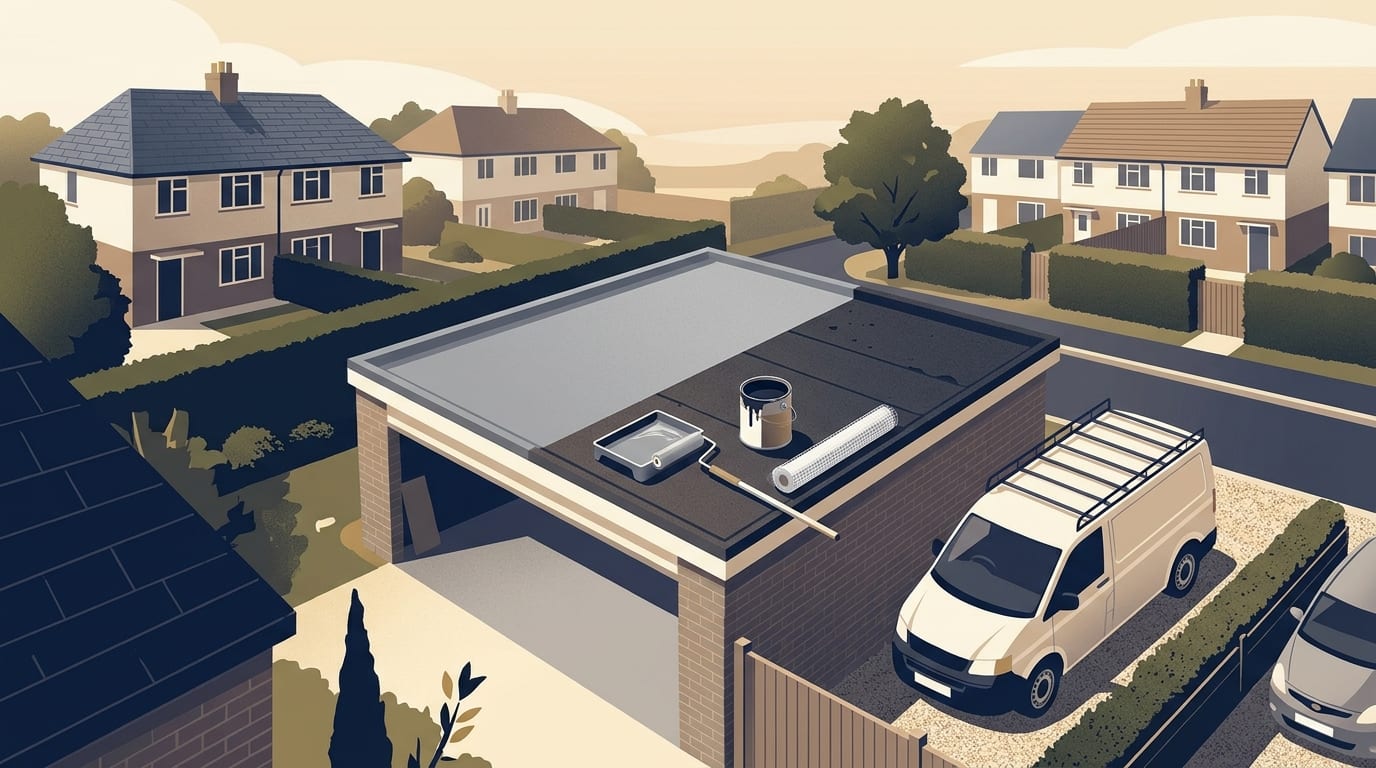
Liquid roofing is designed specifically for flat or low-pitched roofs. It is an excellent choice for roofs with many penetrations. Penetrations are obstacles that come through the roof, such as rooflights, vents and pipes. Because the material is painted on as a liquid, it easily forms a seamless seal around these complex details and upstands without the need for cutting and joining sheet materials.
It is also highly suitable for refurbishing a roof where the existing felt or asphalt is nearing the end of its life but is still firmly attached and structurally sound. Overlaying the old roof saves the cost and waste of tearing it off.
However, liquid roofing does not suit every roof. The old covering must be sound and the deck dry, clean and free of grease, so a liquid overlay is not suitable on every roof. You cannot see rotten timber until the old covering is off, so a good quote says how deck repairs will be priced, which typically cost £45 to £120 per square metre.
Why preparation decides how long it lasts
Poor preparation is the main cause of failure for liquid roofs. The deck must be dry, clean and free of grease before the liquid goes on, and any repairs, reinforcement and sealant at joints and upstands come first.
Ask the installer how they will check that the deck is dry and what preparation is included in the price. Roof preparation typically costs £10 to £25 per square metre.
Weather and timing
UK weather dictates exactly when a liquid roof can be installed. The weather during laying and the timing between coats are critical to the success of the job. The deck must be dry before work starts.
Temperature also changes how the liquid behaves. Cold temperatures make the liquid thicker and can slow curing times.
Extreme heat causes the opposite problem. High temperatures can dry the liquid too quickly. If it cures before it has had time to properly bond with the primer or the deck below, it may weaken the adhesion. Ask your roofer how they will plan around the temperature on the day.
Typical costs in 2026
Prices for liquid roofing depend heavily on the size of your roof, the chemical system used, and whether you need new insulation. The figures below are typical 2026 prices. Local quotes will vary, and prices are generally higher in London and the South East.
The following table shows typical total job costs for different sizes of flat roof. Preparation, deck repairs and removing old coverings are priced separately below.
Typical total job costs for liquid roofing
|
Roof type or size |
Typical cost range |
|---|---|
|
Small flat roof |
£480 to £1,100 |
|
Garage roof |
£800 to £1,800 |
|
Medium flat roof |
£1,000 to £2,250 |
|
Large flat roof |
£1,600 to £3,600 |
|
Extension flat roof |
£2,000 to £4,500 |
|
Average overall job |
£2,600 |
Typical 2026 prices. Local quotes will differ based on access and condition.
An average liquid roofing job takes one to three days to complete. Flat roofing specialists typically charge between £200 and £350 per day for their labour.
When looking at the price per square metre, the costs break down into the liquid system itself and the preparation work required. Typical prices for a liquid system on a straightforward domestic flat roof with a warm roof build-up and new insulation are £90 to £160 per square metre. For comparison, felt typically costs £50 to £90, EPDM rubber is £80 to £120, and GRP fibreglass is £90 to £140 per square metre.
Typical 2026 prices also give an overall fitted cost of roughly £40 to £90 per square metre. The two sets of figures were worked out differently, so read them separately. The table below breaks down the typical costs for each system and the extra work that might be needed.
Typical costs for materials and preparation per square metre
|
Item or task |
Typical cost range |
|---|---|
|
Polyurethane system |
£20 to £25 per square metre |
|
Acrylic (PMMA) system |
£25 to £50 per square metre |
|
Reinforced liquid membrane |
£20 to £50 per square metre |
|
Roof preparation |
£10 to £25 per square metre |
|
Deck repairs |
£45 to £120 per square metre |
|
Removing old coverings (labour) |
£5 to £20 per square metre |
Typical 2026 prices. Local quotes will differ.
Waste removal and access are often separate and significant lines on a quote. A skip for disposing of old roof coverings usually costs between £200 and £500. If your roof is high up or difficult to reach, you may need a scaffold tower. Hiring a scaffold tower for six weeks typically costs between £650 and £1,000. Always check what a good roofing quote should include to ensure waste removal and scaffolding are covered.
Lifespan and guarantees
A well installed liquid roof will last for decades. Polyurethane systems typically last 20 to 25 years. Acrylic and reinforced liquid membranes have an expected lifespan of 20 to 30 years. Some estimates suggest you can get about 10 extra years of life from the roof by cleaning it and applying a fresh recoating before the original layer fails completely.
You should ask installers about the expected lifespan and any workmanship guarantee before hiring them. A manufacturer will usually only honour their product guarantee if the person applying it is an approved and trained installer. The workmanship guarantee covers the quality of the roofer's labour.
Guarantees are worthless if the roofing firm folds, so ask if their guarantee is insurance-backed. Ask what the guarantee covers and who pays if the firm stops trading.
Building regulations and insulation
Repairing or replacing a roof is subject to strict rules. In England, you will not normally need a building control application for repairing or re-covering an existing pitched or flat roof if less than 25 per cent of the total building envelope and less than 50 per cent of the roof is affected. You can verify these exemption limits on the Planning Portal rules for existing roofs.
If your project exceeds those limits, or if you are replacing a whole roof covering, building regulations approval is normally required. A roof is defined in the regulations as a thermal element. This means that when you re-cover a roof, you should also improve its insulation. For flat roofs with integral insulation, you may be required to upgrade the thermal element to modern standards when the roof is replaced. You can read the exact requirements on the Planning Portal guidance for re-roofing.
Rules differ in Scotland and Northern Ireland, so you should check with your local council rather than guessing. In England and Wales, roofers registered with CompetentRoofer, a government-authorised competent person scheme run by the National Federation of Roofing Contractors (NFRC), can self-certify their roof refurbishment work. If you use a registered roofer, you should receive a building regulations compliance certificate upon completion. Otherwise, the work must go through council building control or a registered building control approver.
Consumer rights and avoiding scams
When you hire a roofer, you are protected by the Consumer Rights Act 2015. This law states that all work must be done with reasonable care and skill. If it is not, you can ask for it to be put right or for money back. If you end up in a dispute with a trader, Citizens Advice is the official body to contact for guidance.
Understanding your paperwork is vital. A quote is a fixed price, whereas an estimate is not. If you agree to a contract at home, over the phone or online, you normally have a 14-day cooling-off period. However, if you ask for the work to start inside that 14-day window, you must pay for any materials used and work done up to the point you cancel.
Paying for at least part of the job by credit card gives you Section 75 protection on purchases over £100 and up to £30,000. Citizens Advice can explain how to claim if something goes wrong.
The roofing trade attracts cold callers and rogue traders. Be highly suspicious of anyone who knocks on your door claiming they have spotted a loose tile or moss on your roof from the street. They often use high-pressure tactics to force you to decide today. Never deal with tradespeople who demand cash only, ask for huge upfront deposits, or refuse to provide a physical business address.
Be wary of vague one-line quotes that lack detail. Bad traders will often try to sell you a whole new roof for a minor local fault, or offer worthless pressure washing services disguised as essential maintenance. Roof coating and painting claims that promise to magically seal broken tiles are also a common trap. Always ask for a detailed, itemised written quote.
Common questions
Can you apply liquid roofing over old felt?
Yes, liquid roofing can be applied over an existing felt or asphalt roof. However, the old covering must be sound, and the deck must be dry, clean and free of grease. Ask the installer to confirm in writing that your roof is suitable.
How long does a liquid roof take to install?
An average liquid roofing job takes one to three days to complete. The exact time depends on the size of the roof, the amount of preparation needed, and the weather. The deck must be entirely dry before the primer and coats are applied, and curing times vary with the temperature.
Is liquid roofing better than rubber or fibreglass?
No single material is best for every situation. Liquid roofing is an excellent choice for roofs with complex shapes, pipes or rooflights because it paints seamlessly around them. For comparison, felt is £50 to £90, EPDM £80 to £120 and GRP £90 to £140 per square metre, against £90 to £160 for a liquid system with a warm roof build-up and new insulation, so liquid is at the higher end per square metre.
Does a liquid roof smell during application?
It depends on the product. Ask your installer what to expect and what to do about windows and ventilation while the work is on.
Next steps before you agree to a liquid roof
Before you commit to a liquid roofing system, take these practical steps to protect your home and your money:
- Get three written quotes to compare prices and proposed materials.
- Ensure each quote details how extra costs will be handled if rotten timber is found under your old roof.
- Check the quote clearly states whether waste removal, scaffolding and VAT are included.
- Ask for proof of the firm's insurance and check they are registered with TrustMark or CompetentRoofer on the scheme's own register.
- Take photos of your flat roof from a safe vantage point before work begins to understand the current condition.
- Agree a staged payment plan and only hand over the final payment when the job is completely finished.
- Make sure you will receive a written workmanship guarantee and a building regulations compliance certificate where required.
Taking the time to gather itemised quotes and check credentials ensures you get a durable, seamless roof without hidden costs. If you are ready to compare prices for your garage or extension, you can find a roofer near you to start getting written estimates.
Find a top rated roofer near you
3,861 roofers across the UK, each ranked on their Google rating and the number of reviews behind it. Start with your county: