Lead is a traditional metal covering that can last for decades if the right thickness is used and it is detailed properly, but it is specialist work, and lead and hard metal installation requires skills that general roofers may lack. If you have been quoted for lead on a porch, bay, dormer or flat roof, or you are wondering whether to replace failing leadwork, understanding the typical prices and correct thickness codes will help you avoid overpaying.
Where lead is used on a roof
Lead is a traditional metal that tradespeople use to waterproof difficult junctions across various parts of a property.
On pitched roofs, which slope downwards to shed rainwater, lead is heavily used in the valleys. A valley is the internal angle where two sloping roof sections meet. Rainwater funnels down this joint, so it requires a robust lining to prevent leaks into the loft.
Lead is also the standard material for lead flashing, which is the metal stripping used to seal the gap between the roof tiles and a brick chimney stack. Chimney flashing is one of the most common leadwork jobs.
The eaves are the lowest edges of the roof where water runs off into your guttering. The guttering is attached to the fascias, which are the long wooden or plastic boards under the lower edge of the roof. The soffits are the boards tucked under the fascias that you see when looking up from the street.
The ridge is the horizontal peak of the roof, and the hip is a sloping external corner. The verge is the outer edge of a roof above a gable end. Lead is often used to weather these complex junctions, whether the roof is covered in traditional concrete and clay tiles, or natural and fibre cement slate.
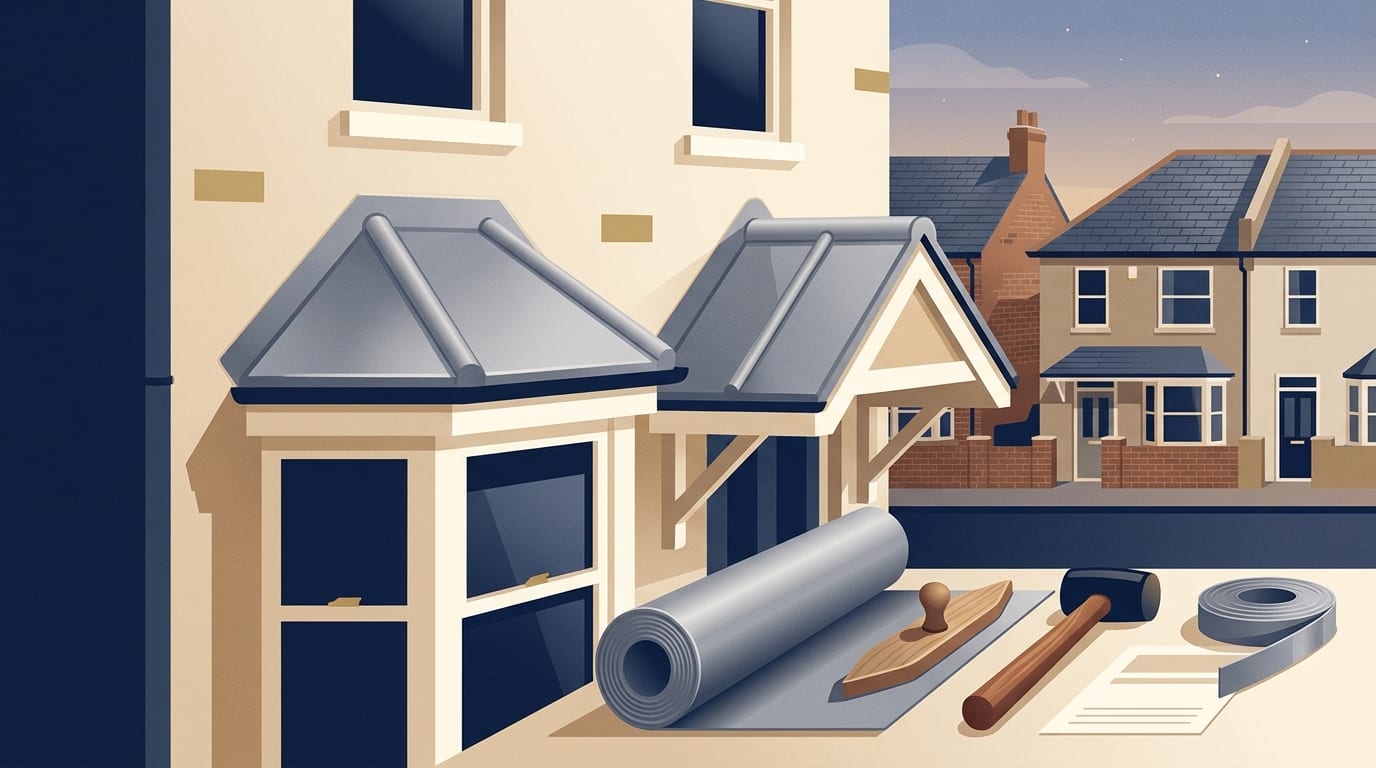
For smaller protruding structures, lead is often used as the primary roof covering. A bay roof, which sits over a protruding window, and a porch roof are frequently covered entirely in sheet lead. Dormer cheeks, which are the vertical triangular sides of a window built out from a pitched roof, are also commonly covered in lead.
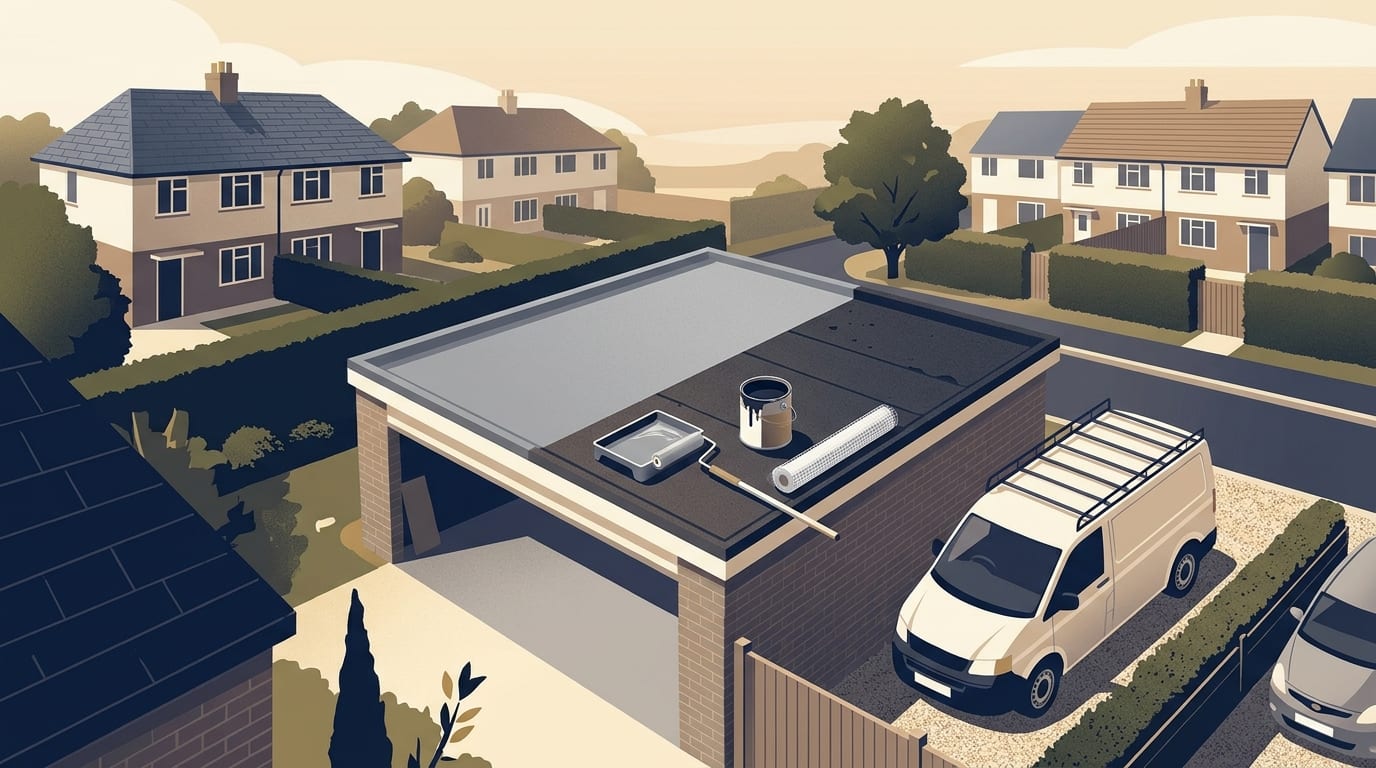
On flat roofs, which are horizontal or slightly pitched, lead is sometimes used as the main covering instead of modern systems like built-up felt (usually torch-on), EPDM rubber, GRP fibreglass, single-ply and liquid coatings. The timber deck on a flat roof must be completely protected from standing water. A lead flat roof is a significant investment. Parapet gutters are concealed channels that collect rainwater behind a low wall and are another place where lead is used.
Lead codes and what they mean
When you receive a quote for leadwork, it should specify the code of lead being used. Lead is manufactured in standard thicknesses, and these are categorised by a numbering system. Workmanship and correct code choice drive the difference between leadwork that lasts and leadwork that cracks early.
Heavier codes are thicker. Lighter codes are used for smaller details such as soakers and light flashings, and heavier codes for valleys, gutters and large flat areas, as the table shows.
This table shows the standard lead codes with their thickness and typical uses.
|
Lead code |
Thickness |
Typical uses |
|---|---|---|
|
Code 3 |
1.32mm |
Soakers and light flashings |
|
Code 4 |
1.80mm |
Step and cover flashings, lighter aprons |
|
Code 5 |
2.24mm |
Heavier flashings, valleys, larger aprons, back gutters |
|
Code 6 |
2.65mm |
Valleys, dormers, parapet and box gutters |
|
Code 7 and 8 |
3.15mm and 3.55mm |
Heavy-duty bespoke work, large flat areas, bay roofs |
Your roofer should confirm which code suits each part of your roof.
The cost of the raw material rises significantly with the thickness. Mid-2026 supply prices show Code 3 is about £35 to £45 per square metre. Code 4 costs £55 to £70 per square metre, and Code 5 is £75 to £95 per square metre. No supply price is given for Codes 6, 7 and 8, so ask your roofer to quote for them.
Typical lead roofing costs in 2026
The total price you pay includes both the raw materials and the specialist labour required to install them. Because every roof is different in size and complexity, typical prices are given as brackets rather than exact figures.
This table shows typical installed prices for common lead roofing jobs, including both labour and materials.
|
Type of leadwork |
Typical installed price |
|---|---|
|
Flat roof lead covering (Code 5) |
£150 to £300 per m2 |
|
Valley lining |
£80 to £150 per metre |
|
Parapet gutter relining |
£100 to £200 per metre |
|
Bay window roof relining |
£400 to £800 |
|
Dormer cheeks |
£500 to £1,500 |
|
Chimney flashing repair |
£200 to £500 |
|
Chimney flashing full replacement |
£600 to £1,500 |
These are typical 2026 prices, and local quotes will differ based on the specifics of your property.
Other 2026 prices differ from the table above, so the two should not be combined. They put a step and cover flashing to an abutment at £25 to £60 per metre, and valley lead replacement at £40 to £90 per metre.
On those figures, a single chimney flashing replacement is £200 to £600 and a full chimney re-lead is £400 to £900 or more. Dormer cheek and roof leadwork is £500 to £1,500, and a bay roof re-lead is £900 to £2,500 or more.
Use the figures as a broad guide when checking your own quotes, and do not mix figures between the two sets. Ask your chosen roofer to itemise exactly what is included in their final figure.
What affects the price
The most significant variable in any quote is access. If tradespeople cannot safely reach the area from a ladder, they will need a secure working platform. Paying for scaffolding for roof work is often a separate and significant line on your final bill. For a standard two-storey house, scaffold for chimney work is an extra £800 to £1,500.
Labour costs also heavily influence the total. A specialist leadworker or roofer day rate is typically £250 to £400. Prices are generally higher in London and the South East.
Hidden damage is another common factor that pushes the price up. Nobody can see rotten timber until the old covering is removed. When replacing lead on a pitched roof, the roofer will strip back the tiles to expose the battens, which are the horizontal timber lengths that the tiles hook onto. They will also expose the underlay, often called felt or membrane, which provides a secondary waterproof barrier.
If these are rotten, they will need replacing before the new lead flashing can be dressed into place. A good written quote will state clearly how extra timber work will be priced if it is discovered. Waste removal and VAT may or may not be included in the headline figure you are given, so you must always ask.
How long does leadwork last
When installed to the Lead Sheet Association and BS EN 12588 standards, lead lasts 50 to 150 or more years.
By comparison, the aluminium alternative lasts 20 to 30 years.
However, the lifespan depends on correct installation and the right code. Leadwork can last 60 years or crack in five.
Why workmanship matters as much as the metal
The difference between leadwork that lasts 60 years and leadwork that cracks in five is driven by workmanship and correct code choice.
A skilled leadworker will choose the right code and detail the lead correctly for each part of the roof, so ask what experience they have.
Safety is another critical reason to rely on experienced professionals. The Health and Safety Executive (HSE) warns that all work on roofs is highly dangerous, even if a job only takes a few minutes. They state that almost one in five deaths in construction work involve roof work.
The HSE also notes that many deaths each year involve smaller builders working on the roofs of domestic dwellings. You must never attempt to climb on a roof or carry out leadwork yourself. All roofs should be treated as fragile until a competent person has confirmed they are not.
Choosing a skilled leadworker
Because proper installation is so vital to the lifespan of the roof, you should look for tradespeople with verifiable expertise. Lead and hard metal installation requires specialist skills that general roofers may lack, so you must ask about their specific experience and check current references.
To help consumers, the Lead Sheet Training Academy runs a Traditional Metal Roofer Directory. It lists metal roofers who trained with the Academy, and categorises them by skill level in lead, hard metals or both.
The levels indicate their documented experience:
- Level 1 Basic Skills.
- Level 2 Secondary Skills (a year or more in the industry).
- Level 3 Highly Skilled (at least three years, able to work almost entirely unsupervised).
- Level 4 Advanced Skills (Leadworker).
Membership of this directory or the TrustMark quality scheme is a good sign, not a guarantee. The Academy states that it cannot take responsibility for the work listed roofers carry out, so you must still conduct your own checks.
You should also check if the firm is registered with CompetentRoofer. This is a government-authorised competent person scheme run by the National Federation of Roofing Contractors (NFRC). Registered roofers can self-certify roof refurbishment in England and Wales, and you should receive a building regulations compliance certificate.
Lead against alternatives
If you are repairing roof flashings and the cost of lead is stretching your budget, there are modern alternatives available. One alternative is aluminium flashing.
The aluminium alternative lasts 20 to 30 years, against 50 to 150 or more years for lead installed to the Lead Sheet Association and BS EN 12588 standards. No price for aluminium is given here, so ask your roofer to quote both.
When deciding between the two, you have to balance the immediate saving against the long-term costs. If you choose aluminium, you or the next owner of the house may have to pay for scaffolding and roofing labour again after 20 to 30 years.
Questions to ask before you agree a quote
Before you agree to any work, you need to ensure you are legally and financially protected. Under the Consumer Rights Act 2015, all work must be done with reasonable care and skill. If it is not, you can ask for it to be put right or for your money back.
Citizens Advice recommends getting written quotes from at least three traders. A proper written quote should show a fixed total price, not just a daily rate, and include a breakdown of all work and materials with separate costs for each.
It should also state clearly how long the price is valid, whether it includes VAT, and under what specific circumstances the price can go up. A quote is a fixed price, whereas an estimate is not. If a deposit is unavoidable, do not agree to more than 25 per cent.
If a firm demands cash only, asks for a massive deposit, or refuses to give a physical address, these are classic warning signs of a scam. Cold callers who have spotted a loose tile or moss from the street should be turned away. You should also be highly sceptical of roof coating and painting claims that promise to fix severe leaks, and remember that power washing can damage the roof.
Paying by credit card gives Section 75 protection on purchases over £100 and up to £30,000. If you agree to a contract at home, by phone or online, you normally get a 14-day cooling-off period. If you ask for the work to start inside that period, you must pay for what has been done if you then cancel.
You must also ask about building regulations. The Planning Portal states that in most situations, re-roofing will need building regulations approval. Replacing a covering with a different material is likely to need it for structural stability, fire safety and energy efficiency.
In England, repairing or re-covering a roof does not normally need a building control application if less than 25 per cent of the building envelope and less than 50 per cent of the roof is affected. Above that, approval is needed and the insulation may have to be upgraded. Approval is also needed for structural alterations, where a new covering performs significantly differently in fire, or where it adds 15 per cent or more to the weight.
Replacing a glazed or polycarbonate conservatory roof with a solid one takes the conservatory out of its exemption, so building regulations apply to the new roof. Rules differ in Scotland and Northern Ireland, so check with your council rather than guessing.
If you are replacing a flat roof with integral insulation, the thermal element may need upgrading. A warm roof has insulation above the deck, while a cold roof has it between the joists. Finally, ensure you receive insurance-backed warranties for the work. Standard guarantees are worthless if the firm folds because they are not insurance-backed.
Common questions
Is a lead roof worth the money?
Lead can be worth the investment if you want a long-lasting covering. Installed to the Lead Sheet Association and BS EN 12588 standards, it lasts 50 to 150 years or more, and the aluminium alternative lasts 20 to 30 years. Ask for quotes for both and compare.
Can I patch repair a split lead roof?
A repair may be possible, but that is a question for a skilled leadworker, not a job to attempt yourself. If lead has cracked early, workmanship and the choice of code are the likely causes, so ask the leadworker to explain what went wrong and what they would do about it.
Why do roofers charge so much for leadwork?
Lead is an expensive material to buy, and shaping it safely requires specialist skills. A quote also reflects safe access at height, with scaffold for chimney work adding £800 to £1,500 to the bill for a standard two-storey house.
Does a new lead roof need building regulations approval?
In England, repairing or re-covering a roof does not normally need approval if less than 25 per cent of the building envelope and less than 50 per cent of the roof is affected. However, replacing a covering with a different material is likely to need approval for structural stability, fire safety and energy efficiency. Going without the building regulations certificate can leave you with no paperwork when you come to sell your house.
Next steps
Before you hire anyone to replace or repair your leadwork, use this checklist to ensure you are fully prepared:
- Take photos of the roof from the ground or inside the loft to show tradespeople what you need without anyone climbing up.
- Ask three different firms for a written quote that shows a fixed total price.
- Check that the quote names the exact lead code being used for the job.
- Confirm if the price includes scaffolding, waste removal and VAT.
- Ask about their specific experience with lead and check their recent references.
- Request a staged payment plan and make the final payment only when the job is finished.
Finding a tradesperson with the right skills is the most important part of any lead project, as workmanship and correct code choice drive the difference between leadwork that lasts and leadwork that cracks early. Be highly sceptical of cold callers, cash only deals, and vague one-line quotes. When you are ready to start comparing prices, you can find a roofer near you to inspect your property and provide a detailed, fixed-price quote.
Find a top rated roofer near you
3,861 roofers across the UK, each ranked on their Google rating and the number of reviews behind it. Start with your county: