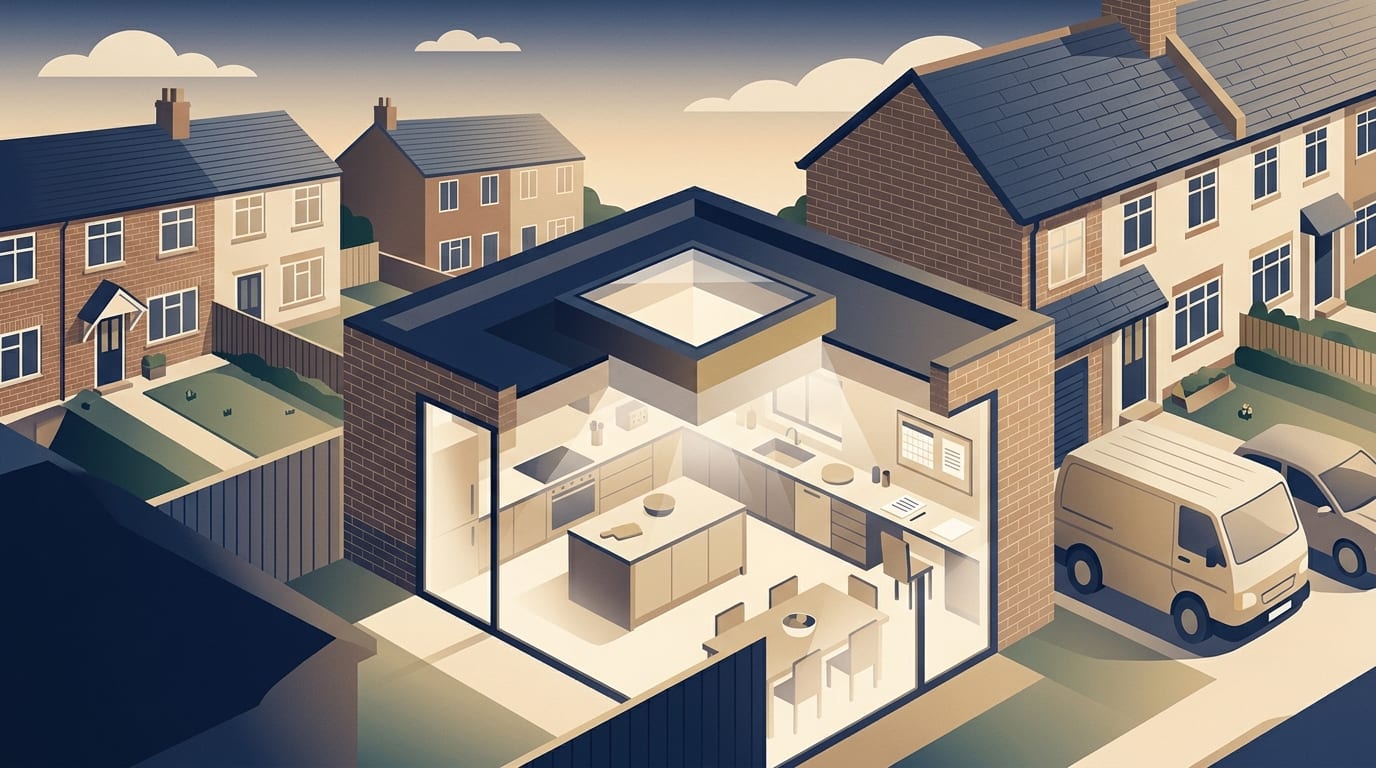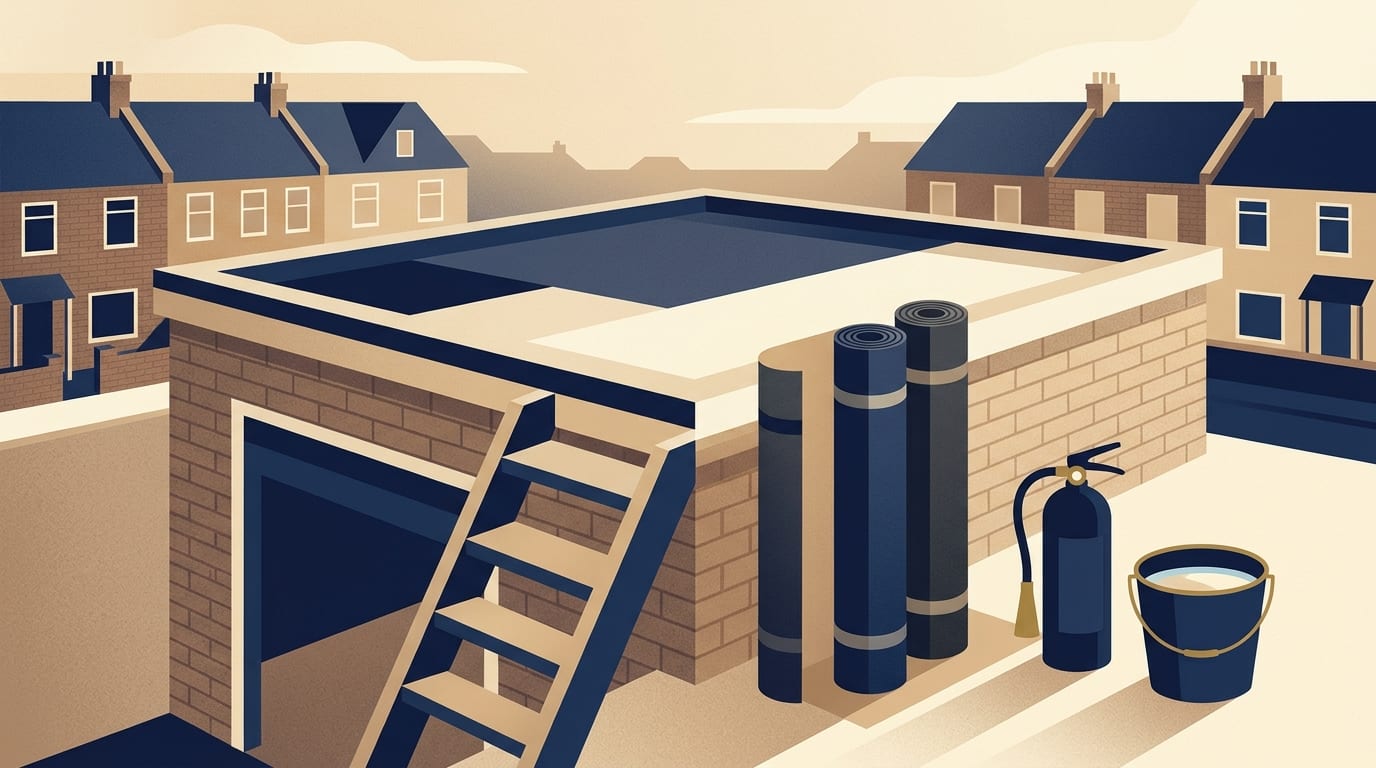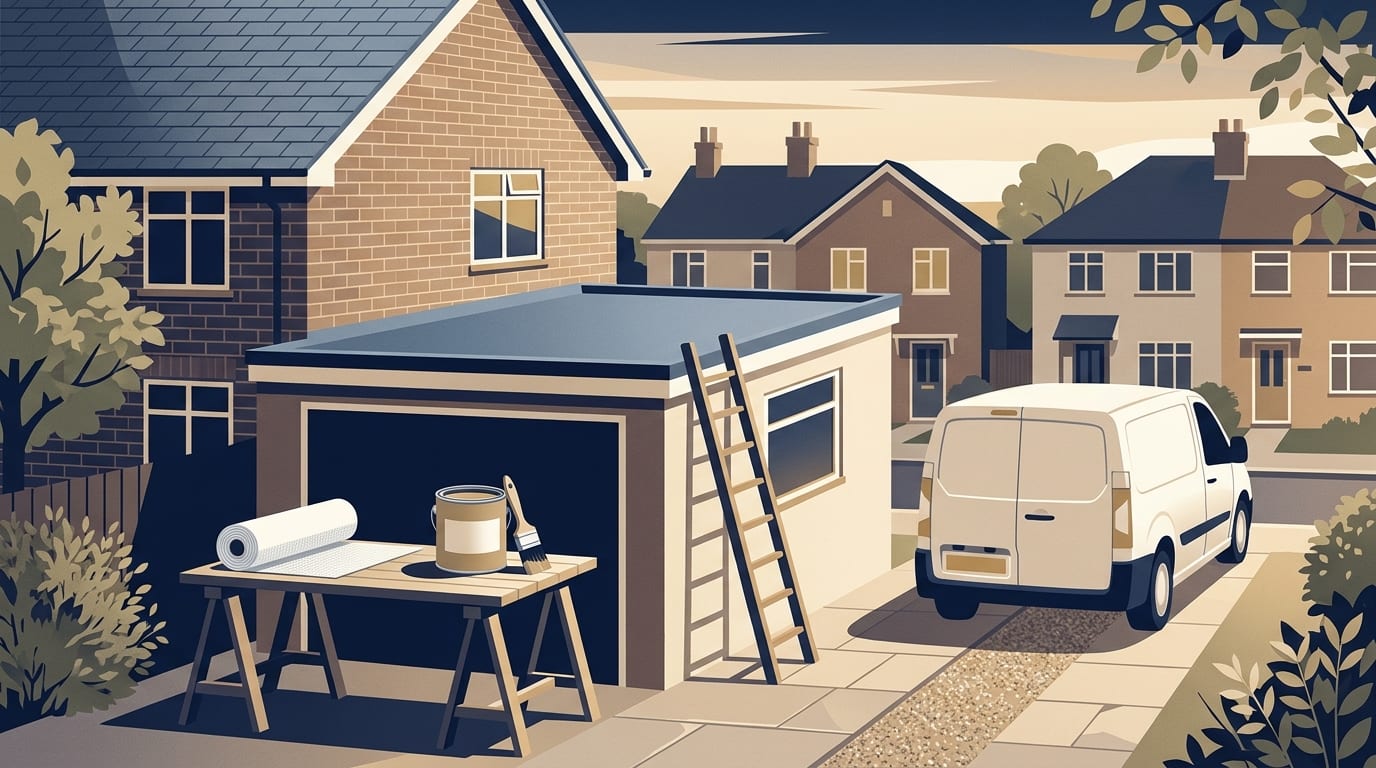
GRP stands for glass reinforced plastic, which is commonly known as fibreglass. A GRP roof is created by applying layers of this material over a flat roof structure to form a single, seamless, rigid laminate. You will often see it used on small extensions, dormer windows, and garages. The system relies on a structural timber deck, usually made from 18mm OSB3 or exterior-grade plywood. OSB3 is an orientated strand board designed for exterior use, and standard OSB2 is unsuitable for this work.
The laminate itself is made by bonding chopped-strand glass matting to the timber deck. This matting is then saturated with a catalysed polyester resin. Once the resin cures and hardens, it creates a tough, waterproof layer without any joints or seams. The deck beneath the laminate must be fixed and supported so it cannot move.
The final layer is a pigmented, UV-stable topcoat. This is applied as a flood coat over the hardened laminate. The topcoat gives the roof its final colour, protects the resin below from sunlight, and provides the smooth, hard, seamless finish that fibreglass is known for.
A fibreglass roof must also have an upstand where the flat roof meets any adjacent brick walls. An upstand is simply the waterproofing material continuing up the wall to prevent water getting into the joint. Building standards state that this waterproofing must extend at least 150mm up the adjacent walls. The glass matting used in the laminate must overlap any upstand by at least 75mm to ensure a watertight seal.
How much a GRP flat roof costs in 2026
Estimates vary widely. Some 2026 price lists put GRP at £90 to £140 per square metre supplied and installed on a sound deck. Others put an insulated fibreglass roof fully installed at £210 to £270 per square metre, and about £240 per square metre on average. Because these estimates are very different, getting itemised local quotes is the only way to know exactly what your roof will cost.
For small jobs, the cost per square metre is often much higher. A tiny porch roof can work out at well over £150 per square metre. As a worked example, a 24 square metre warm roof re-roof might cost about £4,320 in total, which works out at roughly £180 per square metre.
The table below shows typical 2026 GRP prices by roof size for a full installation on a sound deck.
|
Roof size and type |
Estimated cost |
|---|---|
|
Small porch or bay under 8 square metres |
£1,200 to £2,000 |
|
Single garage or small extension 8 to 15 square metres |
£1,500 to £2,800 |
|
Single-storey extension or garage 20 to 30 square metres |
£2,000 to £4,500 |
|
Larger or wrap-around extension 30 to 50 square metres |
£3,500 to £6,500 |
|
Dormer, balcony or complex roof |
£5,000 and above |
These figures are typical published prices for 2026, and your local quotes will differ. Prices are generally higher in London and the South East.
A different set of 2026 estimates prices projects on their own. Per square metre it puts a covering applied directly onto existing decking at £35 to £45, and the average for a fully installed roof at £240. That covering-only work needs the decking in good condition. For projects, replacing just the covering on a small front porch of 5 square metres costs £175 to £225, while a covering-only job for a detached garage of 15 square metres costs £525 to £675. If you need a fully insulated roof, a dormer loft conversion roof of 10 square metres costs £2,100 to £2,700, and a single-storey rear extension of 20 square metres fully insulated costs £4,200 to £5,400.
What affects the price of a fibreglass roof
The condition of your existing roof deck is the biggest unknown when pricing a flat roof. Nobody can see rotten timber until the old covering is stripped off. If your roofer finds that the underlying boards are damaged or flexing, they must be replaced. A new deck in 18mm OSB3 costs £600 to £1,200 for an area of about 25 square metres.
Insulation is another major factor. You will need to decide between a warm roof or cold roof design. A warm roof has insulation placed above the timber deck, while a cold roof has it placed between the internal ceiling joists. Estimates for warm roof insulation vary. Some 2026 price lists put the insulation build-up at £25 to £45 per square metre, others put the extra over a like-for-like cold roof re-cover at £15 to £35 per square metre.
Removing your old roof covering and disposing of the waste will also add to the final bill. Removing an existing fibreglass roof costs £60 to £90 per square metre. A skip for the strip-out waste typically costs £200 to £350. Labour costs make up a significant portion of any roofing quote. Roofer labour is put at £200 to £275 daily for one person in some 2026 estimates, while others put a two-man team at £350 to £550 per day, higher in London and the South East.
Your quote may be pushed up by several specific requirements:
- Replacing rotten or undersized timber joists beneath the deck.
- Upgrading insulation to meet current building regulations.
- Hiring scaffolding for safe access to a high extension or dormer.
- Adding complex trims around skylights, pipes, or awkward corners.
- Removing an existing fibreglass roof before the new one goes on.
- Working in central London or the South East where day rates are highest.
How long a fibreglass roof lasts
A fibreglass roof is known for being durable, but the lifespan figures you read are published claims, not absolute promises. A well-laid roof should last 20 to 30 years. The general industry claim is that fibreglass will last 25 years or more.
BBA-certified systems are rated for at least 25 years. In practice, well-executed systems laid on sound substrates often reach 30 to 40 years before they need replacing.
These lifespans depend on the roof being well laid in dry conditions on a sound deck that cannot flex.
How a GRP roof is laid
Understanding how a fibreglass roof is laid helps you judge whether a roofer is doing the job properly. A GRP roof must never be attempted as a DIY project. The materials involve heavy rolls, strong resin fumes, and hot resin, and all roofs should be treated as fragile until a competent person has confirmed they are not. Falls from flat roof edges are prevented with a secure double guardrail and toeboard around the edge, and almost one in five construction deaths involve roof work.
The work starts with the timber deck. For a cold roof, the 18mm OSB3 or plywood deck is fixed directly to the joists. For a warm roof, PIR insulation boards are placed over the structural deck, followed by an 18mm overlay deck, and then the GRP is applied on top. The deck must be fixed and supported securely so it cannot move or flex.
Before the main laminate goes on, pre-formed edge trims must be fitted and bonded into place. The deck is then covered with chopped-strand glass matting, which is bonded to the boards and saturated with catalysed polyester resin. A minimum fall of 1:80 must be built into the roof structure so that rainwater drains away rather than sitting in puddles.
Weather plays a critical role in how the roof is laid. Fibreglass needs dry conditions and a dry deck. The temperature during application should be above 5°C, and ideally above 10°C. Rain and cold weather can stop the resin from curing properly, which can delay the work.
What can go wrong with GRP and what repairs cost
While a fibreglass roof provides a hard, seamless finish, things can go wrong if the installation is rushed or the weather turns. Hidden deck damage is often found only after stripping the old roof, and if a roofer ignores this and lays fibreglass over a weak deck, the new roof will fail.
Cracking is a common problem if the timber deck flexes underfoot or if the supporting joists are undersized. Poor installation can also lead to pinholes, delamination or cracking.
Another frequent issue is fibre showing through the surface. This happens when the topcoat is applied too thinly, and it is a common cause of callbacks for roofers. Fibreglass and felt do not bond well, which can cause leaks where the two materials meet.
If you spot a problem, professional roof repair costs typically fall between £150 and £600 for fibreglass patching work.
Look out for these common signs that a fibreglass roof is failing:
- Cracks in the surface, especially where the deck flexes.
- Visible white glass fibres showing through the coloured topcoat.
- Leaks where fibreglass meets felt.
- Tiny pinholes across the surface of the topcoat.
- Puddles of water that never drain away due to an incorrect fall.
- Damp patches on your ceiling directly beneath the flat roof.
When a fibreglass roof suits your building
Typical GRP jobs include small porch and garage roofs, small extensions and dormers. The size table above runs from a small porch up to a wrap-around extension.
It only suits a roof with a sound deck, because GRP can crack if the deck flexes or is undersized. The temperature and dry-conditions limits can also cause weather delays, so ask your roofer how a delay would be handled.
Building regulations and guarantees
Replacing a flat roof often involves building regulations. If you are replacing a roof with integral insulation, you may require upgrading its insulation, since the roof counts as a thermal element. In England, repairing or re-covering a roof does not normally need a building control application if less than 25 per cent of the building envelope and less than 50 per cent of the roof is affected. Above that, approval is needed and the insulation may have to be upgraded. The NFRC competent person scheme gives a target U-value of 0.16 for flat roof upgrades.
Garage roofs are not reportable unless the garage has fixed heating. Approval is also needed for structural alterations, where a new covering performs significantly differently in fire, or where it adds 15 per cent or more to the weight. Replacing a glazed or polycarbonate conservatory roof with a solid one takes the conservatory out of its exemption, so building regulations apply to the new roof. Rules differ in Scotland and Northern Ireland, so check with your council rather than guessing.
You can handle this notification in two ways. You can apply directly to a Building Control body, or you can use a roofer who is registered with a government-authorised competent person scheme. Members of the NFRC CPS (Competent Person Scheme) or CompetentRoofer can self-certify their roof refurbishment work in England and Wales. Once the work is signed off, you will be issued a Building Regulations Compliance Certificate. Keep this safe, as you will need it if you ever sell your home.
When the job is finished, your contractor would normally provide a workmanship guarantee. However, this is worthless if the firm goes out of business. An Insurance-Backed Guarantee (IBG) can provide valuable protection to you as a homeowner when commissioning roofing work. It carries an additional cost that must be measured against the risk of failure, but an IBG would apply if the contractor has ceased to trade during that term.
Common questions
Can a fibreglass roof be repaired?
Yes, a fibreglass roof can be repaired. Professional repairs typically cost £150 to £600. A roofer can assess the damage and quote for the repair.
Why is my fibreglass roof cracking?
Cracking usually happens because the timber deck underneath is flexing or undersized. Because GRP is a rigid laminate, it cannot stretch. If the boards move when walked on, the rigid fibreglass on top can crack.
How much does it cost to remove a fibreglass roof?
The removal of an existing fibreglass roof typically costs £60 to £90 per square metre. You will also need to pay for waste disposal, with a strip-out skip costing £200 to £350.
Can you lay fibreglass over old roofing felt?
Fibreglass and felt do not bond well, which can cause leaks where the two meet. A covering-only job applies the GRP directly onto existing decking after the old surface is stripped, and it needs the decking in good condition. The deck itself should be 18mm OSB3 or exterior-grade plywood.
What to do next and how to judge a quote
When you are ready to hire a roofer, always get three written quotes. Do not accept a vague one-line price. A good quote will break down the costs and explain exactly what materials are being used.
Check that your quotes include the following details:
- The type and thickness of the timber deck, which must be at least 18mm OSB3 or plywood.
- Confirmation that trims will be fitted and bonded before the main laminate goes on.
- A clear statement of how extras for rotten decking or joists will be priced if found.
- The inclusion of a UV-stable topcoat applied as a flood coat.
- Confirmation that a minimum fall of 1:80 will be maintained for drainage.
- Whether waste removal and skip hire are included in the final price.
- Details of the workmanship guarantee and the option for an insurance-backed guarantee in writing.
Under the Consumer Rights Act 2015 work must be done with reasonable care and skill, and if it is not you can ask for it to be put right or for money back. A quote is a fixed price, while an estimate is not. Contracts agreed at home, by phone or online normally carry a 14-day cooling-off period, but if you ask for work to start inside that period you must pay for what has been done. Paying by credit card gives Section 75 protection on purchases over £100 and up to £30,000. If you end up in a dispute, Citizens Advice is the best place to go for help.
Never pay the full amount upfront in cash. Agree to staged payments, and only make the final payment when the job is completely finished, the site is clear, and you have received your paperwork. If you are ready to start comparing prices, you can find a roofer near you to get a detailed assessment of your flat roof.
Find a top rated roofer near you
3,906 roofers across the UK, each ranked on their Google rating and the number of reviews behind it. Start with your county: