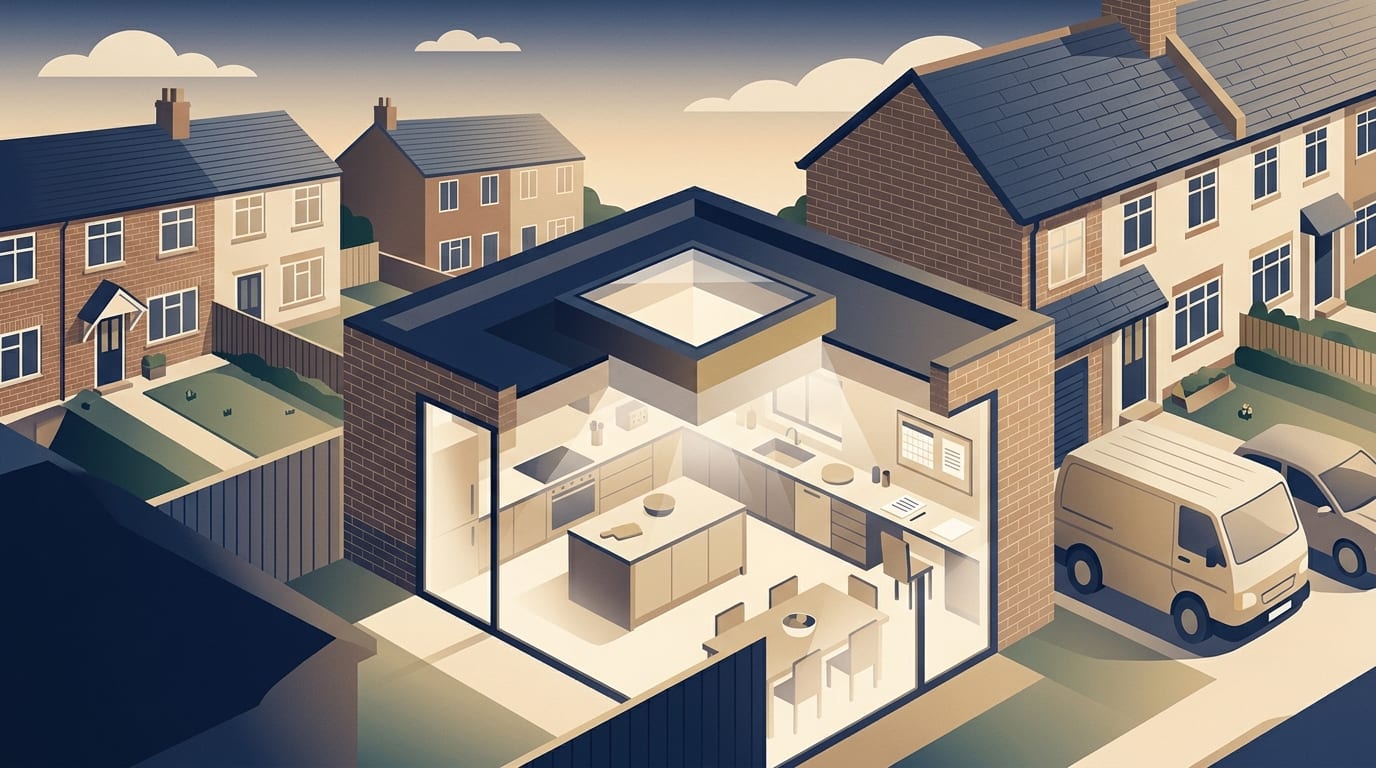
Flat roof rooflights are fixed or opening glazed units fitted onto an upstand or kerb on your roof. Typical published 2026 trade prices put the total fitted cost at £800 to £1,600 excluding VAT. Adding a new rooflight generally needs building regulations approval according to the Planning Portal, because it means altering the roof structure and meeting insulation rules. Cutting the roof deck and sealing the new unit is a job for a professional roofer. You should never try to fit, waterproof or stand on a rooflight yourself.
What a flat roof skylight or rooflight is
A flat roof skylight or rooflight is a glazed unit designed to let daylight into a room below a flat roof. Flat roof rooflights are designed for flat or very low-pitch roofs, from 0 to 15 degrees. Flat roof coverings are usually built-up felt (often called torch-on felt), EPDM rubber, GRP fibreglass, single-ply membranes or liquid coatings.
This is very different from a pitched roof, which is steeper and relies on gravity to shed water over overlapping concrete and clay tiles, or natural and fibre cement slates. Pitched roofs are built with horizontal timber battens over a breathable underlay (often called felt or membrane), with distinct parts like the ridge at the top peak, the hip on a sloping corner, the valley where two slopes meet, the verge at the gable edge, and the eaves at the bottom. The eaves are usually finished with fascias (the vertical boards holding the gutters) and soffits (the boards under the overhang).
Because flat roofs do not have this steep slope, rainwater clears slowly. A flat roof rooflight does not sit directly on the flat roof surface. It is installed on an upstand, which is a raised edge or kerb that lifts the unit above the roof. The roofer waterproofs around the upstand.
This integrated upstand makes a rooflight distinctly different from a standard roof window. Under British standards, a roof window sits in the same plane as the roof and is used on pitched roofs of 15 degrees or more. A rooflight is always installed on an upstand.
Fixed or opening rooflights for a flat roof
You can choose between fixed units that only let in light, and opening units that also provide ventilation. Approved Document B2, which covers fire safety in building regulations, defines a rooflight as an element that admits daylight through a roof. This definition includes a dome light, a skylight, a ridge light and a glazed barrel vault.
Opening rooflights can help natural ventilation through the stack effect, where warm air rises and escapes through the roof. Rooflights can also allow access to roofs or roof terraces.
Rooflights must have safety glazing. If you choose an opening unit and it is out of reach, it may need a mechanism or a motor to open it.
What a roofer does to fit one
Fitting a skylight into a flat roof is a slower job than fitting a window into a pitched roof. The roofer has to cut a precise hole through the flat roof build-up, which includes the waterproof covering, the insulation and the timber deck. A warm roof has its insulation above the timber deck, while a cold roof has it between the joists, and the roofer must manage these layers carefully.
These units have an integrated upstand and kerb rather than a separate flashing kit. The waterproofing around the upstand is covered by joint guidance from the roofing trade bodies.
A joint guidance note from the National Federation of Roofing Contractors (NFRC), the Liquid Roofing and Waterproofing Association, the Rooflight Association and the Single Ply Roofing Association covers this exact work. The guidance covers upstand dimensions, corner detailing, proprietary kerbs, flashings and insulation continuity.
The NFRC states there is no universal detail for every roof arrangement. The rooflight and waterproofing details must be coordinated before installation, following the requirements of both manufacturers. The finished upstand dimensions should be checked, and the completed waterproofing must be inspected and photographed before the rooflight is installed.
Roofs should always be treated as fragile until a competent person confirms otherwise. The Health and Safety Executive warns that fragile rooflights are a particular hazard because they can be hard to see in some light or hidden by paint. Almost one in five construction deaths involve roof work, with falls through fragile roofs and fragile rooflights among the main causes.
Do you need building regulations approval
Adding a new rooflight generally needs building regulations approval. The Planning Portal states that approval is usually required because the roof structure usually must be altered to create the opening. The roof must be able to carry the load of the new unit, the rooflight must meet insulation standards, and fire performance matters if the roof is near a boundary.
Heat loss through the new unit is measured as a U-value, which includes the frame. Building control will check this against the maximum U-value allowed in Approved Document L, Volume 1.
If you are replacing an existing rooflight with a new one of the exact same size, a roofing contractor registered with a competent person scheme can replace a rooflight like-for-like. CompetentRoofer is a government-authorised scheme run by the NFRC, and registered roofers can self-certify roof refurbishment in England and Wales. However, if they need to cut into or re-form the rafter gaps, this structural work must be reported to building control.
A building control application is not normally needed for general roof repairs if less than 25 per cent of the building envelope and less than 50 per cent of the roof is affected. The building envelope includes roof windows and rooflights. If you are replacing the roof covering at the same time and the work goes beyond that 50 per cent limit, you must notify building control and the thermal insulation may have to be upgraded. When approved work is signed off, you will receive a building regulations compliance certificate.
If your flat roof is on a conservatory, be aware that replacing a glazed or polycarbonate conservatory roof with a solid one takes the conservatory out of its exemption, so building regulations apply to the new roof. Rules differ in Scotland, Wales and Northern Ireland, so you should check with your local council rather than guessing.
Do you need planning permission
In England, adding skylights to a house normally falls under permitted development rights. The Planning Portal explains that these rules allow certain alterations to the roof of a house without a full planning application. These rights are set out in Schedule 2, Part 1, Class C of the General Permitted Development Order 2015 as amended.
To qualify for permitted development, the rooflight must not project more than 150 millimetres from the plane of the existing roof slope, and it must not exceed the height of the existing roof. If your plans do not meet these limits, or if permitted development rights have been removed in your area, a planning application is needed.
These permitted development rights do not apply to a building containing flats, or a flat within it. If you live in a flat, a conservation area, or outside England, you should check the planning rules with your local council before you start work.
What a flat roof rooflight costs fitted
The cost of a flat roof skylight depends on the size of the unit, whether it opens, and the structural work needed to alter your roof deck. The labour to cut and seal the roof makes up a large part of the bill, and installation is slower than for a pitched-roof window.
The table below shows typical 2026 published trade prices for installing a flat roof rooflight.
|
Item |
Typical cost (excluding VAT) |
|---|---|
|
Window supply |
£400 to £800 |
|
Labour to cut, fit and seal |
£400 to £800 |
|
Total fitted price |
£800 to £1,600 |
These are typical published prices for 2026 and local quotes will vary. Prices are usually higher in London and the South East. A separate 2026 figure puts the average skylight on a fibreglass roof at about £1,100. It is a single rough figure, not a flat roof rooflight price list, so treat it with care.
When you compare prices, remember that a quote is a fixed price, whereas an estimate is not. A good quote will itemise the cost of the unit, the upstand and any waste removal. Scaffolding is often a separate and significant line on the quote. Nobody can see rotten timber until the old covering is off, so a good quote will also say how extra timber repairs will be priced. You must also ask whether VAT is included in the final figure.
Why leaks happen round rooflights
Flat roofs have a very slight fall to help rainwater drain away, but water clears much slower than it does on a pitched roof. Rooflights can suffer from water ponding around the kerb, as well as dirt accumulation and staining on the glass.
The NFRC guidance says required membrane layers should not be removed to create a flatter surface for the rooflight.
Installers should also never force a rooflight onto an uneven upstand by overtightening the fixings. The finished upstand dimensions should be checked before the unit is attached. If you are worried about an existing leak, understanding flat roof repair costs will help before you call a roofer.
Be wary of cold callers who have spotted moss from the street and offer to pressure wash your flat roof to stop leaks. Pressure washing sold as maintenance is a common scam, and roof coating and painting claims need careful checking.
How to judge a quote
A vague one-line quote that just says "supply and fit skylight" is a warning sign. You need to know exactly what you are paying for so you can compare prices fairly. You should watch out for cold callers offering to fit a skylight for cash today, asking for big deposits, or providing no fixed address. You should also resist being sold a whole new roof for a local fault around a single skylight.
A proper written quote for a flat roof rooflight should include:
- The exact size and type of the glazed unit.
- The cost of cutting the deck and forming the upstand.
- How the upstand will be insulated to meet building regulations.
- The specific materials used to waterproof the kerb.
- Whether waste removal and VAT are included.
- Details of any scaffolding or edge protection needed.
You should also ask what paperwork you will receive. The NFRC states that roofing components should be fitted in line with current building regulations, industry codes of practice and manufacturer guidance. Ask if the firm provides an insurance-backed guarantee. Standard guarantees are worthless if the firm folds because they are not insurance-backed.
TrustMark is the government-endorsed quality scheme for work in and around the home, and checking their register is one way to check a firm. Knowing what a good roofing quote should include will help you spot missing details before you agree to the work.
Under the Consumer Rights Act 2015, work must be done with reasonable care and skill. If it is not, you can ask for it to be put right or for money back. Contracts agreed at home, by phone or online normally carry a 14-day cooling-off period, but if you ask for work to start inside that period you must pay for what has been done. Paying by credit card gives Section 75 protection on purchases over £100 and up to £30,000. If you have a dispute, Citizens Advice is the best place to seek help.
Common questions
Can I put a pitched roof window on a flat roof?
Flat roofs need units designed for flat or very low-pitch roofs, up to 15 degrees. A roof window sits in the same plane as the roof with a minimum pitch of 15 degrees, while a rooflight is installed on an upstand.
Do flat roof windows need safety glass?
Yes, rooflights must have safety glazing. Fragile rooflights are also a particular hazard for anyone working on a roof, so never stand on one.
Why are rooflights flat roof installations so expensive?
Installation is slower than for a pitched-roof window because it means cutting through the flat roof build-up. Labour to cut, fit and seal is put at £400 to £800 of the £800 to £1,600 total.
Does a flat roof skylight add value to a house?
Daylight can make a dark kitchen or extension more pleasant, but any effect on the value of a house varies. A new rooflight generally needs building regulations approval, so keep the compliance certificate with your paperwork.
What to do next
Before you hire a roofer to fit a flat roof skylight, follow these steps to protect your home and your money:
- Check with your local council if you need planning permission, especially if you live in a flat.
- Get three written, itemised quotes that separate the cost of the unit, the labour and the access equipment.
- Ask the roofer how they will coordinate the waterproofing with the upstand details.
- Confirm who is handling the building regulations application or if the roofer will self-certify the work.
- Ask for proof of the firm's insurance.
- Agree a staged payment plan and make the final payment only when the job is finished.
Taking the time to check the paperwork and the planning rules will save you from expensive mistakes later. When you are ready to get quotes and compare local prices, you can find a roofer near you to discuss the best options for your roof.
Find a top rated roofer near you
3,906 roofers across the UK, each ranked on their Google rating and the number of reviews behind it. Start with your county: