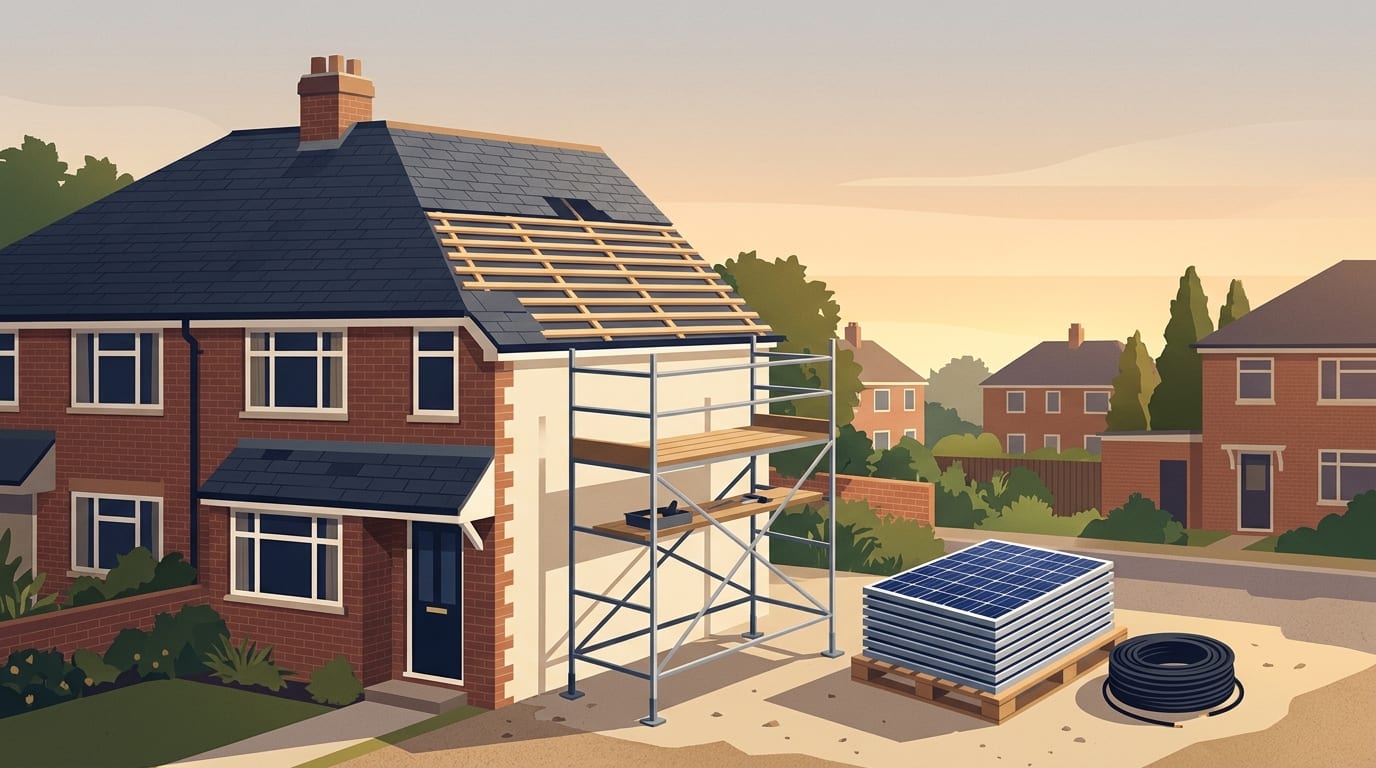
For anything beyond a small local repair, your solar panels usually need to come off and be refitted by a qualified solar professional. This work is priced separately from your roofing quote. One indicative 2026 range for panel removal and refit is £500 to £1,500, and you should get a written quote. Doing the job properly means coordinating a roofing contractor and a solar installer to keep your home safe, your roof watertight and your warranties intact.
Why your panels have to come off
When you have a pitched roof, the solar panels sit above the main roof covering. This covering is usually made of concrete and clay tiles, or natural and fibre cement slate. The panels are fixed to the roof structure, so if a problem develops underneath the array, the panels physically block the roofer from fixing it.
A roof is made of several layers that all work together. Beneath the tiles or slates are timber battens, and beneath those is the underlay, which is often called felt or membrane. If your roof is leaking because the underlay has perished or the battens have rotted, the roofer has to strip the outer covering to reach the damage. You cannot just lift a solar panel out of the way to do this, because the panels are wired together and fixed to the roof structure.
The same rule applies if your panels are mounted on a flat roof. Flat roof systems include the following materials.
- Built-up felt, which is usually torch-on
- EPDM rubber
- GRP fibreglass
- Single-ply
- Liquid coatings
The solar panels sit on top of this waterproof layer, fixed in place by weights or mounts. If the timber deck on a flat roof has rotted and needs replacing, everything on top of it has to be moved safely out of the way first.
Who should remove and refit solar panels
Solar panels should be removed and reinstalled by qualified solar professionals rather than general roofing contractors. You should not ask your roofer to unbolt the panels to save money, and homeowners should never attempt to remove panels themselves. Removing solar panels is electrical work and work at height, and it is strictly for qualified people only.
The Health and Safety Executive warns that all work on roofs is highly dangerous, even if a job only takes a few minutes. Their figures show that almost one in five deaths in construction work involve roof work. You can read the Health and Safety Executive guidance on roof work to understand exactly why professionals take these risks so seriously.
Electrical Safety First says it is vitally important to use a skilled, trained and qualified solar PV installer who is registered with a competent person scheme. They add that companies registered with the Microgeneration Certification Scheme, known as MCS, offer an additional level of assurance. Hiring the right person helps make sure the electrical work is done safely.
What removal and refitting costs
The cost of dealing with your solar panels is an extra expense on top of your main roofing quote. Small roof repairs are usually a fixed price or a day rate, while larger work is priced per square metre plus access. The solar removal is billed separately by the solar installer, and you will need a written quote from them to confirm the exact price.
The table below shows typical costs for taking solar panels down and putting them back up during a roof repair.
|
Service required |
Typical price range |
|---|---|
|
Panel removal and refit for re-roofing or repairs |
£500 to £1,500 |
|
Electrical isolation (DC isolator or wiring fault) |
£150 to £450 |
These figures are typical 2026 prices, and local quotes will differ. Prices are generally higher in London and the South East. You must ask for an itemised written quote to get an exact price for your home. You also need to ask whether VAT and waste removal are included in both your roofing and solar quotes, as these can change the final bill significantly.
Scaffolding and electrical isolation
Before any spanners are used on the roof, the solar system must be safely shut down. Electrical isolation stops the direct current electricity flowing from the panels down to your inverter. This is a vital safety step. Typical 2026 prices put electrical isolation (a DC isolator or wiring fault) at £150 to £450, so ask the solar installer whether it is included in their quote.
Access to the roof is another major factor for both sets of tradespeople. Anything above a single-storey may need scaffold, which is booked separately. Your roofer and solar installer may both need to use the scaffolding, so agree who is hiring it and how long it needs to stay up.
The Health and Safety Executive for Northern Ireland notes that falls account for more deaths and serious injuries in construction than any other cause. They strictly advise that no-one should stand directly on unprotected fragile roof surfaces. Scaffolding should only be erected, altered or dismantled by a trained and competent scaffolder. You can read more about how scaffolding is booked separately for these projects.
Protecting your solar warranty
If your solar panels are relatively new, taking them down can affect your guarantees, depending on the terms. Warranty implications depend on the manufacturer, the installer and the type of warranty you have. Inverters usually carry five to 12-year warranties, and the panels themselves often carry longer ones.
If your solar system is still under warranty, it is often sensible to involve the original installer where possible. If you cannot use the original firm, use an MCS certified engineer if the system is still under guarantee. Non-accredited work can void your cover.
Keep all records of panel removal, reinstallation and electrical testing. This paperwork is useful for a future warranty claim. You should also keep the paperwork for any inverter change, as a Feed-in Tariff licensee may ask for it.
Planning the work in the right order
Coordinating two trades takes careful planning. Doing the roofing and panel work as one planned job is a sensible approach. The process follows five clear steps.
- Shutdown of the solar electrical system
- Removal of the panels and mounting rails
- Roof repairs carried out by the roofing contractor
- Reinstallation of the rails and panels
- Testing of the reconnected system
Once the panels are off, the roofer steps in. Depending on the job, they may strip the old tiles and underlay to expose the timber below. They may also repair damaged lead flashing around the chimney, and fix problems with the ridge, hip, valley, verge and eaves. When the new covering is secured and the roof is watertight, the solar installer returns for the final reinstallation and testing.
Checking the roof before panels go back
A roof repair is the perfect time to check the timber structure. Nobody can see rotten timber until the old covering is off, so a good quote always says how extras will be priced if the roofer finds damp rafters or broken joists.
Croydon Council household retrofit guidance says you must ensure your roof is in good condition and strong enough to support the panels. The installer will check the roof's suitability, and structural improvements may be needed before installation. If the roof needs structural improvements, they should be done before the panels go back up.
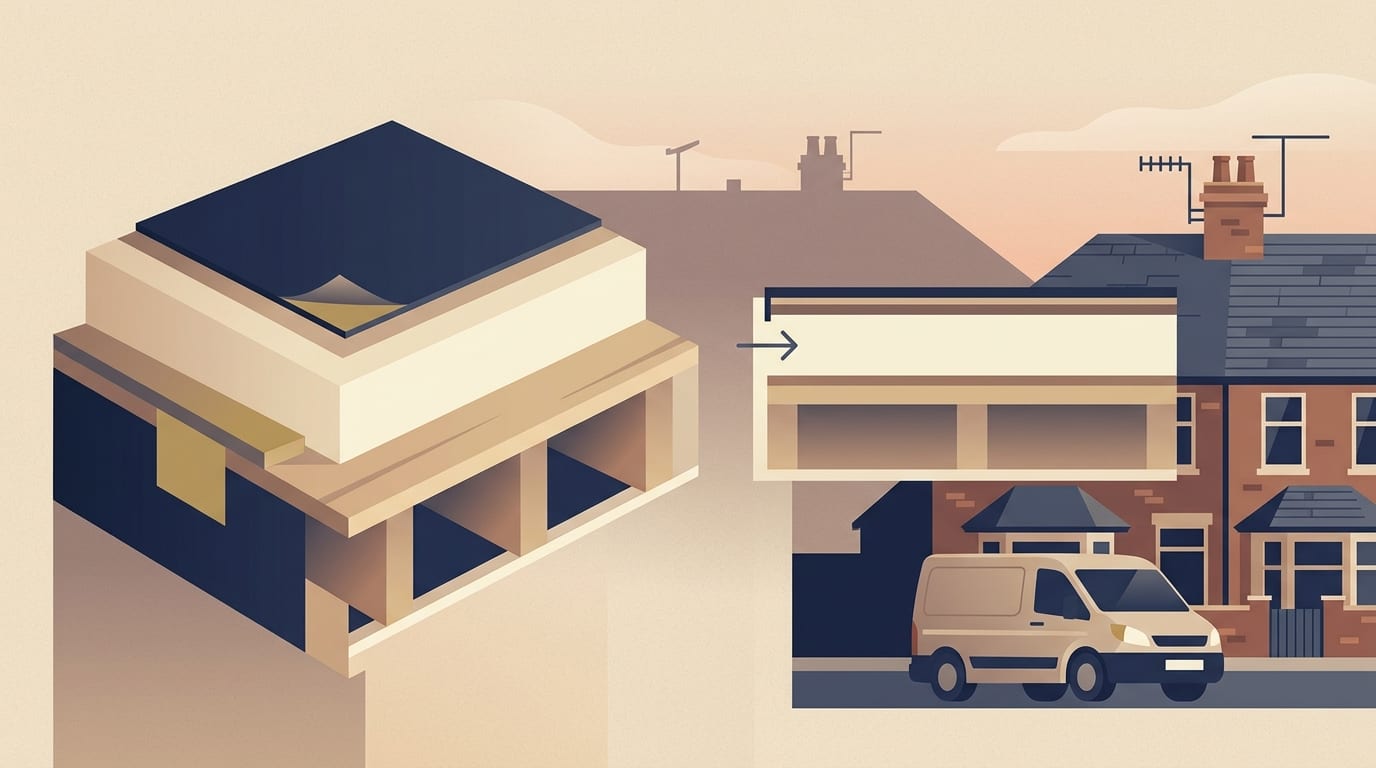
If your repair turns into a large re-roofing job, building regulations may apply. In England, repairing or re-covering a roof does not normally need a building control application if less than 25 per cent of the building envelope and less than 50 per cent of the roof is affected. Above that, approval is needed and the insulation may have to be upgraded. A warm roof has insulation above the deck, while a cold roof has it between the joists.
CompetentRoofer is a government-authorised competent person scheme run by the National Federation of Roofing Contractors. Registered roofers can self-certify roof refurbishment in England and Wales, and the customer should receive a building regulations compliance certificate. Otherwise, the work goes through council building control or a registered building control approver. Rules differ in Scotland and Northern Ireland, so you should check with your local council rather than guessing.
Consumer rights and avoiding roofing scams
Most homeowners have never hired a roofer before and cannot see their own roof properly. This makes it easy to worry about being overcharged or talked into a full re-roof when a repair would do. Watch out for these common warning signs when hiring a roofer.
- Cold callers who have spotted a loose tile or moss from the street
- Pressure to make a decision today
- Tradespeople asking for cash only or demanding big deposits
- Paperwork with no physical address
- Vague one-line quotes
- Worthless guarantees that are not insurance-backed
Under the Consumer Rights Act 2015, work must be done with reasonable care and skill. If it is not, the customer can ask for it to be put right or for money back. Remember that a quote is a fixed price, while an estimate is not. Contracts agreed at home, by phone or online normally carry a 14-day cooling-off period. If you ask for work to start inside that period, you must pay for what has been done.
Paying by credit card gives Section 75 protection on purchases over £100 and up to £30,000. TrustMark is the government-endorsed quality scheme for work in and around the home. Membership is a good sign, not a guarantee, and you should check the scheme's own register. If you end up in a dispute with a tradesperson, Citizens Advice is the place to go for help.
Regular checks once the panels are back
When the roof is fixed and the scaffolding is gone, your solar panels should run safely and efficiently. Keeping an eye on them helps spot small issues before they become expensive electrical problems.
Electrical Safety First says you should have the system inspected and tested at least every five years. This helps check that the system is in safe working order.
You should also do regular visual checks from the ground. Look for cracks in the glass, breaks in the frames, or loose connections dangling under the panels. If you spot cracks, breaks or loose connections, contact a professional immediately. Never climb up a ladder to check the panels yourself, as checks from the ground or from inside the loft are fine.
Common questions
Do I have to remove all my panels to fix one broken tile?
If the broken tile is directly under the middle of your solar array, the surrounding panels must come off to reach it safely. If the damaged area is near the edge, a solar installer might need to remove fewer panels. Your roofer and solar installer will assess the roof and tell you exactly what access they need.
Can my roofer take the panels down to save money?
No, solar panels should be removed and reinstalled by qualified solar professionals rather than general roofing contractors. Removing panels involves handling live electrical equipment and working at height. Non-accredited work can void your cover, and the job involves live electrical equipment.
Will removing panels affect my feed-in tariff?
Ask how removal affects a tariff. Keep the paperwork for any inverter change, because a Feed-in Tariff licensee may ask for it. Keep your records of the removal, reinstallation and testing as well, and ask your solar installer whether anything affects your tariff.
How do I know if I need a repair or a full new roof?
If your roof has a widespread problem like perished underlay or rotting battens across a large area, a full replacement is often the honest answer. If a storm has simply dislodged a few ridge tiles or slates, a local repair is usually enough. Knowing what to expect from a roofer helps you judge whether their advice matches the damage you can see.
Do I need building regulations approval for a new roof?
In England, repairing or re-covering a roof does not normally need a building control application if less than 25 per cent of the building envelope and less than 50 per cent of the roof is affected. Above that, approval is needed and the insulation may have to be upgraded. Replacing a glazed or polycarbonate conservatory roof with a solid one takes the conservatory out of its exemption, so building regulations apply to the new roof.
Next steps for your roof repair
Getting your roof fixed while managing solar panels takes a little extra effort, but doing it properly protects your property. Follow these steps to get the job moving.
- Take photos of the roof defect from the ground or inside the loft to show contractors.
- Contact your original solar installer to ask if they can handle the removal and refitting.
- Get three written quotes for the roofing work, ensuring they include itemised prices for scaffolding and waste removal.
- Ask the roofing contractor how they will price any rotten timber they find once the old covering is off.
- Check that your chosen solar installer is registered with a competent person scheme or MCS.
- Ask the roofer for proof of insurance and check their TrustMark membership on the official register.
- Agree a staged payment plan, and only make the final payment when the job is finished, tested and you have your building regulations certificate.
When you are ready to start gathering quotes and checking credentials for your repair, you can find a roofer near you to assess the job.
Find a top rated roofer near you
3,861 roofers across the UK, each ranked on their Google rating and the number of reviews behind it. Start with your county: