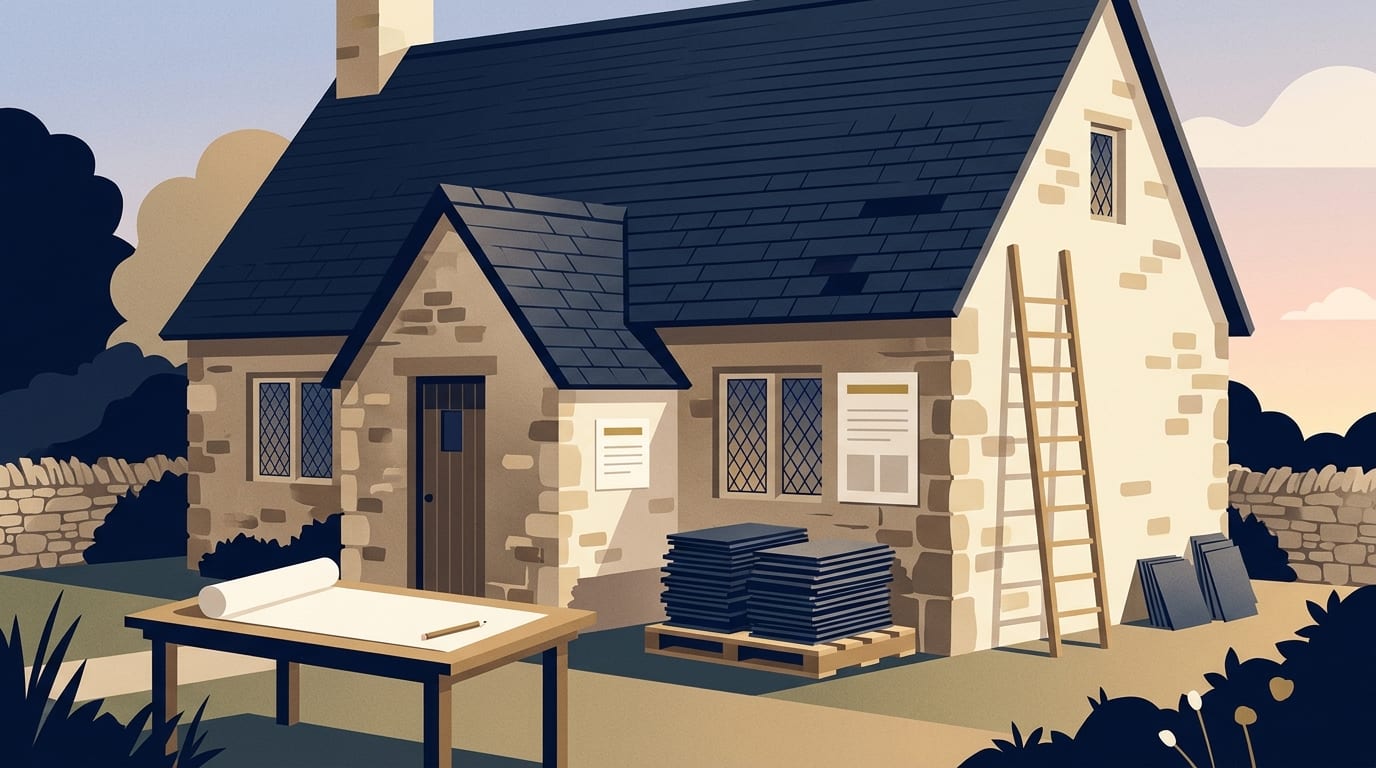
Liquid coatings have a genuine use on a sound but tired flat roof, but you should treat claims about painting pitched roof tiles with extreme caution. The National Federation of Roofing Contractors (NFRC) urges extreme caution about claims that a coating extends tile life or improves thermal efficiency unless the product has credible UK based third party accreditation. A roof coating is never the right way to fix a failed roof covering, rotten timber or active leaks.
What people mean by a roof coating
People use the term roof coating to describe completely different products depending on the type of roof they have. Knowing the difference helps you understand what you are being sold and whether it is actually useful.
UK houses generally have either pitched roofs or flat roofs. Pitched roofs are sloped and usually covered with concrete and clay tiles, or natural and fibre cement slate. Flat roofs are horizontal, though they have a slight fall to let water drain. They are built on a timber deck, which is the wooden board structure that supports the waterproofing layer.
When roofers talk about a coating on a flat roof, they mean a thick, waterproof liquid membrane. This is a legitimate roofing system designed to keep water out. Liquid coatings are often used to extend the life of an existing flat roof covering.
When someone offers a coating for a pitched roof, they usually mean painting or sealing the existing tiles. This is often sold as a way to improve the look of the house or make the tiles more energy efficient. Sometimes, the word coating is also used to describe a clear chemical biocide spray applied to kill moss and algae.
Liquid coatings and systems on flat roofs
Flat roof systems come in several forms. The most common are built-up felt (usually torch-on), EPDM rubber, GRP fibreglass, and single-ply membranes. Liquid coatings are a different approach. They are painted or rolled onto the roof as a liquid and cure into a solid, seamless rubber-like waterproof layer.
A liquid overlay only suits a clean, dry, sound surface. You cannot simply paint it over a ruined roof. A failed covering such as cracked or blistering felt must be fully removed first. Poor preparation is the main cause of failure for these products. The membrane will not adhere properly if the surface is dusty, greasy or damp.
The table below shows typical prices per square metre for different liquid systems. These are typical 2026 prices.
|
Material type |
Typical cost per square metre |
|---|---|
|
Polyurethane |
£20 to £25 |
|
Acrylic (PMMA) |
£25 to £50 |
|
Reinforced liquid membrane |
£20 to £50 |
When fitted by a professional, the overall cost is roughly £40 to £90 per square metre. Local quotes will differ based on the size of your roof and your location. Prices are higher in London and the South East.
Scaffolding is often a separate and significant line on your quote. Waste removal and VAT may or may not be included, so you must ask the roofer to clarify this in writing. If you have an older garage or shed, you must also be aware of hazardous materials. If you have asbestos in your roof, you must hire a specialist to remove and dispose of it safely.
When applied correctly to a well prepared surface, liquid roofing systems can work well. Recoating may be worth considering once the existing finish reaches the end of its lifespan. Based on a manufacturer estimate, an extra coat can add around 10 more years of protection to the roof.
Painting or coating roof tiles and the claims made
Doorstep sellers often offer to paint or coat pitched roof tiles. They make claims that painting tiles can increase thermal efficiency and extend the life of roof tiles. The NFRC takes a cautious view of these promises.
Unless the products carry credible UK based, third party accreditation, the NFRC urges members of the public to view any claims with extreme caution. This warning was published on 25 June 2025. The NFRC does not say whether tile paints work or not. It says to be cautious unless the product carries credible UK based third party accreditation.
Painting your roof will also not fix underlying physical faults. A pitched roof has many vulnerable junctions. The ridge is the peak at the top, the hip is the sloping external edge, the valley is the internal corner where two slopes meet, the verge is the outer edge at the gable end, and the eaves form the bottom edge overhanging the gutters.
Paint cannot bridge a cracked ridge tile or seal a leaking valley. It cannot replace failed lead flashing, which is the metal strip used to seal the roof against brickwork and chimneys. If your roof is leaking, painting the tiles is the wrong approach.
Biocide treatments after moss removal
Some companies sell a clear chemical biocide treatment rather than a coloured paint. This is applied after the roof has been cleaned to stop moss growing back. Biocide treatments usually cost £150 to £400 as a standalone service. These are typical 2026 prices.
Without a biocide treatment, moss and algae will return within 6 to 12 months. However, you should question whether the moss actually needs removing at all. The NFRC states that moss on roof tiles is rarely a problem. It generally only needs removing if it blocks gutters, outlets or other drainage points.
If moss is falling off your roof, it usually gathers in the guttering attached to your fascias and soffits. Fascias are the long straight boards that carry the gutters, and soffits are the boards tucked under the eaves. A blocked gutter is a job for a tradesperson with safe access, not something to tackle from a ladder yourself, and it is a different job from a full roof treatment. You can read more about this in our guide to roof cleaning and moss removal.
Pressure washing and coatings
Before applying any paint or liquid treatment to a pitched roof, sellers will usually insist on cleaning it. This is often done using a high-pressure jet wash. You should be very careful about allowing anyone to pressure wash your roof tiles.
High-pressure washing can strip protective coatings, loosen tiles and force water under the roof covering. The NFRC warns that power-washing may cause damage to the roof. Furthermore, unnecessary foot traffic from the workers walking across the slopes can crack or break tiles.
Water forced under the covering can reach the underlay, which is often called felt or membrane and acts as the secondary waterproof barrier. It can also reach the battens, which are the horizontal timber strips your tiles hang on.
When a coating is the wrong answer
A coating or spray is never a substitute for structural repair work. You should never coat over active damage or trap moisture inside a failing roof. Here are the clear signs that a coating is the wrong answer for your home:
- A roofer finds that your flat roof has a rotten timber deck.
- Your pitched roof is visibly sagging in the middle.
- You have active leaks coming from the lead flashing or the valleys.
- The existing flat roof felt is heavily blistered, cracked or lifting at the seams.
- The roof tiles are crumbling, heavily cracked or suffering from severe frost damage.
Nobody can see rotten timber until the old covering is off. A good quote always says how extras will be priced if the roofer finds damaged decking or rotten battens once the work starts. If the damage is severe, you may need a completely new roof covering.
Building regulations apply to major roof work. In England, repairing or re-covering a roof does not normally need a building control application if less than 25 per cent of the building envelope and less than 50 per cent of the roof is affected. Above that, approval is needed and the insulation may have to be upgraded to modern standards.
Approval is also needed for structural alterations, where a new covering performs significantly differently in fire, or where it adds 15 per cent or more to the weight of the roof. Replacing a glazed or polycarbonate conservatory roof with a solid one takes the conservatory out of its exemption, so building regulations apply to the new roof. Rules differ in Scotland and Northern Ireland, so you must check with your local council rather than guessing.
When upgrading insulation on a flat roof, you must decide between a warm roof and a cold roof. A warm roof has insulation above the timber deck, while a cold roof has it below the deck between the joists.
Doorstep and cold call sellers
Roof coatings and moss treatments are heavily sold by cold callers. These sellers often spot a loose tile or a patch of moss from the street and knock on your door. They may pressure you to decide today, ask for cash only, demand big deposits, or provide vague one-line quotes with no physical business address.
You have strict consumer rights in these situations. Citizens Advice states that you get a 14-day cooling-off period if the business approached you away from its premises and the service costs £42 or more. This starts the day after you enter the contract, whether the agreement is written or verbal.
During the 14 days, you can cancel for any reason and get your money back. However, the business will keep what is necessary to cover the cost of services provided up until you cancelled. If you asked for work to start inside that period, you must pay for what has been done. This cooling-off rule applies in England.
Citizens Advice also warns that you should check what a trader or their website tells you. This is especially true if they approached you by phone or at your door. Always check any scheme or association claim on the scheme's own list. Ask for references and be very cautious of a trader who gives only a mobile number.
What to ask before agreeing
If you have decided that a liquid coating is the right choice for your flat roof, or you want to proceed with a pitched roof treatment, you must protect yourself before handing over any money. Always ask these questions:
- Are you providing a fixed price quote or just an estimate?
- Exactly how will the surface be prepared before the coating goes on?
- Does this specific product have credible UK based third party accreditation?
- Is the guarantee insurance-backed so it remains valid if your firm folds?
- Are waste removal and VAT included in the final price?
- Can you provide a registered business address and proof of public liability insurance?
A quote is a fixed price, while an estimate is just a rough guess that can go up. Under the Consumer Rights Act 2015, all work must be done with reasonable care and skill. If it is not, you can ask for it to be put right or for your money back. Paying by credit card gives you Section 75 protection on purchases over £100 and up to £30,000.
Look for contractors registered with official schemes. CompetentRoofer is a government-authorised competent person scheme run by the NFRC. Registered roofers can self-certify roof refurbishment in England and Wales, and you should receive a building regulations compliance certificate when the job is done. Otherwise, the work must go through council building control or a registered building control approver. TrustMark is the government-endorsed quality scheme for work in and around the home. Membership is a good sign, though it is not a guarantee of perfect work.
Alternatives to consider first
A coating is sometimes sold as a cheap alternative to a new roof, but a coating does not fix a failed roof, and a local repair may be all that is needed. Small repairs are usually a fixed price or a day rate. A roofer can tell you whether a local repair would do the job.
Do not be talked into a full re-roof or an expensive whole roof coating when a minor repair would do. If your flat roof has completely failed and the timber deck is rotten, replacement is the honest answer. Larger replacement work is priced per square metre plus access.
If you are unhappy with the work or feel you have been misled by a cold caller, Citizens Advice is the best place to go for help with a dispute.
Common questions
Can I apply a roof coating myself?
You should never climb on a roof or use ladders at height to carry out repairs yourself. Checks from the ground or from inside the loft are fine. Proper preparation for a liquid coating requires professional equipment, and applying torch-on felting, structural work or leadwork must be left to a trained roofer.
Will a roof coating fix a leak?
No, a liquid coating will not bridge a large gap or fix a structural fault. If you coat over a leak without fixing the underlying issue, you can trap moisture inside the roof, which can damage the timber deck on a flat roof or the battens on a pitched roof.
Do I need planning permission to paint my roof tiles?
Planning rules can be stricter if your home is listed or in a conservation area, so check with your local planning authority before changing the external appearance of your home.
Does my roof need to be completely dry before coating?
Yes, the surface must be entirely clean, dry and sound before a liquid coating is applied. Poor preparation is the main cause of failure. If the surface is damp, dusty or greasy, the membrane will not adhere properly.
Next steps
If you are worried about the condition of your roof or have been offered a coating by a doorstep seller, take a calm and measured approach. Do not rush into a decision today.
- Take photos of the defect or the moss from the ground to show to a professional.
- Get three written quotes from established local roofing firms, not cold callers.
- Ensure each quote provides itemised prices so you know exactly what you are paying for.
- Check the trader's claims on official scheme websites like CompetentRoofer or TrustMark.
- Agree to staged payments and make the final payment only when the job is fully finished.
A sound roof protects your entire home, so take your time to choose the right solution and avoid being pressured into unnecessary work. If you need professional advice on a repair or a replacement, you can find a roofer near you to inspect the damage safely.
Find a top rated roofer near you
3,861 roofers across the UK, each ranked on their Google rating and the number of reviews behind it. Start with your county: