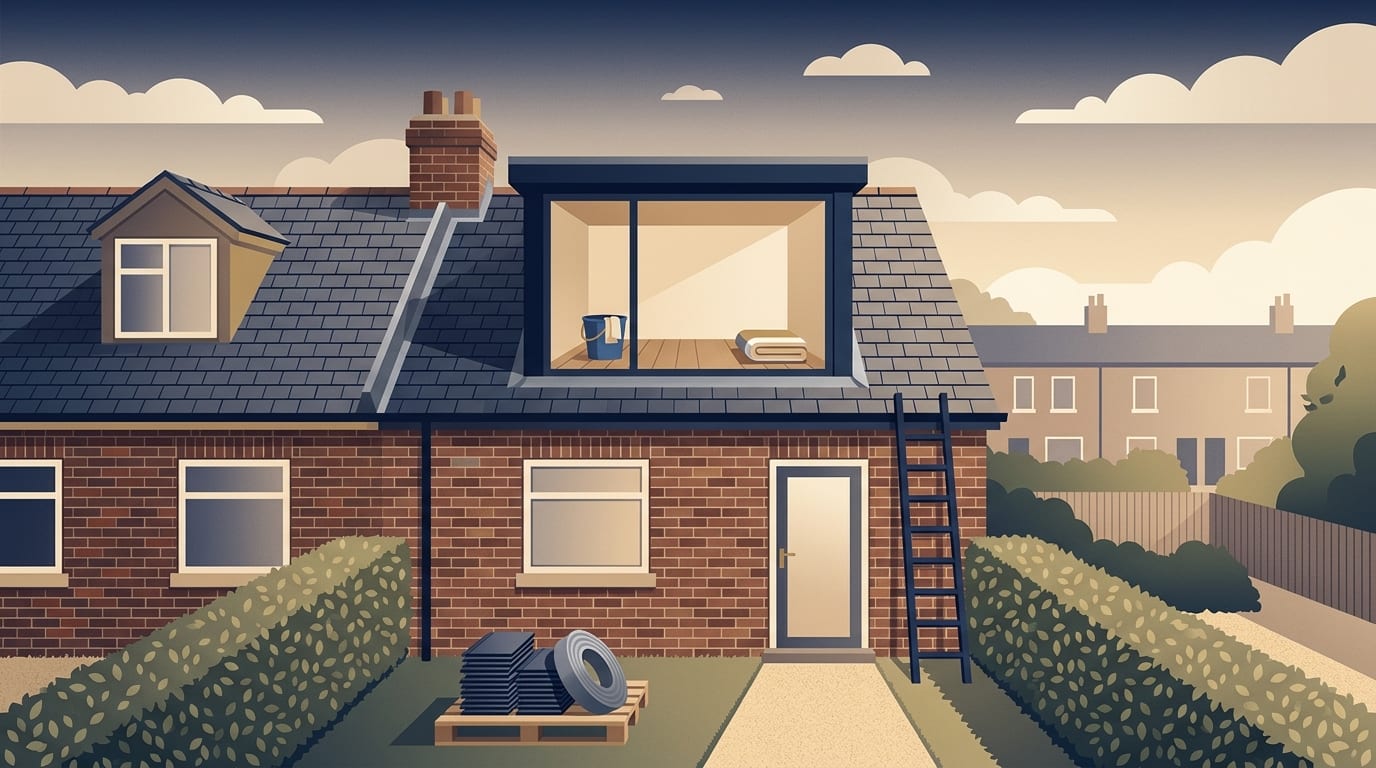
Dormer leaks usually come from the flat roof on top, the side walls, or the metal joints where the dormer meets the main roof. A roofer needs to investigate to find exactly which part is failing before you agree to any work. Because dormers project outwards and are highly exposed to the weather, water will always find the weakest point.
A dormer is a structure built out from a sloping roof to create extra headroom and floor space, usually for a loft conversion. They are exposed to wind and driving rain. The shape of your dormer dictates how the roof is built and what materials cover it.
The main dormer types are box or flat, gable, hip, and arched or eyebrow designs. Box and flat dormers have a horizontal roof plane and provide the most internal space. If you have a pitched dormer, it will have its own sloping roof.
Pitched roofs are covered in overlapping materials such as concrete and clay tiles, or natural and fibre cement slate. A pitched dormer has a more traditional appearance than a flat dormer, but the more complex roof construction and the need to source matching tiles can raise the cost of repairs. Pitched dormers also have their own specific sections to maintain, including a ridge at the very top peak, a hip on external sloping corners, a valley on internal sloping corners, a verge at the exposed outer edge, and eaves at the lowest overhang.
The edges of a dormer roof are usually finished with fascias, soffits and guttering. The fascia is the long board running along the lower edge of the roof, the soffit is the board tucked underneath it, and the guttering collects the rainwater. A leak in these areas can look like a roof failure, so ask the roofer to check the gutters as well.
The flat top and its covering
Many dormers built for loft conversions have a flat roof. The foundation of this structure is the timber deck on a flat roof, which is the layer of structural boards that supports the waterproofing. Keeping this timber deck dry is the main job of the roof covering.
Because dormers are constructed like any other flat roof, the covering options are exactly the same. Roofers use several flat roof systems to form a waterproof barrier. Built-up felt (usually torch-on) is applied with a blowtorch in overlapping layers. EPDM rubber is a single-ply synthetic rubber membrane that comes in large sheets. GRP fibreglass forms a hard, continuous shell.
Roofers also use single-ply membranes made of PVC, and liquid coatings that are painted or rolled onto the roof to form a seamless barrier. EPDM rubber suits dormers well as a mid-range choice, and GRP fibreglass is also suited to them where a crisp finish matters.
The way your dormer is insulated determines how the structure behaves. A warm roof has insulation above the deck, keeping the timber structure warm and preventing condensation. A cold roof has it between the joists below the deck, which requires careful ventilation. If you are unsure which setup you have, read the guide on choosing a warm roof or cold roof.
Cheeks and lead flashings
The vertical side walls of a dormer are known as the cheeks. Because they face the elements directly, they must be clad in a durable material to keep the rain out. Lead cladding is a common choice for dormer cheeks.
Roofers use Code 5 lead for flat roofs, dormers and parapet gutters. Replacing dormer cheeks is a skilled job, and typical 2026 prices put dormer cheeks (lead cladding) at £500 to £1,500.
This price range depends heavily on the size of the cheeks and how easy they are to access, and excludes the cost of scaffolding. You should never attempt to carry out leadwork yourself, as it requires specialist tools and training.
Windows and junctions with the main roof
Wherever a dormer meets the sloping roof of your house, there is a junction that relies on lead flashing to stay watertight. Lead flashing is the strip of metal used to seal joints and bridge the gap between the dormer walls and the surrounding roof tiles. If this flashing is damaged, lifted by high winds, or poorly installed, water will quickly find its way inside.
Beneath your main roof tiles, there is an underlay (often called felt or membrane) that provides a secondary barrier against wind and rain. The tiles themselves sit on wooden battens nailed horizontally across the roof. If the lead flashing fails, water can get under the tiles and reach the underlay and battens before it shows inside.
The area beneath the dormer window is another common weak point. An apron flashing sits under the window sill and dresses down over the roof tiles below. If a leak only appears when rain is driven hard against the window, the fault may lie with this flashing or the window seals rather than the main flat roof above.
Signs of a dormer leak from inside
You can often spot a dormer problem long before water starts dripping onto your loft floor. Inspecting the area from the inside is the safest way to gather evidence for a roofer. Look closely at the ceiling and walls around the dormer window during or immediately after a wet spell.
Tell your roofer if you notice any of these common signs:
- Brown or yellow water stains on the plasterboard ceiling of the dormer.
- Damp patches or peeling paint on the cheeks inside the room.
- Water pooling on the window sill or dripping from the top of the window frame.
- A musty smell in the loft room that never seems to go away.
- Dark marks on the timber joists if you can see into the eaves space beside the dormer.
Take photos of the damp patches from inside, or step outside and take photos of the dormer from the ground. Never climb onto the roof to look for a leak yourself. The Health and Safety Executive (HSE) warns that "all work on roofs is highly dangerous, even if a job only takes a few minutes." You should treat all roofs as fragile until a competent person has confirmed they are not.
Repair or renew your dormer roof
When a dormer starts leaking, your roofer will need to decide if a patch repair is enough or if the whole covering needs replacing. Small patch repairs certainly have their place if the damage is localised, such as a single tear in the felt or a lifted edge of lead flashing. A liquid overlay can also extend the life of a sound but tired covering.
However, if the timber deck beneath the covering is rotten, or the roof has failed repeatedly, a full strip and replacement is the durable fix. Water trapped inside a flat roof structure causes the timber deck to decay, and nobody can see rotten timber until the old covering is off. Deck condition is the single biggest source of cost surprises on a flat roof job.
Be aware of common scams and pressure tactics in the roofing trade. You should ignore cold callers who knock on your door claiming they have spotted a loose tile or moss on your dormer from the street. Walk away from any roofer who applies pressure to decide today, asks for cash only, demands big deposits, or refuses to provide a physical address.
A dishonest roofer may try to sell you a whole new roof for a local fault, such as a single slipped tile. You should also be highly suspicious of roof coating and painting claims, or pressure washing sold as maintenance, so ask what evidence supports the claim. Finally, remember that long guarantees are worthless if the firm folds because they are not insurance-backed.
What a repair costs and what the figures cover
Because a dormer leak could be anything from a broken tile to a completely rotten flat roof, there is no single price for a dormer roof repair. You will not find a reliable average cost for repairing a dormer flat top or re-roofing the whole structure, so you must ask a roofer for a detailed quote based on your specific problem.
How jobs are priced depends on the scale of the work. Small repairs are usually a fixed price or a day rate. Larger work is priced per square metre plus access. However, very small roofs cost more per square metre than the headline rate suggests, simply because the roofer still has to cover their travel, setup, and fixed material costs.
This table shows headline flat roof rates per square metre, which are not dormer prices, alongside the cost for lead cheeks.
|
Item |
Typical cost |
|---|---|
|
Felt flat roof (supply and fit, warm roof) |
£50 to £90 per m2 |
|
EPDM rubber flat roof (supply and fit, warm roof) |
£80 to £120 per m2 |
|
GRP fibreglass flat roof (supply and fit, warm roof) |
£90 to £140 per m2 |
|
Dormer cheeks (lead cladding) |
£500 to £1,500 (excludes scaffold) |
These are typical 2026 prices, and local quotes will differ based on where you live and the condition of your timber deck. Prices are generally higher in London and the South East. Waste removal and VAT may or may not be included, so you must ask your roofer to specify this in writing. Because nobody can see rotten timber until the old covering is off, a good quote always states exactly how extras will be priced.
Access and safety requirements
Working on a dormer requires proper access equipment. Dormers are often high up, and leaning a ladder against the gutter is not a safe way to carry out major repairs. Scaffolding or an elevated work platform is normally needed to complete the job properly.
Scaffolding is often a separate and significant line on your quote. There is no fixed dormer scaffold price because every house is different and access restrictions vary widely. Professional roofers take access seriously because the HSE notes that "almost one in five deaths in construction work involve roof work."
What a good dormer quote contains
A professional quote should be in writing and clearly explain what the roofer intends to do. An estimate is just a guess at the final price, whereas a quote is a fixed price for the work described. Do not accept a vague one-line quote that just says "dormer roof repair."
A thorough quote for dormer work should include:
- Exactly which part is failing (the flat top, the cheeks, or the flashing).
- Photos of the defect taken by the roofer while on the roof.
- How extras will be priced if the timber deck is found to be rotten.
- Confirmation that the price includes waste removal and VAT.
- Details of the lead flashing to be used.
- Whether scaffolding is included in the total price or billed separately.
- Details of any guarantee, ideally an insurance-backed warranty.
You also need to understand building regulations. In England, repairing or re-covering a roof does not normally need a building control application if less than 25 per cent of the building envelope and less than 50 per cent of the roof is affected. Above that, approval is needed and the insulation may have to be upgraded. The Planning Portal warns that "the removal or alteration to any roof elements could affect how the roof works and cause movement to occur."
Approval is also needed for structural alterations, where a new covering performs significantly differently in fire, or where it adds 15 per cent or more to the weight. Replacing a glazed or polycarbonate conservatory roof with a solid one takes the conservatory out of its exemption, so building regulations apply to the new roof. Rules differ in Scotland and Northern Ireland, so tell your council what you are planning rather than guessing.
Look for roofers registered with CompetentRoofer, a government-authorised competent person scheme run by the National Federation of Roofing Contractors (NFRC). Registered roofers can self-certify roof refurbishment in England and Wales, and the customer should receive a building regulations compliance certificate. Otherwise, the work goes through council building control or a registered building control approver. TrustMark is the government-endorsed quality scheme for work in and around the home. Present these as things to check on the scheme's own register, and remember that membership is a good sign, not a guarantee. Read our guide to what NFRC and CompetentRoofer membership mean when hiring for more details.
Under the Consumer Rights Act 2015 work must be done with reasonable care and skill, and if it is not you can ask for it to be put right or for money back. Contracts agreed at home, by phone or online normally carry a 14-day cooling-off period, but if you ask for work to start inside that period you must pay for what has been done. Paying by credit card gives Section 75 protection on purchases over £100 and up to £30,000. Citizens Advice is the place to go if you end up with a dispute.
Common questions
Can I seal a leaking dormer roof myself?
No, you should never attempt to seal a dormer roof yourself. Accessing a dormer safely requires scaffolding, and you should not carry out torch-on felting or structural work yourself. Temporary DIY sealants can hide the cause of a leak and make it harder for a roofer to find.
Why does my dormer roof pool water?
Standing water on a flat dormer roof is worth showing to a roofer, because it can point to a problem with the deck or the fall of the roof. Take photos from inside or from the ground, and ask the roofer to explain the cause before you agree to any work.
Does home insurance cover a leaking dormer roof?
Whether a policy covers a dormer leak depends on its wording and on the cause of the damage. Check your policy and ask your insurer before you arrange repairs.
How long does a flat dormer roof last?
The lifespan depends on the material used, how well it was installed and the condition of the timber deck. A roofer who inspects your dormer can tell you how much life the covering has left, and any guarantee offered should be in writing.
Your next steps
Before you hire a roofer to fix your dormer, make sure you have everything you need to make an informed choice. Take your time, even if the leak is worrying, to avoid making an expensive mistake.
- Take photos of the damp patches or stains from inside your loft room to show the roofer.
- Get three written, itemised quotes to compare prices and approaches.
- Ask the roofers to specify exactly which part of the dormer is leaking.
- Check how they price extras, especially if the timber deck needs replacing.
- Ask for proof of their public liability insurance before they start work.
- Agree to staged payments and only pay the final balance when the job is completely finished.
Finding a reliable tradesperson is the best way to ensure your dormer stays watertight for years to come. When you are ready to get quotes, you can use our directory to find a roofer near you.
Find a top rated roofer near you
3,861 roofers across the UK, each ranked on their Google rating and the number of reviews behind it. Start with your county: