Looking at your roof from the ground at least once a year and after storms is the best way to spot problems before they cause expensive leaks. Have your gutters cleared by a professional twice a year, and for anything on the roof itself, call a professional roofer rather than climbing up. Regular visual checks help you spot problems early and show that the roof has been looked after if the weather turns nasty.
Why a few minutes of checking saves money
Roof problems usually start small. A cracked tile or a blocked gutter is cheap to fix, but ignoring it allows water to rot the timber battens and rafters underneath. The battens are the horizontal timbers your tiles are fixed to, and nobody can see if they are rotten until the old roof covering is taken off.
Insurers exclude wear and tear, so storm damage may not be covered if the roof has not been maintained adequately. A storm in this context is generally treated as strong winds over 55mph, or damage from extreme rain, snow or hail.
If the real cause of the damage turns out to be neglected maintenance, a claim may not be paid. Storm damage may not be covered if the roof has not been maintained adequately, so a slipped tile or a sagging ridge is worth having looked at early.
Stay on the ground and check safely
The most important rule of roof maintenance is that you should never climb on your roof unless you are a trained professional with proper safety equipment. The Health and Safety Executive reports that almost one in five deaths in construction work involve roof work. Many deaths each year involve smaller builders working on the roofs of domestic dwellings.
All work on roofs is highly dangerous, even if a job only takes a few minutes. All roofs should be treated as fragile until a competent person has confirmed they are not. Sloping roofs require scaffolding to prevent people or materials falling from the edge. That is why roof access is a job for a professional with the right equipment and not for a homeowner.
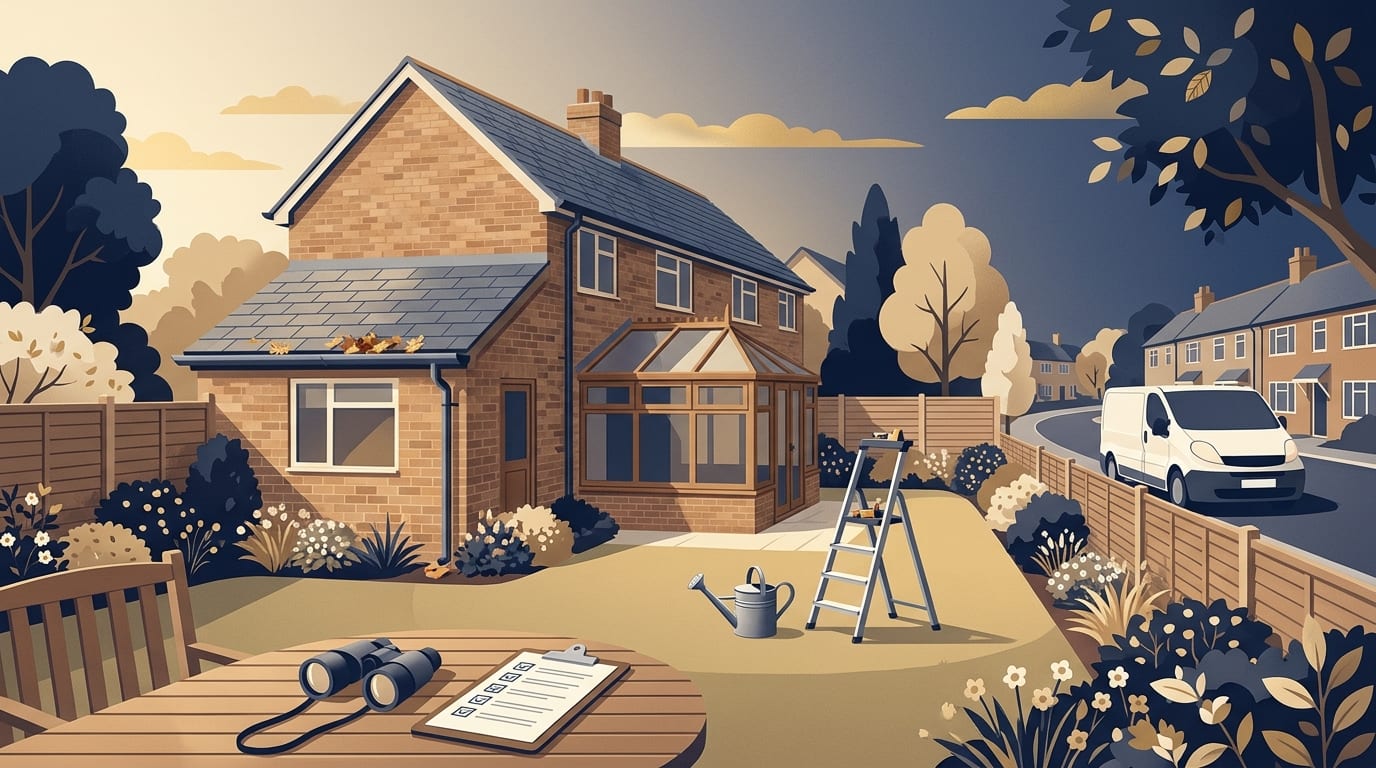
You can do a thorough check safely from the ground using binoculars. Walk around your property and look at the roof from several different angles. Cotswold District Council suggests that a quick visual inspection of gutters, fascia boards, bargeboards, soffit boards and roof valleys is a good way to check them.
Look for these common faults from the street or your garden:
- Gaps, cracked tiles or slipped tiles on the main pitched roof slopes.
- Missing ridge tiles along the very top of the roof.
- Damaged lead flashing, which is the metal used to seal joints around the chimney stack.
- Moss growth on north-facing slopes.
- Debris in the roof valleys, which are the internal angles where two slopes meet.
- Plant growth or soil build-up around drains, ventilator bricks or gutters.
You should also look closely at the overall roof line from the street. Any dips, sags, or waves indicate structural issues that require a professional assessment.
Your seasonal roof maintenance checklist
This table shows what parts of your roof to check, how often to inspect them and what ignoring them can lead to.
|
What to check |
How often |
What it can lead to |
|---|---|---|
|
Chimney stack, lead flashing, valleys and tiles |
Once a year and after bad weather or heavy rain |
Water leaking into the roof space and rotting the timbers |
|
Slate roof nails |
Every two to three years and after strong winds |
Slipped slates and exposed roof underlay |
|
Felt or rubber flat roofs |
Once a year before summer |
Worn areas that let water in |
|
Plastic roof panels |
Once a year and after big temperature changes |
Damaged panels that let rain in |
|
Moss growth |
Twice a year in spring and autumn |
Blocked gutters, outlets and drainage points |
|
Gutters and downpipes |
Twice a year and after heavy leaf fall or storms |
Overflowing water running down and damaging the exterior walls |
These frequencies are a rough guide. Other advice is to inspect at least once a year, especially before winter and after severe weather, or quarterly and after storms, and your local weather will affect when you need to look. Flat roofs, plastic panels and slate nails usually cannot be checked safely from the ground, so ask a roofer to check those.
Spring and summer roof checks
Spring is a good time to check for damage caused by winter weather and for any blockages. Ask a professional to check that your gutters and downpipes are clear of any debris washed down over the winter. You should also check for moss growth, which tends to thrive in damp conditions.
Felt or rubber flat roofs should be checked once a year before summer. Flat roof systems include built-up felt (usually torch-on), EPDM rubber, GRP fibreglass, single-ply and liquid coatings, and a roofer can tell you which you have and what to look for. Do not go onto a flat roof to check it yourself.
If you spot moss on your roof during the summer, do not panic. The National Federation of Roofing Contractors says moss on tiles is usually harmless and only needs removing if it is blocking gutters, outlets and other drainage points. Power washing can damage the roof, so do not have it done to remove moss.
A UK tile maker advises against high-powered jet washes because they can damage the tile or slate surface and shorten its life. Walking on the roof to clean it can also crack or break otherwise healthy tiles.
Autumn and winter checks
Autumn brings leaf fall, and gutters and downpipes should be cleaned twice a year and after heavy leaf fall or storms. Blocked gutters force rainwater to spill over the fascias and run down your brickwork, which can lead to damp inside your home.
Fascias are the long straight boards running right under the lower roof edge, while soffits are the boards tucked underneath them. Your guttering is fixed directly to the fascias. Keeping the gutters clear stops water backing up and rotting these timber roofline products.
Check your roof from the ground after severe weather, including your chimney stack, lead flashing, valley areas and tiles after bad weather or heavy rain. If you have a natural slate or fibre cement slate roof, slate roof nails should be checked by a roofer every two to three years and after strong winds.
What to look for in your loft
You can learn a lot about the health of your roof without leaving the house. Checking the loft space is a safe way to spot leaks before they damage your ceilings. It is best to do this during the day so you can spot external light, and again after heavy rain to check for active leaks.
Use a torch and look around from the loft hatch. Do not walk across an unboarded loft, because stepping between the joists can take you through the ceiling below. If a roofer needs to go further into the loft, leave that to them.
Look for these warning signs inside your roof space:
- Daylight showing through the roof tiles, slates or the underlay.
- Water stains on the timber rafters or the felt.
- Damp areas after rain, which suggest a leaking roof.
- Wet or flattened insulation material sitting between the joists.
- Mould or mildew on the timbers, underlay or stored boxes.
- Blocked vents at the eaves.
Finding mould in your loft does not always mean the roof is leaking. Damp areas after rain point to a leak, but mould in dry areas suggests poor ventilation. Your roof needs clear vents to allow air to circulate and stop condensation forming on the underside of the underlay.
Checks that suit different roof types
Different roof materials require slightly different checks. Pitched roofs covered in concrete or clay tiles are heavy and durable, but the mortar on the ridge tiles and the verges can crumble over time. The ridge is the peak of the roof, and the verge is the outer edge above a gable end. Look for missing chunks of mortar from the ground.
Flat roofs have a timber deck supporting the waterproof covering. A warm roof has insulation above this deck, while a cold roof has it between the joists. Flat roofs have a slight slope to let water run off. If you can see standing water on a flat roof days after it has rained, ask a roofer to investigate.
Replacing a glazed or polycarbonate conservatory roof with a solid one changes how the structure behaves. This takes the conservatory out of its normal exemption, meaning building regulations apply to the new roof. Check these solid roofs just as you would your main house roof, looking for slipped tiles and clear gutters.
When to call a roofer and what to leave alone
You should call a reputable roofing contractor for a proper assessment the moment you spot a loose tile, a sagging ridge, daylight in the loft or damp patches on your ceilings. Cracked or broken tiles should be replaced as soon as convenient to stop water reaching the underlay and the battens.
Never try to carry out leadwork, torch-on felting, structural repairs or electrical work yourself. Always leave working at height to the experts. You should also watch out for cold callers who knock on your door claiming they have spotted a loose tile or moss from the street. Good roofers do not need to pressure you into deciding today.
Avoid any roofer who demands cash only, asks for a big deposit upfront, or cannot provide a physical address. Be wary of firms selling roof coating or painting as a miracle cure, or those pushing you into a full re-roof when a simple local repair would do. A quote is a fixed price, whereas an estimate is not, so ask for a quote in writing.
If you are hiring a roofer, look out for these protections and rules:
- Under the Consumer Rights Act 2015, all work must be done with reasonable care and skill. If it is not, you can ask for it to be put right or for your money back.
- Contracts agreed at home, by phone or online normally carry a 14-day cooling-off period. If you ask for work to start inside that period, you must pay for what has been done.
- Paying by credit card gives you Section 75 protection on purchases over £100 and up to £30,000.
- In England, repairing or re-covering a roof does not normally need a building control application if less than 25 per cent of the building envelope and less than 50 per cent of the roof is affected.
- If more than 50 per cent is affected, approval is needed and the insulation may have to be upgraded.
Rules differ in Scotland and Northern Ireland, so you should check with your local council rather than guessing. In England and Wales, roofers registered with the CompetentRoofer scheme can self-certify roof refurbishment, and you should receive a building regulations compliance certificate.
Common questions
Can I clean roof moss myself?
No, you should never climb onto your roof to clean moss. Walking on the roof can crack or break tiles, and power washing can damage the roof. Moss is usually harmless unless it is blocking your gutters or drainage points, and a professional roofer should handle its removal.
How often should I check my gutters?
You should have your gutters and downpipes cleaned twice a year. They should also be cleaned after heavy leaf fall or storms. You should also check them visually from the ground after severe storms to make sure they have not been pulled loose.
Does a slipped tile mean I need a new roof?
Not usually. A few slipped or cracked tiles can often be replaced as a simple repair. Small repairs are usually charged at a fixed price or a day rate. However, if many tiles are slipping across the whole roof, it might indicate that the fixings have failed or the timber battens are rotten.
What is the difference between an estimate and a quote?
A quote is a fixed price for the job, whereas an estimate is not. Always insist on a written quote. Because nobody can see rotten timber until the old covering is off, a good written quote will state exactly how any unexpected extras will be priced.
Your next steps for roof maintenance
A well maintained roof protects your home and prevents minor faults turning into major building work. Use this checklist to keep on top of your roof care safely.
- Walk around your property with binoculars at least once a year to inspect the roof slopes, ridge and chimney.
- Look inside your loft with a torch to check for daylight, damp patches and mould on the timbers.
- Take clear photos of any defects you spot from the ground or from the loft hatch.
- Book a professional to clear your gutters twice a year, especially after autumn leaves have fallen.
- Check the TrustMark register to find a government-endorsed tradesperson, and gather three written, itemised quotes for any repair work.
- Ask the roofer for proof of insurance and agree to staged payments, keeping the final payment until the job is completely finished.
If your visual checks have highlighted a cracked tile, missing flashing or a blocked gutter, it is time to find a roofer near you to put it right safely.
Find a top rated roofer near you
3,861 roofers across the UK, each ranked on their Google rating and the number of reviews behind it. Start with your county: