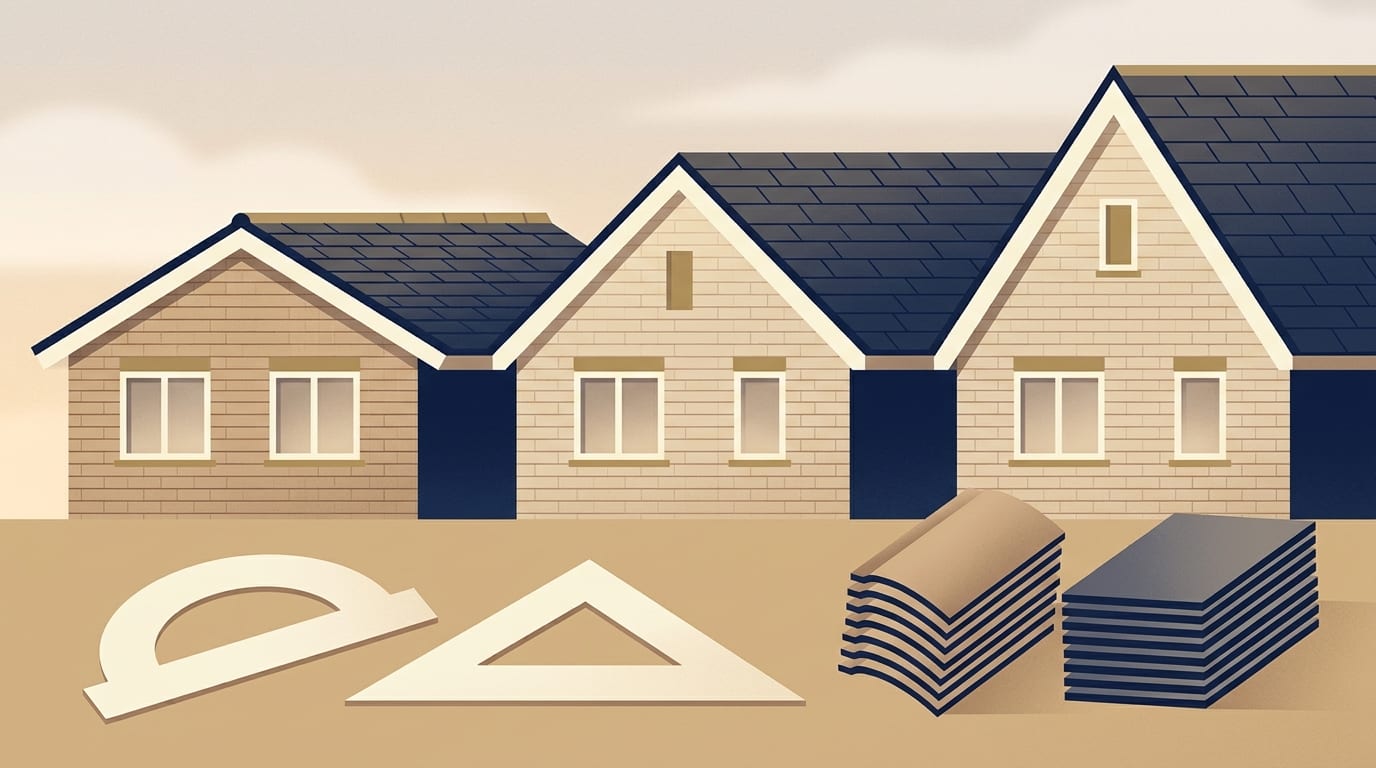
The eaves are the lowest part of your roof, which projects over the wall and directs rainwater away from the brickwork so it does not touch the walls. They are also where the roof covering meets the edge of the building, meaning the felt underneath is exposed and can easily perish over time. If your eaves felt has rotted or torn, typical 2026 prices put a professional replacement at around £450 on average.
What the eaves of a roof are
The eaves are the roof edges that extend past a wall's face. If you stand outside your house and look up at the point where a pitched roof meets the top of the brickwork, the section hanging over you is the eaves.
The very first horizontal row of slates or tiles resting on this lower edge is known as the eaves course. This course has to take the brunt of the weather as rainwater rushes down the roof slope and into the gutters. Beneath these concrete or clay tiles, the roof underlay (often called felt or membrane) stretches down to direct any trapped moisture safely away. Because the eaves form the boundary between the roof and the external walls, they are a critical area for weatherproofing your home.
The underside of the eaves is often closed with a horizontal board called a soffit, while the vertical board facing outwards at the ends of the roof timbers is called a fascia.
What the eaves do for the roof and the walls
The primary function of the eaves is keeping rain off your walls and preventing water from entering where the roof meets the wall. By throwing rainwater clear of the building, the overhang protects your brickwork, windows and doors from constant soaking. It can also shield a path around the building and reduce rain splatter on the lower walls.
However, the size of this overhang matters because it can significantly increase wind loading on the roof. For this reason, the eaves must be designed for local wind speeds.
The eaves also play a vital role in sealing the roof space. The underside of the eaves may be closed with a horizontal soffit that seals the gap between the rafters against vermin and weather. At the same time, the eaves overhang shelters the openings in the soffit that are designed to ventilate the roof space, allowing fresh air in while keeping the rain out.
Eaves felt and the eaves course
Roof felt sits under your roof battens and tiles to catch any water that blows underneath them. At the bottom of the roof, this felt has to bridge the gap between the internal roof structure and the external guttering. Eaves felt sits on that exposed area, so it tends to deteriorate or become brittle over time.
Older homes typically have traditional bitumen felt at the eaves. Modern properties usually have a plastic or uPVC tray beneath the felt to support it and prevent it rotting.
Eaves felt usually needs replacing because of age deterioration or wind damage, as the felt is at the exposed roof edge. It is also routinely replaced as part of a wider re-roof, or if the original installation was poor.
How the eaves ventilate the roof space
Roof space ventilation is essential in pitched roofs to prevent condensation, damp, mould and long-term structural damage. This is especially true in homes made more airtight by insulation and draught-proofing. Ask your roofer how the eaves ventilation on your roof is arranged.
The eaves are a crucial part of how a building breathes. The National Federation of Roofing Contractors (NFRC) published guidance note GN67 on 26 January 2026, stating that condensation should be addressed through recognised external ventilation methods such as eaves, ridge or purpose-made tile and slate ventilators. The NFRC position is that internal retrofit lap vents do not constitute compliant roof ventilation.
Soffits are where the ventilation holes are generally provided for the eaves. If you have any replacement work done at the roof edge, it must not reduce the ventilation provided to the roof void. If the existing system has vents installed, a similar system will need to be maintained to keep your loft dry.
Signs something is wrong at the eaves
Because you cannot easily see under your roof tiles, problems at the eaves often go unnoticed until water causes visible damage. Catching these issues early can save you from more expensive timber repairs.
Look out for these common signs of trouble at the roof edge:
- Damp patches that appear near the roof edge.
- Visible decay or rot on your fascia boards, soffits or the exposed ends of the rafters.
- Condensation, because older forms of eaves felt can restrict airflow if they decay.
- Gaps at the roof edge that allow birds or vermin to get into the roof space.
- Brittle or perished eaves felt, which a roofer can check.
If water gets into the roof void, it can cause serious damage to the timber. Wet rots are often associated with joist or beam ends that rot where they meet wet walls. In voids such as roofs where there is a lot of water held in the air, wet rots can occur. Poor ventilation and poor weather protection will lead to wet rot damage.
Broken roof tiles, blocked gutters and leaking water pipes provide sources of excess moisture. However, wet rot will not spread beyond the area of dampness. Dry rot needs a moisture content above 20 per cent to develop. If you find rotten timber in your roof, a specialist will need to tell you which type of rot you are dealing with.
What a roofer does when the eaves need repair
Never attempt to climb on your roof or work at the eaves yourself. Working at height is dangerous, and the Health and Safety Executive (HSE) clearly states that contractors must fit edge protection to the eaves of any roof, and on terraced properties to the rear as well as the front. You should hire a professional roofer and expect scaffolding to be a necessary part of the job.
When a roofer replaces damaged eaves felt, the job involves the following:
- Erecting scaffolding or safe edge protection to reach the roof edge securely.
- Removing enough roof tiles to reach the eaves.
- Cutting out and removing the defective old eaves felt.
- Fitting a modern plastic eaves felt tray, securing it with nails so it overhangs safely into the guttering.
- Fitting the tray so that it supports the felt.
- Re-laying the tiles and ensuring the roof covering is secure and watertight.
On smaller repairs, the roofer will only strip and fix the affected area. Keep in mind that nobody can see rotten timber until the old covering is off. Estimates for refurbishment work can change once the main covering of tiles or slates is removed to expose the structure underneath, so a good quote will always explain how any extra timber repairs will be priced.
Typical 2026 prices for eaves felt replacement
Small eaves repairs are usually charged on a day rate, while larger strips might be priced per square metre or by the overall size of the roof edge. Roofers typically charge £200 to £275 per day for labour in the UK.
The scaffolding required for safe access is often a separate and significant line on your quote. Waste removal and VAT may or may not be included, so you must ask the contractor to clarify this before you agree to the work.
The table below shows typical costs and timings for replacing eaves felt, based on the type of roof you have.
|
Roof type |
Typical price |
Estimated duration |
|---|---|---|
|
Gable roof |
£350 to £450 |
4 to 6 hours |
|
Hip roof on a terraced home |
£350 to £450 |
4 to 6 hours |
|
Hip roof on a semi-detached home |
£400 to £500 |
5 to 7 hours |
|
Hip roof on a detached home |
£450 to £650 |
6 to 8 hours |
These figures are typical published prices for 2026. Local quotes will differ based on the exact size of your roof, scaffolding costs, and where you live, with prices generally higher in London and the South East.
Rules and permission for eaves work
Eaves felt replacement does not usually need planning permission or building regulations approval. The Planning Portal states that replacing a fascia board or soffit will not normally need building regulations approval, and maintenance of a fascia generally does not require planning permission. However, if you live in a listed building or a designated area, you must check with your local planning authority first.
If your eaves repair turns into a larger roofing project, stricter rules apply. Repairs or re-covering are generally exempt from building regulations where less than 25 per cent of the total building envelope and less than 50 per cent of the roof is affected. Above that, building regulations approval is needed and the roof insulation may have to be upgraded.
Approval is also needed for structural alterations, if a new covering increases the weight of the roof by 15 per cent or more, or if its fire performance is significantly different. Rafters are the timbers that form the main pitch to the roof and support the tiles and battens.
In England, if you are building an extension, it cannot be higher at the eaves than the existing eaves. Where an extension comes within two metres of the boundary, the eaves height cannot exceed three metres. For loft conversions, the enlarged roof must not exceed the height of the existing roof, and the eaves of the original roof must be maintained or reinstated. In Scotland and Northern Ireland, rules differ, so you should check directly with your local council rather than guessing.
Consumer rights and roofing schemes
When hiring a tradesperson, you are protected by the Consumer Rights Act 2015. This law states that all work must be done with reasonable care and skill. If the repair at your eaves is not up to standard, you have the right to ask for it to be put right or for your money back.
A quote is a fixed price, whereas an estimate is not and can change once the work begins. If you agree to a contract at home, by phone or online, it normally carries a 14-day cooling-off period. However, if you ask for the work to start inside that period, you must pay for what has been done. Paying by credit card gives you Section 75 protection on purchases over £100 and up to £30,000. If you end up in a dispute with a roofer, Citizens Advice is the best place to go for guidance.
You can also look for roofers registered with official schemes. CompetentRoofer is a government-authorised competent person scheme run by the NFRC. Registered roofers can self-certify roof refurbishment in England and Wales, meaning you should receive a building regulations compliance certificate. Otherwise, the work must go through council building control or a registered building control approver. TrustMark is the government-endorsed quality scheme for work in and around the home. Membership of these schemes is a good sign, though it is not a guarantee, so always check the scheme's own register to confirm a firm is actually listed.
Common questions
What is eaves protection?
Modern properties usually have a plastic or uPVC tray beneath the eaves felt to support it and prevent it rotting. Ask your roofer what they propose for your roof.
What is the roof overhang called?
The roof overhang is simply called the eaves. It is the part of the roof that extends past the external walls to throw rainwater clear of the brickwork and shelter the building from severe weather.
Do I need scaffolding for eaves repairs?
You should expect it. The contractor erects scaffolding as part of the job, and HSE guidance says edge protection must be fitted to the eaves of any roof.
Can rotten eaves felt cause condensation?
It can. Older forms of eaves felt can restrict airflow if they decay, and poor ventilation can let excess moisture build up. Ask a roofer to check the eaves.
What to do next
If you suspect your eaves felt has perished or you have spotted damp near your roof edge, taking action early will stop the damage spreading to your roof timbers. Follow these steps to get the problem sorted properly:
- Take photos of any visible damage from the ground, such as sagging felt, peeling fascia boards or damp patches on your walls.
- Select up to three roofing contractors to look at the job and invite written quotes, but do not automatically take the cheapest option.
- Make sure you receive a proper written quote, except possibly for very small emergency repairs.
- Ask the roofers to confirm if the price includes scaffolding, waste removal and VAT, and how they will price any rotten timber they find once the tiles are lifted.
- Ask what eaves felt and support the roofer proposes, and why.
- Ask for a guarantee, noting that the NFRC recommends an Insurance-Backed Guarantee that protects you even if the firm ceases trading.
- Agree payment terms before work starts, avoid paying large upfront deposits in cash, and never hand over the final payment until the job is completely finished.
When you are ready to compare itemised quotes and get your roof edge watertight again, you can find a roofer near you to inspect the damage safely and explain exactly what needs to be done.
Find a top rated roofer near you
3,907 roofers across the UK, each ranked on their Google rating and the number of reviews behind it. Start with your county: