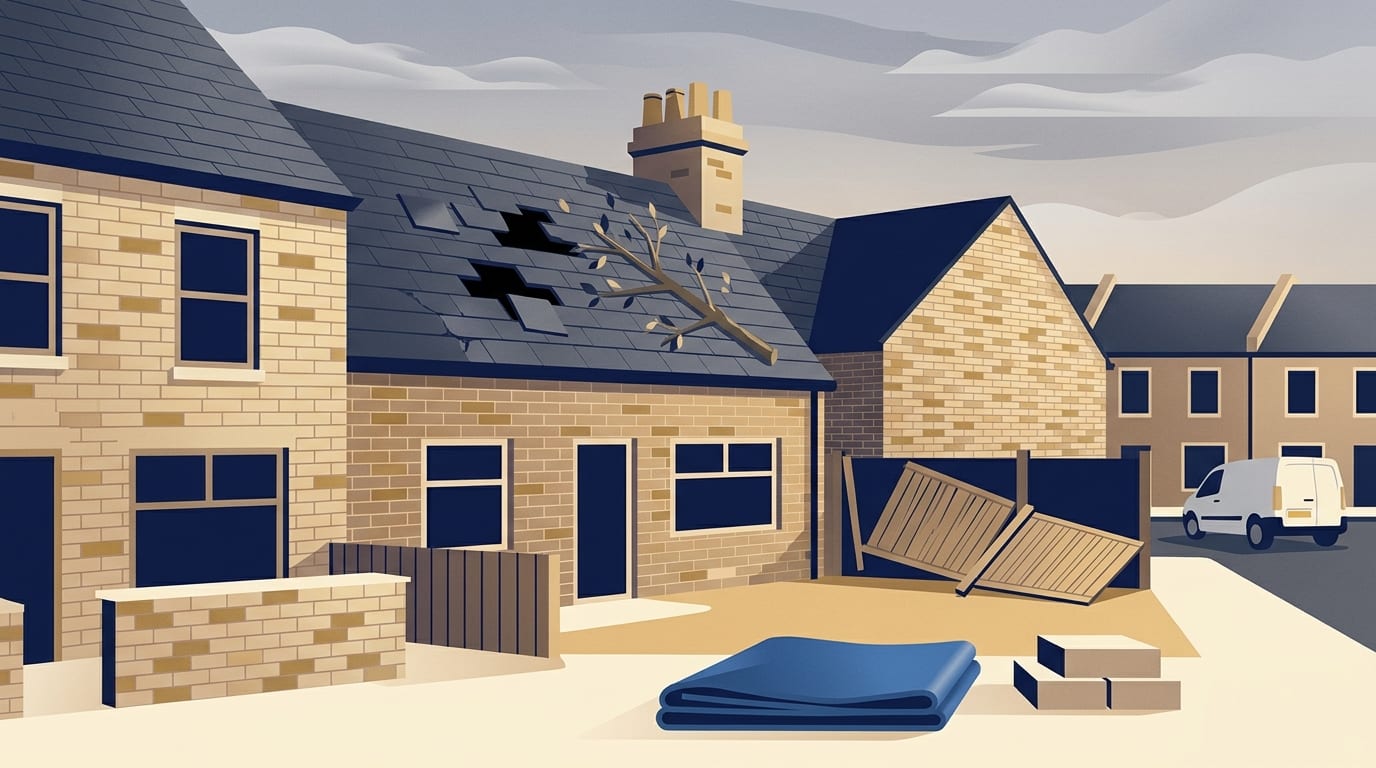
When a storm damages your roof, the immediate priorities are to stay safe, stop more water getting in and contact your insurer. You need to record the damage before moving anything, but you must do this without climbing onto the roof yourself. Getting a temporary make-safe repair done quickly will protect your home while you arrange permanent quotes.
Stay safe first
Nobody should go up on the roof to check the damage. The Health and Safety Executive states that all work on roofs is highly dangerous, even if a job only takes a few minutes. They also note that almost one in five deaths in construction work involve roof work. The people carrying out roof work must be trained, competent and instructed in the precautions required.
If water is coming in near light fittings, plug sockets or the consumer unit, keep well away from them. You should call a registered electrician to make the power safe. Do not touch wet electrical fittings or try to isolate them yourself.
Check from the ground and from inside
You can assess most of the damage safely without using a ladder. Stand in your garden or on the pavement and look up at the roof covering. You are looking for obvious gaps, slipped tiles, or debris that has fallen to the ground.
If you have a pitched roof, check the ridge tiles along the very top and the verges at the exposed edges of the gable end. You should also look at the eaves, which are the lowest edges of the roof, and the valleys where two roof slopes meet. Lead flashing is used to seal joints around chimneys and in valleys, and high winds can sometimes lift it out of place.
If you have a flat roof, you might not be able to see the surface from the ground. Flat roof systems are usually made of built-up felt, which is usually torch-on, EPDM rubber, GRP fibreglass, single-ply or liquid coatings. Look for damaged fascias, soffits and guttering where the flat roof meets the walls.
Inside the house, go into the loft if it is safe and well lit. Look for daylight showing through the roof covering. Check for damp patches on the timber battens that hold the tiles in place, drips, or water pooling on the loft insulation. If you can see torn underlay, which is often called felt or membrane, water will likely find its way in.
Here are the main things to look out for during your ground and loft checks:
- Missing or broken concrete or clay tiles
- Displaced natural or fibre cement slates
- Dislodged ridge, hip or valley tiles
- Torn underlay visible from inside the loft
- Damaged lead flashing around the chimney
- Broken fascias, soffits and guttering
Take photos before anything is moved
Your insurer will want to see exactly what the storm did before anyone starts clearing up. Take clear photographs of the damage from the ground. Photograph any fallen tiles, branches or debris exactly where they landed in your garden.
If water has come inside, take pictures of the leak and any damaged belongings. Write down the date and time the damage happened, and make a note of what was ruined.
If you have to pay a local roofer to make a temporary repair to stop water pouring in, keep the receipt to show your insurer. Having a clear record of the immediate aftermath helps support your claim.
Tell your insurer before you agree work
If the damage is weather related, you must contact your insurer before agreeing to any work. Insurers often have approved traders and may arrange repairs themselves. If you hire a roofer for a permanent repair before speaking to your provider, you may cause problems with your claim, so check what your policy says.
The Financial Ombudsman Service says that home and buildings insurance policies usually cover financial loss caused by storm damage. However, many policies exclude certain types of damage such as wear and tear or gradual damage. You can read more about what policies cover in our guide on whether home insurance covers a leaking roof.
When you call your insurer, ask exactly what your policy covers and whether they will send their own assessor. Ask if you are allowed to instruct a local roofer to carry out a temporary repair to prevent further loss.
Arrange a temporary repair
A temporary repair is a fast make-safe measure to stop water ruining your home while you wait for a permanent fix. This might involve pinning a tarpaulin over a hole or sealing a slipped tile. The roofer may make this temporary repair straight away and finish the permanent repair once the weather improves or the right materials are available.
When you book this work, ask the roofer whether the temporary cost will be deducted from the permanent repair quote. Sometimes these costs are deducted, but they might not be, so it is best to know where you stand.
Do not ask a roofer to carry out permanent work during high winds or heavy rain. The timber deck on a flat roof, or the wooden battens on a pitched roof, need to be dry before new coverings are permanently fixed.
What temporary repairs and call-outs cost
Small repairs are usually charged at a fixed price or a day rate. Larger permanent work is priced per square metre plus access.
This table shows typical costs for emergency call-outs and temporary repairs.
|
Service |
Typical cost |
|---|---|
|
Emergency roofer call-out |
£150 to £300 |
|
Temporary roof repair (make-safe) |
£150 to £500 |
|
Out of hours, weekend or bank holiday surcharge |
£100 to £300 or more |
|
Scaffolding on a two-storey roof |
£500 to £1,200 |
These figures are typical 2026 prices, and local quotes will differ. Prices are higher in London and the South East. Estimates vary. Some put a same-day temporary make-safe at £150 to £400, with a permanent fix quoted separately, while others put a temporary repair at £150 to £500. Out of hours and bank holiday call-outs can sit at the top of the range or above it, so ask for the out of hours cost before you agree. Scaffolding is often a separate and significant line on a quote.
Beware of cold callers after a storm
After high winds, rogue traders often knock on doors offering quick fixes. Longstanding trading standards advice from Devon County Council warns homeowners not to agree to have work done by anyone who cold calls. Be suspicious of anyone who says your property needs repairs without you asking.
Traders may claim a branch or tile is dangerous to pressure you into a quick decision. The official advice is to ignore them if they make such claims on your doorstep. According to the Citizens Advice consumer service, they shouldn't put pressure on you to pay straight away if they're genuine.
Here are the best ways to handle unsolicited offers of roof work:
- Do not agree to any work on the doorstep
- Ask friends and family for recommendations instead
- Confirm the trader's name and address
- Report rogue traders to the Citizens Advice Consumer Service on 0808 223 1133
Cold callers who have spotted a loose tile or moss from the street often demand cash only, ask for big deposits, and provide no address. They may also try to sell you a whole new roof for a local fault, or offer unnecessary pressure washing as maintenance. Roof coating and painting claims are another common tactic to watch out for.
Getting the permanent repair done properly
Once your home is watertight, you can arrange the permanent repair. Citizens Advice recommends you try to get written quotes from at least three traders. A quote is a fixed price, whereas an estimate can change, so insist on a firm quote in writing. Vague one-line quotes are a warning sign.
When you compare your quotes, check that they include scaffolding, waste removal and VAT. Nobody can see rotten timber until the old covering is off, so a good quote says how extras will be priced. Under the Consumer Rights Act 2015, work must be done with reasonable care and skill. If it is not, you can ask for it to be put right or for money back.
Here is what a good roofing quote should include:
- A fixed price rather than an estimate
- Scaffolding costs itemised separately
- Whether waste removal is included
- Whether VAT is included
- How extras for hidden rotten timber will be priced
- Details of any insurance-backed guarantees
Citizens Advice states you should pay by card or bank transfer and don't pay with cash. Paying by credit card gives you Section 75 protection on purchases over £100 and up to £30,000. If a deposit is unavoidable on a long job, don't agree to more than 25 per cent. Arrange staged payments and only make the final payment when the job is finished.
You can check if a roofer is registered with CompetentRoofer, a government-authorised competent person scheme run by the National Federation of Roofing Contractors. Registered roofers can self-certify roof refurbishment in England and Wales, and the customer should receive a building regulations compliance certificate. Otherwise the work goes through council building control or a registered building control approver. You can also check the TrustMark register, which is the government-endorsed quality scheme for work in and around the home. Membership is a good sign, not a guarantee.
If your claim is turned down
If your insurer rejects your claim, ask for their reason in writing. If a claim is rejected for wear and tear or gradual damage, the insurer has to prove that the exclusion applies, for example with an inspection report.
If you disagree with their decision, you can take your complaint to the Financial Ombudsman Service. The Ombudsman works out the cause of the damage. If a local roofer tells you the damage was definitely caused by the storm, ask them to put that in writing to support your case.
A guarantee from the roofing firm alone is only as good as the firm, and gives little protection if the firm folds. An insurance-backed guarantee can protect you if the original company goes out of business before putting a defect right, so ask whether one is available. If you have a dispute, Citizens Advice is the place to go.
Common questions
How much does an emergency roofer cost?
Typical 2026 prices put an emergency roofer call-out at £150 to £300 and a temporary repair at £150 to £500, though local quotes will vary. Attending out of hours, on a weekend or on a bank holiday adds a surcharge of £100 to £300 or more. You can read more about typical emergency roofer call-out costs to see what to expect.
Will I need building regulations approval for a roof repair?
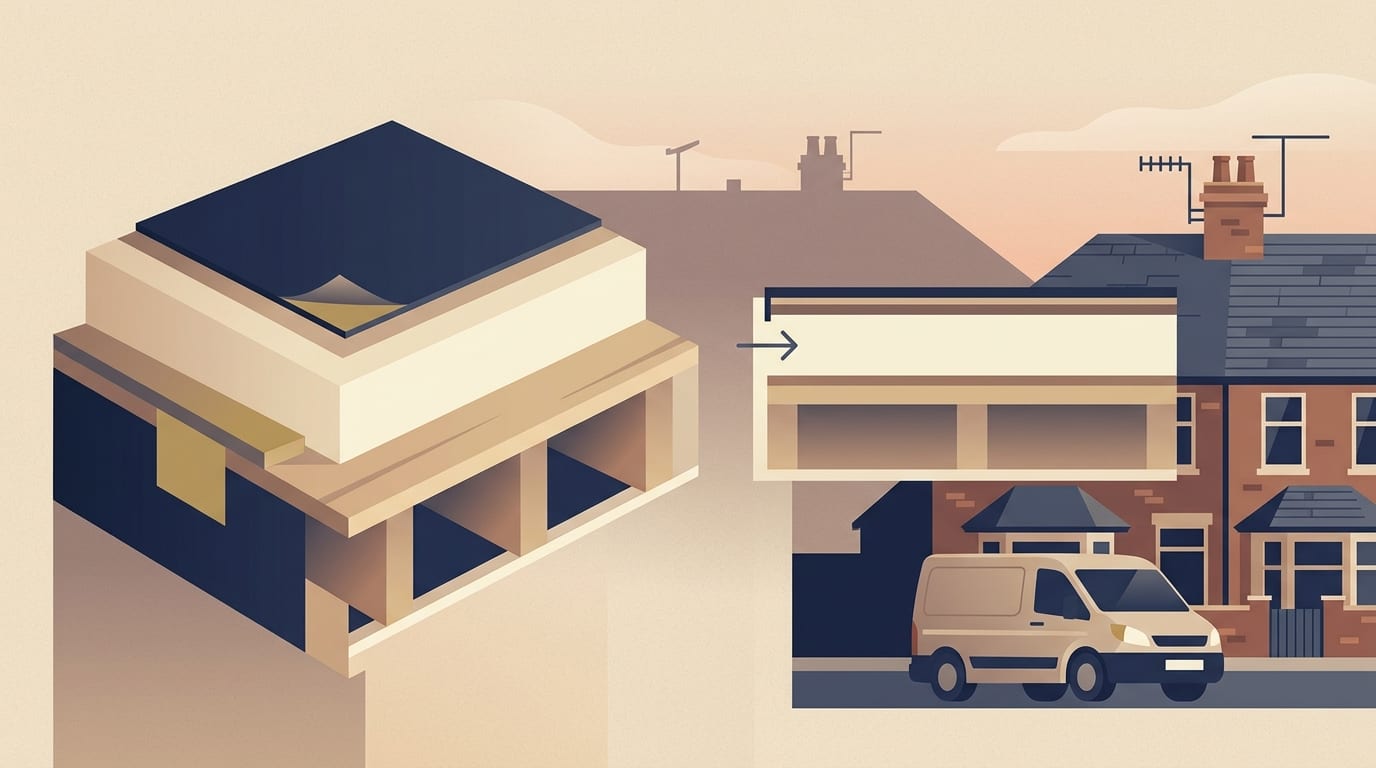
In England, repairing or re-covering a roof does not normally need a building control application if less than 25 per cent of the building envelope and less than 50 per cent of the roof is affected. Above that, approval is needed and the insulation may have to be upgraded. A warm roof has insulation above the deck, while a cold roof has it between the joists. Rules differ in Scotland and Northern Ireland, so check with your council rather than guessing.
Do conservatory roofs need building regulations approval?
Replacing a glazed or polycarbonate conservatory roof with a solid one takes the conservatory out of its exemption, so building regulations apply to the new roof. Approval is also needed for structural alterations, where a new covering performs significantly differently in fire, or where it adds 15 per cent or more to the weight.
What is a cooling-off period?
Contracts agreed at home, by phone or online normally carry a 14-day cooling-off period. However, if you ask for emergency work to start inside that period, you must pay for what has been done.
Do I need a whole new roof after a storm?
Being sold a whole new roof for a local fault is a common trap. If the rest of the roof is in good condition, replacing a few slipped tiles or repairing a section of lead flashing is usually enough. A full replacement is only the honest answer if the materials have reached the end of their lifespan or the underlying timbers are severely damaged.
Your next steps
Dealing with a damaged roof is stressful, but taking the right steps in the right order will protect your home and your money. Use this checklist to stay on track when dealing with storm damage.
- Stay on the ground and keep away from wet electrics
- Take photos of the exterior damage and any interior leaks
- Call your insurer to check your cover and find out if they want to use their own approved traders
- Arrange a temporary make-safe repair if water is getting in
- Get three written quotes for the permanent repair
When you are ready to arrange permanent repairs, take your time to compare local quotes and find a roofer near you who can do the job properly.
Find a top rated roofer near you
3,861 roofers across the UK, each ranked on their Google rating and the number of reviews behind it. Start with your county: