If you have a complaint about a roofer, act early, put everything in writing and keep a record of dates. Most problems start to get resolved with a calm written complaint to the firm that did the job. Under the Consumer Rights Act 2015, tradespeople must carry out their work with reasonable care and skill. If they fail to do so, you can ask for the problem to be put right or for your money back.
Do not panic and do not pay the final bill in a hurry
When a roofing job goes wrong, your first instinct might be to argue with the tradesperson or refuse to pay. The best approach is to stay calm and communicate clearly while you sort it out. If the work is still ongoing and you spot a serious issue, ask the roofer to pause.
Small repairs are usually a fixed price or a day rate, while larger work is priced per square metre plus access. Scaffolding is often a separate and significant line on your bill. Only make the final payment when the work is finished and you are satisfied.
Paying the final balance can signal that you accept the job as finished, so do not ignore the invoice. Tell the roofing firm in writing exactly what the problem is, and ask Citizens Advice where you stand before you withhold any money.
Gather evidence and paperwork
Before you formally complain, you need a clear record of what has gone wrong. Start by collecting every piece of paperwork relating to the job. This includes the original quote, any written estimates, emails, text messages and invoices.
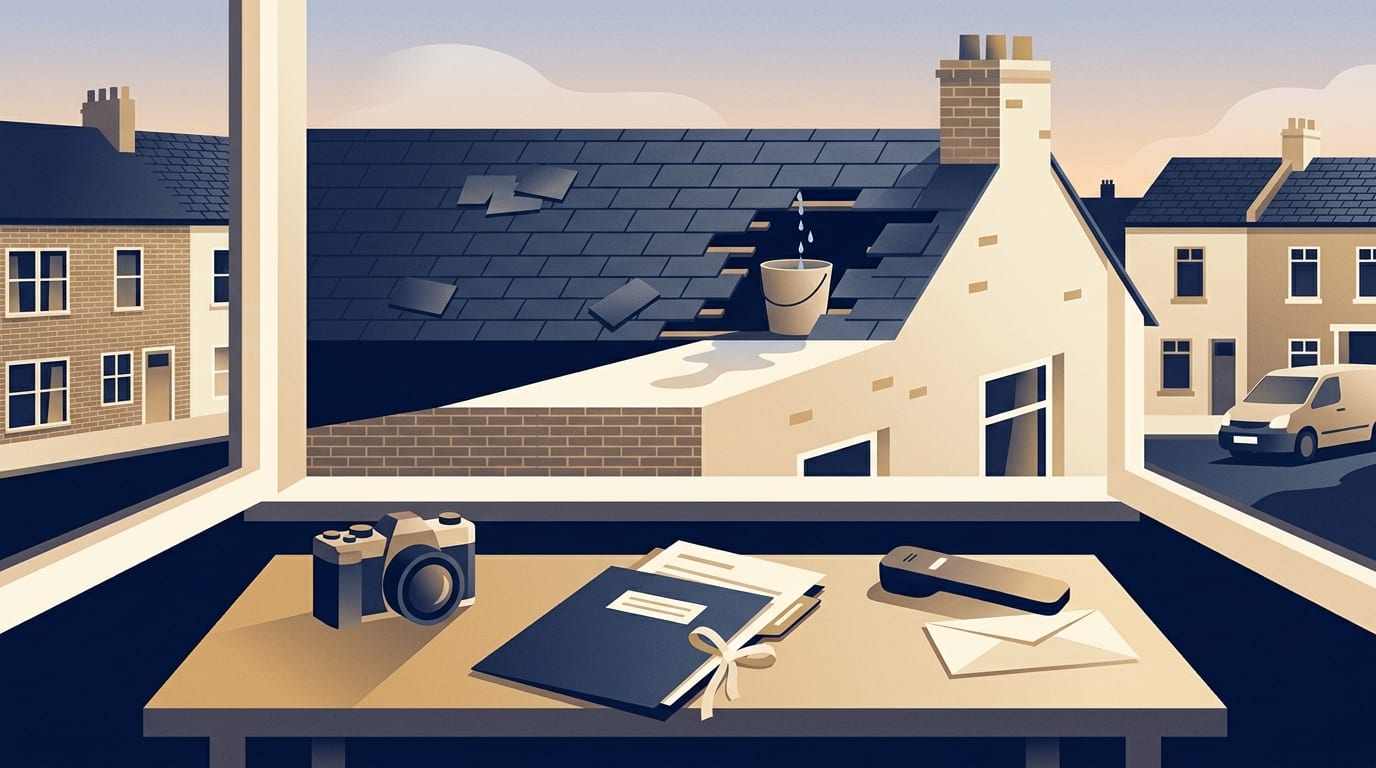
Next, photograph the problem. Never climb on a roof, use ladders at height or attempt to inspect structural work yourself. Take clear photographs from the ground or by looking out of an upstairs window. If the issue is a leak, you can safely take photos of damp patches or dripping water from inside your loft.
Note down exactly what happened, keeping a careful log of dates and times. Record when the roofers arrived, when they left, and when you first noticed the defect. If the main contractor passed the work to a subcontractor, you must still raise the problem with the trader who originally arranged the job.
Defects often relate to specific parts of the roof, so it helps to use the correct terms when noting the damage. On a pitched roof, you might spot issues with concrete and clay tiles, or natural and fibre cement slate. The problem could be at the ridge, the hip, the valley, the verge or the eaves.
If you have a flat roof, note whether the issue is with the timber deck or the covering. Flat roof systems include built-up felt, EPDM rubber, GRP fibreglass, single-ply and liquid coatings. Mention if you have a warm roof, which has insulation above the deck, or a cold roof, which has insulation between the joists.
Complain in writing and say what you want
Most problems can be resolved without legal action if you communicate clearly. Make your complaint in writing so you have a permanent record. An email or a letter keeps a record that the firm received your message.
Under the Consumer Rights Act 2015, any tradesperson working on your home must carry out the job with reasonable care and skill. State clearly in your letter that you do not think they have met this standard. Cite the legislation by name, as Citizens Advice suggests.
Tell the roofer exactly what you want them to do to resolve the situation. If they supplied goods as well as the service, such as fitting new lead flashing or replacing roof underlay, you can ask them to fix the problem. If you only bought a service, you can ask for a refund and tell them to stop work.
You can also ask for a financial discount. Citizens Advice suggests asking for about 5 per cent off as a goodwill gesture to compensate for the hassle. The roofing firm may refuse this.
The rights that apply to poor workmanship
Your consumer rights protect you even if you did not sign a formal contract. A contract exists as soon as you agree to the work, even if it was not written down. Anything you discussed with the roofer before you agreed to the job counts as part of that contract.
This means if the roofer verbally promised to replace the battens or fit new fascias, soffits and guttering, they must do so. If they fail to deliver what was discussed, they have breached the contract. When a job is done poorly, ask the trader to put it right.
If you eventually agree that a refund is the only fair outcome, the law states you should receive that money within 14 days of the agreement. Always ask for itemised prices when discussing refunds or repairs, so you can clearly see the value of the disputed work.
Work not finished, late or overpriced
Delays and unexpected costs are common causes of a complaint about a roofer. If the work is not finished on time, you must normally give the trader a second chance to complete it. The only exception is if you made it explicitly clear before the job started that the deadline was essential.
When giving a roofer a second chance, you must set a firm completion date in writing. If they miss this new deadline, Citizens Advice can explain your options.
Disputes over money usually depend on the type of pricing you were given. A quote is a fixed price, and the trader generally cannot charge you more unless you agreed to extra work or the quote was an obvious mistake. An estimate is a rough guess, but the final price must still be reasonable.
Nobody can see rotten timber until the old covering is off, so a good quote always says how extras will be priced. Waste removal and VAT may or may not be included, so you must ask. Prices are also naturally higher in London and the South East.
Trade body and scheme complaints routes
If complaining directly to the roofing firm does not work, check if they belong to a professional trade body. If you used a National Federation of Roofing Contractors member, you will need to contact the member first and follow their own complaints procedure.
If that fails, the NFRC complaints procedure applies. Their Regional Managers offer conciliation, which means they will endeavour to reconcile a dissatisfied consumer with their member. It is important to remember that the contractor, not the trade body, provides the workmanship guarantee. You can find more detail in the guide on what NFRC and CompetentRoofer membership mean when hiring.
TrustMark is the government-endorsed quality scheme for work in and around the home. If your roofer is registered, their Scheme Providers must do their best to help resolve disputes between businesses and their customers. TrustMark itself does not investigate individual complaints, but it checks that scheme procedures were followed correctly. Membership is a good sign, not a guarantee.
CompetentRoofer is a government-authorised competent person scheme run by the NFRC. Registered roofers can self-certify roof refurbishment in England and Wales. Without a valid Building Regulations Compliance Certificate, Building Control can issue an enforcement notice requiring the roof to be altered or removed at your cost, and selling the property may become difficult.
In England, repairing or re-covering a roof does not normally need a building control application if less than 25 per cent of the building envelope and less than 50 per cent of the roof is affected. Above that, approval is needed and the insulation may have to be upgraded. Approval is also needed for structural alterations, where a new covering performs significantly differently in fire, or where it adds 15 per cent or more to the weight. Replacing a glazed or polycarbonate conservatory roof with a solid one takes the conservatory out of its exemption, so building regulations apply. Rules differ in Scotland and Northern Ireland, so check with your council.
Getting money back through your card
Paying for roof work by card gives you a powerful safety net if things go wrong. Section 75 can protect you if you paid by credit card.
Section 75 applies to credit card payments as long as you paid more than £100 and no more than £30,000. These limits apply to a single item, not the whole order. You usually cannot use Section 75 if you did not buy directly from the trader.
If you paid by debit card or charge card, you cannot use Section 75. Instead, you can ask your bank for a chargeback for the amount you paid on this card. No deadline is given for either route, so ask your card provider quickly.
If you agreed to the work at home, by phone or online, and the service costs £42 or more, you normally have a 14-day cooling-off period starting the day after the contract is made. If you ask for work to start inside that period, you will have to pay for what has been done.
The table below shows the financial limits that apply to different consumer protection rules.
|
Protection rule |
When it applies |
Financial limit |
|---|---|---|
|
Section 75 credit card claim |
When paying by credit card for a single item |
Over £100 and up to £30,000 |
|
Cooling-off period cancellation |
When agreeing to a service away from business premises |
Services costing £42 or more |
These are the limits Citizens Advice gives.
If the roofer has stopped trading or you hold a guarantee
Sometimes a roofing firm will go out of business before they finish the job or fix a mistake. If a company stops trading, you can use the guarantee or warranty which came with the item or contract to get repairs or a replacement.
You should also try to get the details of the administrator or receiver managing the closed company. If you paid by card, you may be able to request a chargeback, though your bank or credit provider might not agree to do it.
Some roofers provide a guarantee backed by an insurance policy, which is designed to still be honoured if the firm folds. A guarantee that is not insurance-backed is worthless if the firm folds. For a complete breakdown of how these policies work, read our guide to roofing guarantees and insurance-backed warranties explained.
Alternative dispute resolution and court
If you cannot reach an agreement with the roofer and they are not part of a trade scheme, you can look into alternative dispute resolution. This involves an independent third party mediating the problem to help both sides reach a fair outcome without going to court.
If mediation fails, your final option in England and Wales is to apply to a county court to claim money you are owed by a person or business. You can make this claim online or by post.
You may not need to attend a hearing if the other party agrees to pay or you reach an agreement through mediation. The court may arrange free mediation depending on the amount claimed. The legal processes differ in Scotland and Northern Ireland.
Reporting an unsafe roof or a rogue trader
Some roofing work is actively dangerous. If the work has left the building or a structure unsafe, act fast. Report dangerous buildings or structures to your council immediately. If you think you are in immediate danger, leave the building.
You should also report the business to Trading Standards by contacting the Citizens Advice consumer service. If you need to discuss a cooling-off period or a cancellation issue in England, the Citizens Advice consumer helpline number is 0808 223 1133.
Watch out for red flags that suggest you are dealing with a rogue trader. These include:
- Cold callers who have spotted a loose tile or moss from the street.
- Pressure to decide today.
- Demanding cash only or big deposits upfront.
- Providing no physical address for the business.
- Giving vague one-line quotes with no detail.
- Selling a whole new roof for a local fault.
A trustworthy roofer will behave very differently. Good advice and honest business practices include:
- Providing three written quotes to help you compare.
- Giving itemised prices so you know exactly what you are paying for.
- Showing proof of their insurance before work starts.
- Agreeing to staged payments rather than demanding money upfront.
- Asking for the final payment only when the job is completely finished.
Common questions
Can I withhold payment if the roof leaks?
Only make the final payment when the job is finished and you are satisfied. If you are thinking of withholding money, ask Citizens Advice where you stand first, do not ignore the invoice, and write to the firm explaining the problem.
What happens if I have no written contract?
A contract exists even if it was not written down. Verbal agreements and things discussed before you agreed to the work count as part of the legal contract. Proving what was said can be difficult, which is why a proper written quote is always recommended.
How long does a roofer have to fix a mistake?
If work is not finished on time, you must normally give the trader a second chance unless you made clear the deadline was essential. Set a firm completion date in writing.
Can a roofer charge more than their quote for extra timber?
If you have a fixed written quote, the trader generally cannot charge more unless you explicitly agreed to extra work, or the quote was an obvious mistake. Because nobody can see rotten timber until the old covering is off, a good quote will state exactly how extras will be priced.
Next steps to resolve your roof complaint
Taking on a dispute with a tradesperson is stressful, but following a clear process will protect your money and your home. Before you do anything else, run through this checklist to ensure you are ready to make your complaint.
- Only make the final payment when you are satisfied, and ask Citizens Advice before withholding money.
- Gather all paperwork, including the original quote, estimates and invoices.
- Take clear photographs of the defect from the ground or inside the loft.
- Write a formal letter or email citing the Consumer Rights Act 2015.
- Set a firm written date for the roofer to put the work right.
- Check if the firm is registered with the NFRC, TrustMark or CompetentRoofer.
- Contact your card provider immediately if you need to use Section 75 or chargeback.
- Call your local council immediately if the roof structure is actively dangerous.
Dealing with a botched roofing job is incredibly frustrating, but knowing your rights puts you back in control. Keeping your communications in writing gives you a clear record. If the relationship with your original contractor has completely broken down and you need a professional to step in and secure your home, you can find a roofer near you to assess the damage and provide a trustworthy quote for putting it right.
Find a top rated roofer near you
3,861 roofers across the UK, each ranked on their Google rating and the number of reviews behind it. Start with your county: