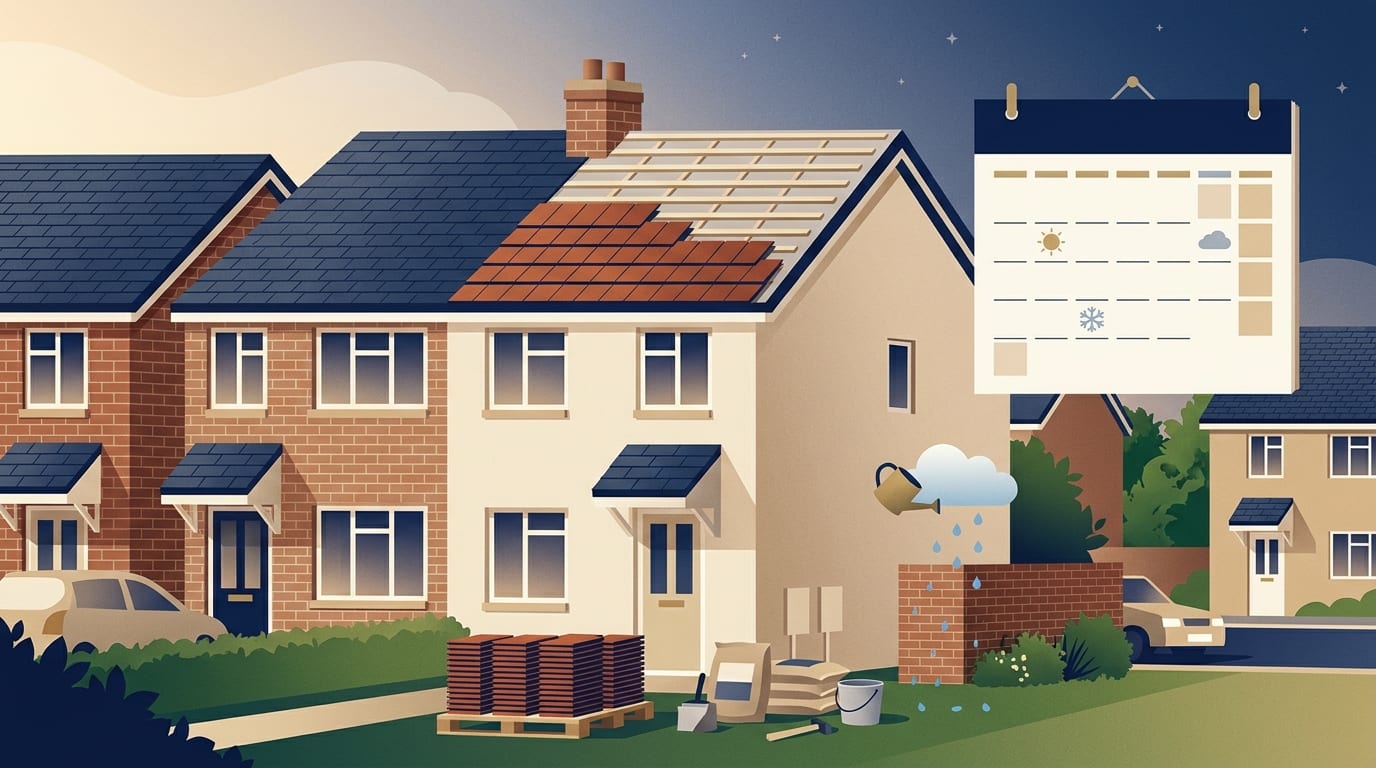
For a planned job, late spring to early autumn gives the most settled weather for a roof replacement. A sound roofing firm can work safely through the year, however, and a failing roof should never wait for the calendar. The best time to book your work depends on the materials your roof needs and how quickly you need the job done.
Is there a best time to replace a roof?
Most roof work happens in the summer because the conditions are generally more favourable. Late spring to early autumn is often considered the best time for a roof replacement because the weather is generally more predictable and conducive to outdoor construction. A dry run of days makes it easier to strip the old materials and get the new covering watertight without rushing.
Professionals may be easier to book in the off-season, as their schedules may be freer than usual. Quieter spring periods might bring competitive quotes, though this is a possibility and not a promise. The season alone does not guarantee a lower price, and there is no reliable percentage saving for booking in any particular season.
It is a common mistake to assume that winter is a quiet time for roofing firms. TrustMark's marketing guide for roofers has a table of demand across the year, and it shows that winter is the busiest period, with late autumn also very busy. The table describes how busy roofers are, which includes repair and emergency work as well as planned replacements.
The table below shows the typical demand for roofing services across the seasons.
|
Season |
Months |
Demand level |
Notes |
|---|---|---|---|
|
Winter |
December to February |
PEAK - Highest demand |
|
|
Spring |
March to May |
BUSY |
|
|
Summer |
June to August |
MODERATE |
Fewer emergencies |
|
Late Autumn |
October to November |
VERY BUSY |
|
The TrustMark page is dated 2025, and local availability will differ. The table does not label any period of the year as quiet.
Why weather matters for pitched and flat roofs
The weather dictates how safely a roofing contractor can work and how well certain materials perform before they dry. High winds, heavy rain and ice make working at height treacherous. The Health and Safety Executive states that all roof work is highly dangerous, which is why you must never attempt repairs or replacements yourself. Checks from the ground or from inside the loft are fine, but stay off the ladders.
Pitched roofs are the traditional sloped roofs seen on most UK houses. They are usually covered in concrete and clay tiles, or natural and fibre cement slate. A roofer fixes these individual pieces to horizontal timber strips called battens, layered over a waterproof sheet known as underlay, which is often called felt or membrane.
The edges and junctions of a pitched roof have specific names you will see on a quote. These include the ridge at the top, the eaves at the bottom, the verge at the side, the hip where two slopes meet outwards, and the valley where two slopes meet inwards. Lead flashing is used to seal the joins against brickwork, such as around a chimney.
There is no widely quoted temperature limit for installing tiles or slate, unlike some flat roof materials. A roofer can replace a pitched roof in the colder months, provided the weather remains dry and safe.
Flat roofs are built differently and rely on a solid timber deck. A warm roof has insulation above the deck, while a cold roof has it between the joists. Modern flat roof systems include built-up felt which is usually torch-on, EPDM rubber, single-ply membranes, GRP fibreglass and liquid coatings. The temperature genuinely matters for some of these materials.
GRP fibreglass needs dry conditions and the right temperature to set. GRP generally needs temperatures above about 5 degrees C and a dry deck. You cannot lay it in the rain, onto a damp deck, or when it is too cold to cure properly.
Liquid systems are painted on and form a seamless waterproof layer. Low temperatures can make the liquid more viscous and thicker, which may slow curing times. On the other hand, extreme heat can dry liquid coatings too quickly, which may weaken their adhesion to the roof.
What the season does to your quote and schedule
Booking a roof replacement in the winter does not automatically make it cheaper, and the season does not come with a set discount or premium. What may change is how easily you can get a firm to start and how smoothly the job runs.
TrustMark's table puts summer demand at moderate with fewer emergencies, and winter at peak. That may make it easier to get a firm to start in summer, while in winter a planned replacement could face delays if urgent repairs take priority. Local firms vary, so ask.
When you ask for a quote, you need to know exactly what is included so you can compare prices fairly. Small repairs are usually a fixed price or a day rate. Larger work is priced per square metre plus access, and prices are generally higher in London and the South East. A good written quote will clearly itemise the following costs:
- The price of the tiles, slates or flat roof coverings.
- The daily rate or fixed price for the labour.
- Scaffolding, which is often a separate and significant line on the bill.
- Waste removal and skip hire costs.
- Whether VAT is included in the final figure.
Nobody can see rotten timber until the old covering is off. A good quote says exactly how extras will be priced if the roofer finds damaged joists or fascias, soffits and guttering that need replacing. Getting three written quotes is the best way to see what the work is likely to cost for your specific roof.
Building regulations and the paperwork you need
Replacing your roof often involves local council rules. In England, repairing or re-covering a roof does not normally need a building control application if less than 25 per cent of the building envelope and less than 50 per cent of the roof is affected. Above that, approval is needed and the insulation may have to be upgraded to modern standards.
Approval is also needed for structural alterations, where a new covering performs significantly differently in fire, or where it adds 15 per cent or more to the weight. Replacing a glazed or polycarbonate conservatory roof with a solid one takes the conservatory out of its exemption, so building regulations apply to the new roof. Rules differ in Scotland and Northern Ireland, so you must check with your local council rather than guessing.
CompetentRoofer is a government-authorised competent person scheme run by the National Federation of Roofing Contractors (NFRC). Registered roofers can self-certify roof refurbishment in England and Wales, and you should receive a building regulations compliance certificate. Otherwise, the work must go through council building control or a registered building control approver. Going without the building regulations certificate is a major mistake that will leave you with no paperwork when you come to sell your home.
You can also look for TrustMark, which is the government-endorsed quality scheme for work in and around the home. Membership is a good sign, not a guarantee, and you should check the roofer's status on the scheme's own register.
Planning ahead and getting the contract right
A roof replacement is a major expense, so you need time to check your options without feeling pressured. Under the Consumer Rights Act 2015, work must be done with reasonable care and skill. If it is not, you can ask for it to be put right or for money back.
Citizens Advice advises getting written quotes from at least 3 traders. A quote is a fixed price, whereas an estimate is not. If a deposit is unavoidable, do not agree to more than 25 per cent. Pay by debit or credit card where possible or by bank transfer, not cash. Paying by credit card gives Section 75 protection on purchases over £100 and up to £30,000.
Contracts agreed at home, by phone or online normally carry a 14-day cooling-off period. However, if you ask for work to start inside that period, you must pay for what has been done.
Citizens Advice also states you should try to get a written contract before work starts. It does not need legal wording, but it should cover start and finish dates, delays, tidying up and skip costs, materials and equipment, subcontractors and payment terms.
Ask the firm for a provisional start date. For flat roofing, allow extra time in the schedule and avoid firm completion dates when the forecast is uncertain. Put the start date in your contract and include a clear statement on what happens if the weather stops work. Get key agreements in writing so everyone knows where they stand.
Common mistakes and scams to avoid
Taking your time to plan a roof replacement helps you avoid common industry scams. The most frequent trap is the cold caller who knocks on your door claiming they have spotted a loose tile or moss from the street. You should always walk away from roofers who display these warning signs:
- Applying pressure for you to decide and sign a contract today.
- Demanding cash only or asking for a big deposit upfront.
- Providing a vague one-line quote with no breakdown of costs.
- Operating with no physical address or verifiable company details.
- Selling you a whole new roof when a simple local fault is the real issue.
Always ask for photos of the defect before agreeing to major work. Beware of aggressive roof coating and painting claims. Pressure washing is often sold as maintenance, but it can strip the protective finish from your tiles and force water under the underlay.
Finally, be very careful with long guarantees. A guarantee is worthless if the firm folds because it is not insurance-backed. Always ask for proof of insurance, agree staged payments, and ensure your final payment is only made when the job is completely finished.
When a roof cannot wait for good weather
If your roof is failing, you cannot wait for the summer to fix it. Water entering your home will rot the timber joists, damage your ceilings and cause damp problems that cost far more to fix than the initial defect. A sagging roof is a structural failure that requires urgent attention regardless of the season.
If a storm tears off your ridge tiles or strips away sections of lead flashing, you need a contractor immediately to make the building watertight. You can read more about what to do when a storm damages your roof to understand the first steps.
Sometimes a temporary repair is enough to get you through the worst of the winter weather. A roofer can secure a tarpaulin over the damage or replace a few slipped tiles to stop the leak. You can then plan the full replacement for the spring. Our guide to how much an emergency roofer costs explains what to expect when calling someone out at short notice.
Common questions
Can you replace a flat roof in the winter?
You can replace a flat roof in the winter, but the weather limits some materials. GRP fibreglass generally needs temperatures above about 5 degrees C and a dry deck, and liquid coatings can be thicker and slower to cure in the cold. Ask your roofer which system suits the conditions on the day.
How long does a roof replacement take in bad weather?
Bad weather will extend the time it takes to replace a roof. High winds, heavy rain and ice make working at height treacherous, so work may have to stop. You should always ask your contractor to explain their delay terms and allow extra time in the schedule if booking in the winter.
Can you replace a roof in the rain?
A sound roofer will not strip a roof in the rain, because it exposes the timber and the rooms below to water damage. Ask the firm in advance what it does if rain starts mid-job, and get the answer into the contract.
Do roofers charge more for winter work?
The season alone should not be treated as a reason for a higher or lower price. TrustMark's table puts winter at peak demand, so you may find it harder to book a firm, and getting three written quotes may take longer.
Next steps for your roof replacement
Replacing your roof is a major commitment, so taking the time to plan the job properly will protect your home and your money. Follow these steps to get started:
- Check your roof from the ground or inside the loft to see if a repair might solve the problem before committing to a full replacement.
- Decide whether you want to wait for the more settled weather of late spring to early autumn, or if the damage is too urgent to wait.
- Ask three local roofing firms for a written quote that breaks down the cost of materials, labour, scaffolding and waste removal.
- Check that the quoted price includes VAT, and ask how the firm will price any rotten timber they find once the old covering is off.
- Agree a provisional start date and put the terms for weather delays in a simple written contract.
- Keep your deposit at 25 per cent or less, and pay by debit or credit card for added protection.
A good roofing contractor will explain exactly how the weather will affect your specific materials and give you a realistic timeline for the work. When you are ready to get quotes, you can find a roofer near you to discuss your options and check their availability.
Find a top rated roofer near you
3,861 roofers across the UK, each ranked on their Google rating and the number of reviews behind it. Start with your county: