Taking down a chimney you no longer use is a major decision that depends entirely on what the structure still does for your home. Removing only the chimney stack above the roof is a much smaller job than removing the chimney breast inside the house. The right choice usually comes down to comparing the cost of a permanent removal against the price of ongoing repairs.
The difference between a chimney stack and a chimney breast
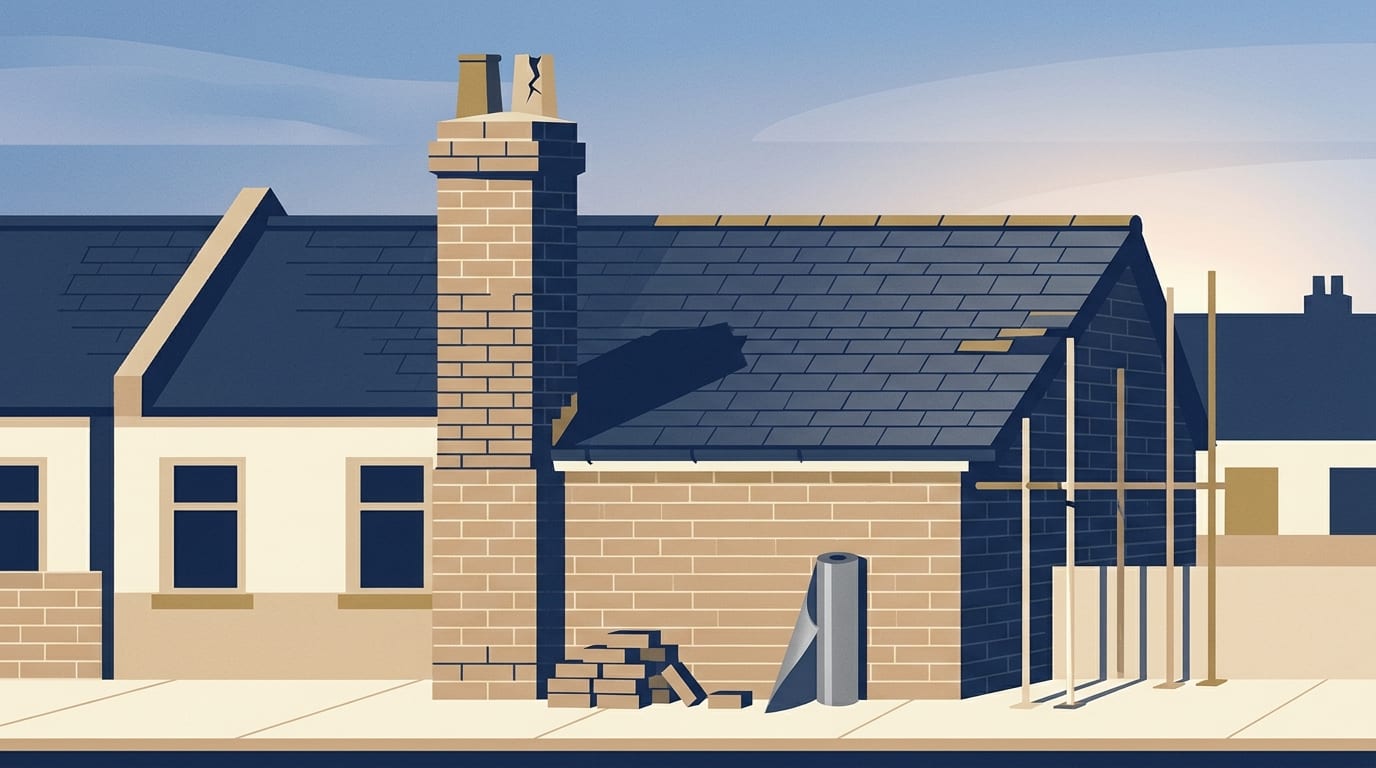
A chimney stack is the part of the chimney that sits above your roof. It is exposed to the wind and rain, and it usually holds the chimney pots. Roofers deal with the stack because it is integrated into your roof covering. If a stack is leaning, dropping mortar onto your patio, or letting water into your loft, the fault lies outside the house.
A chimney breast is the column of brickwork inside your house that contains the flue. It usually runs from the fireplace in your living room, up through the bedrooms, and into the loft. Builders and structural engineers deal with the chimney breast because it is a core part of the building structure.
Removing the stack is primarily a roofing job to stop leaks and remove unsafe masonry. Removing the breast is a major internal building project that creates dust, requires new plastering, and permanently alters your floorplan. You can remove the stack while leaving the breast in place, but if you remove the breast, you must either remove the stack or pay for structural supports to hold it up.
What removing a chimney stack costs
The price of taking down a chimney depends on how much of the structure you are removing. Taking down the external brickwork is a job for a qualified roofer working safely at height, while stripping out the internal breast requires a builder and significant structural planning.
This table shows typical 2026 prices to remove a chimney. The two sets of figures were worked out differently, so read them separately.
|
Job |
Typical cost |
|---|---|
|
Remove stack above roof and make good |
£900 to £2,000 |
|
Remove stack above roof alone |
£1,200 to £1,400 |
|
Full removal including the breast with support works |
£2,500 to £6,000 |
|
Structural engineer calculations |
£250 to £600 |
|
Building regulations application for breast removal |
£200 to £400 |
These figures are typical 2026 prices, and local quotes will differ. Prices are generally higher in London and the South East. Removing the stack above the roof takes one to one and a half days in some cases and one to three days in others. A full removal including the breast takes one to two weeks. Getting structural calculations drawn up takes around one to three days.
Scaffolding is often a separate and significant line on your quote. Scaffolding hire for this type of work is quoted at £300 to £400 in some cases, while in others scaffolding alone commonly adds £800 to £2,500. Scaffolding may be required if you live in a property with two or more storeys.
A structural engineer is normally needed if any part of the chimney will remain inside the house. The engineer calculates how the remaining masonry will be supported.
Removing a stack against repairing it
If your chimney leaks but you still use the fireplace, you have to repair it. If the flue is completely unused, you have a choice to make. Removing the stack can be cheaper than rebuilding it when nothing is connected to the flue and the external brickwork is failing.
This table compares the costs of common chimney repairs.
|
Repair job |
Typical cost |
|---|---|
|
Repoint the chimney stack |
£600 to £1,600 |
|
Renew lead flashing |
£400 to £1,100 |
|
Rebuild the stack above roof level |
£1,500 to £3,500 |
These figures are typical 2026 prices, and local quotes will differ. Repointing the stack takes one to two days, while completely rebuilding the stack above roof level takes two to four days.
Repointing involves grinding out the crumbling mortar between the bricks and replacing it with fresh mortar. This stops water soaking through the masonry. You can read more about chimney repointing and repair costs in our dedicated guide.
Lead flashing is the strip of metal used to seal the join between the roof covering and the brickwork. It flexes with the changing temperature, but over time it can split or pull away from the wall. Renewing failed flashing can stop rainwater getting in around the base of the stack.
If the bricks are crumbling at the surface (known as spalling) and the mortar is completely washed away, the stack may need to be rebuilt. The roofer will dismantle the brickwork down to the roofline and build it back up with new materials. If you never intend to use the chimney again, removal can be cheaper than rebuilding when the stack is failing and nothing is connected to the flue. The ranges overlap (£900 to £2,000 to remove, £1,500 to £3,500 to rebuild), so ask roofers to price both.
The middle option of capping a disused flue
If you have an unused chimney but you do not want to remove the stack entirely, there is a middle option. A roofer can reduce the stack to just above roof level, cap it with a ventilated cover, and re-flash the brickwork. Fitting a cowl or capping to a disused flue typically costs £150 to £400 and takes about half a day.
You must ensure the flue is allowed to breathe. Sealing a disused flue at both ends is the classic mistake that homeowners make. If you block the chimney pot at the top and brick up the fireplace at the bottom, trapped moisture condenses in the masonry. This trapped moisture is why the flue needs to breathe.
To prevent this, the roofer will fit a ventilated cap at the top to keep rain and birds out while letting air flow through. You must then leave an air brick or vent at the fireplace end inside the house. This airflow helps keep the masonry dry.
Building regulations and planning permission
Taking down a chimney stack alters the external appearance of your home, so you need to know where you stand with the local council. The Planning Portal says removing a stack may be permitted development, meaning no formal planning application is needed if certain limits and conditions are met.
However, rules may differ in a conservation area, so you should contact your local planning authority before starting work. If the building is listed, you will definitely need listed building consent. If you want absolute certainty before you hire a roofer, you can apply for a lawful development certificate to confirm the council's position.
Building regulations are a separate set of rules that deal with structural safety rather than visual appearance. The Planning Portal states that planning permission is not required to remove an internal chimney breast because the work does not affect the outside of the house, but building regulations approval is always needed because chimney breasts are part of the structure.
Removing the external stack above the roof may not require building regulations approval on its own. However, work on the internal stack or breasts does. In England, repairing or re-covering a roof does not normally need a building control application if less than 25 per cent of the building envelope and less than 50 per cent of the roof is affected. Above that, approval is needed and the insulation may have to be upgraded. Rules differ in Scotland and Northern Ireland, so tell your council what you plan to do rather than guessing.
Party walls and shared chimneys
If you live in a semi-detached or terraced house, your chimney stack is often shared with your neighbour. On a semi or terrace a Party Wall notice may be needed because the stack is often shared, so speak to your neighbour early.
If the chimney is shared, you may need to speak to your neighbour and obtain a party wall agreement before any work begins. The GOV.UK party wall guidance explains that the Party Wall etc Act 1996 may cover work such as cutting into a party wall, making a party wall taller, shorter or deeper, and removing chimney breasts from a party wall.
If you are taking down a shared stack, ask your roofer or builder how both sides will be kept watertight and whether a party wall process applies to your job.
Bats and other checks before work starts
Bats are protected, and repairing a roof can affect them, so it is worth knowing the rules before the roof is opened up.
According to Natural England guidance on GOV.UK, all bat species, their breeding sites and resting places are fully protected by law. Activities that can affect bats include repairing or replacing a roof. If you or your roofer find bats while dismantling the chimney, you must stop work immediately and call the National Bat Helpline for free advice.
Ignoring this law is a serious criminal offence. Penalties can include up to six months in prison and an unlimited fine. If bats are known to be present in your area, a bat survey and a Natural England mitigation licence may be needed before the roof is opened up. If you are unsure, call the National Bat Helpline before work starts.
What to ask the roofer or builder
When you are ready to find a professional, you need to know exactly what they are pricing for. Small repairs like fitting a cowl are usually a fixed price or a day rate. Larger work, like a full roof repair after a stack removal, is priced per square metre plus access. Always get three written quotes. A quote is a fixed price, whereas an estimate is just a rough guess.
A proper written quote should include:
- A clear statement of whether waste removal and skip hire are included.
- A separate line showing the exact cost of the scaffolding required.
- Confirmation of whether VAT is added to the final total.
- A description of how any hidden rotten timber will be priced once exposed.
- A schedule for staged payments, with the final payment only due when the job is finished.
Check the trader's credentials. CompetentRoofer is a government-authorised competent person scheme run by the National Federation of Roofing Contractors (NFRC). Registered roofers can self-certify roof refurbishment in England and Wales, and the customer should receive a building regulations compliance certificate. Otherwise the work goes through council building control or a registered building control approver. TrustMark is the government-endorsed quality scheme for work in and around the home. Membership is a good sign, not a guarantee, and you should always check the scheme's own register to verify a firm.
Under the Consumer Rights Act 2015, work must be done with reasonable care and skill. If it is not, the customer can ask for it to be put right or for money back. Citizens Advice can help if you have a dispute. If you agree to a contract at home, by phone or online, it normally carries a 14-day cooling-off period. If you ask for work to start inside that period, you must pay for what has been done. Paying by credit card gives Section 75 protection on purchases over £100 and up to £30,000.
You must also know how to spot a bad trader. You can read more on how to choose a roofing company, but you should always watch out for:
- Cold callers who have spotted a loose tile or moss from the street.
- Pressure to decide today or sign a contract immediately.
- Firms that ask for cash only, demand big deposits, or have no physical address.
- Vague one-line quotes that lack detail about the materials being used.
- Being sold a whole new roof for a local fault around the chimney.
- Roof coating and painting claims that promise to fix structural leaks.
- Pressure washing sold as maintenance.
- Guarantees that are worthless if the firm folds because they are not insurance-backed.
- Going without the building regulations certificate when the job is done.
Getting the roof made good properly
Once the chimney stack is removed, there will be a large hole in your roof. The roofer must bridge this gap to make the roof watertight. Nobody can see rotten timber until the old covering is off, so the roofer will inspect the surrounding structure first.
If the chimney was on a pitched roof, which has a slope, the roofer will install new timber battens. These are the wooden lengths that tiles are fixed to. They will also lay new underlay, which is the waterproof sheet beneath the tiles, often called felt or membrane. Finally, they will lay new tiles to cover the hole. If the external chimney stack is removed, replacing 5 roof tiles costs around £200. They will use concrete and clay tiles, which are manufactured concrete or natural baked clay, or they will use natural and fibre cement slate, which is quarried stone or a man-made alternative.
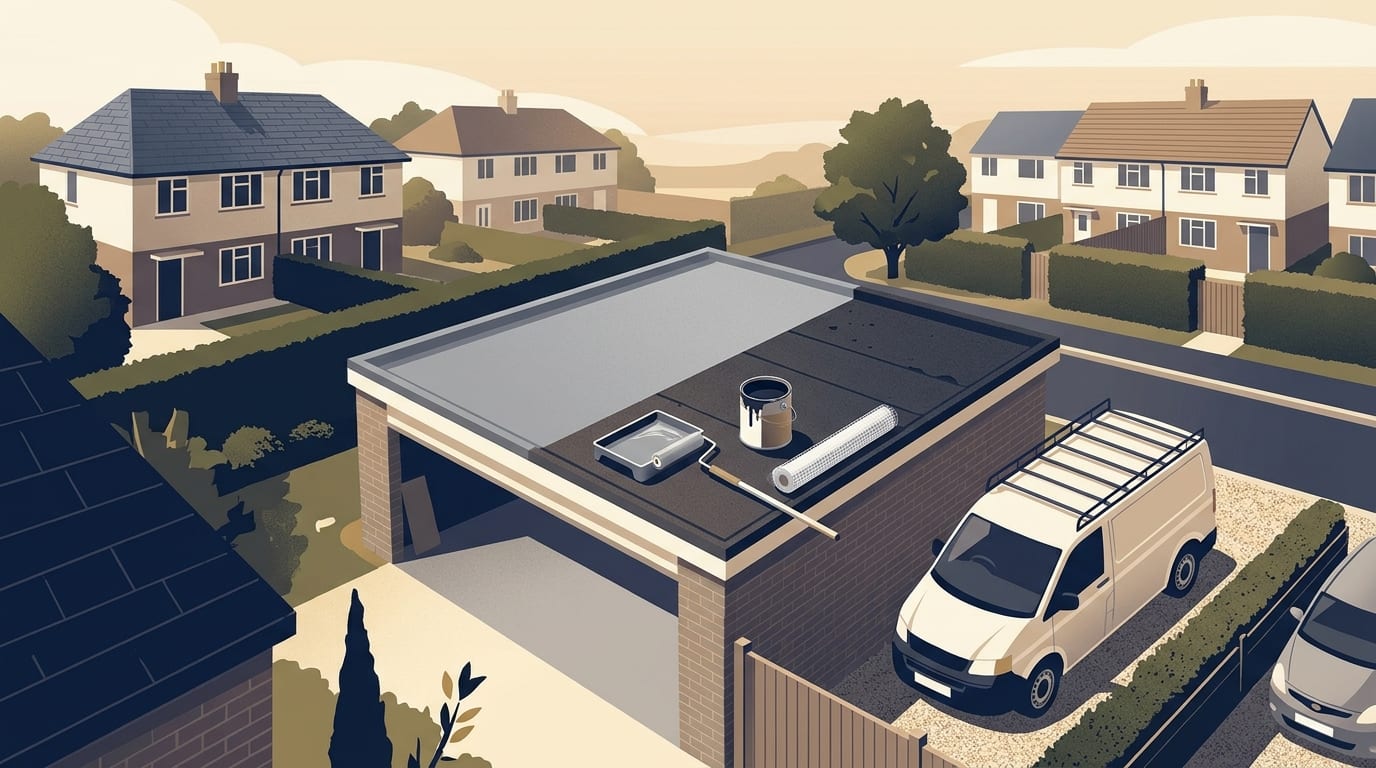
If the chimney was on a flat roof, which is mostly level, the repair process is different. The roofer will need to repair the timber deck on a flat roof, which is the structural wooden base. They will then apply a flat roof system to seal the area. Flat roof systems include built-up felt (usually torch-on), EPDM rubber, GRP fibreglass, single-ply and liquid coatings.
The roofer must also consider the insulation. A warm roof has insulation above the deck, while a cold roof has it between the joists. The new section should match the existing setup.
While the scaffolding is up, the roofer should check the rest of the roof. They will look at the ridge, which is the top peak, and the hip, which is a sloping external corner. They will check the valley, an internal sloping trough where two roofs meet, as well as the verge, the outer edge at a gable end. Finally, they will inspect the eaves, the lower edges overhanging the walls, along with your fascias, soffits and guttering, which are the boards and pipes at the roof edge that carry rainwater away.
Common questions
Do I need a structural engineer to remove a chimney stack?
Removing only the stack above the roofline is a job for a qualified roofer or builder, who can tell you whether an engineer is needed. For chimney breast removal, a structural engineer is normally needed if any part of the chimney will remain, to calculate how to support the remaining brickwork safely.
Can I remove a chimney stack myself?
Taking down a stack is dangerous work at height and involves heavy materials. You should never climb on a roof, use ladders at height, or carry out structural work yourself. Always hire a qualified roofer or builder with the right safety equipment and scaffolding.
Does removing a chimney always save money?
Taking down a stack does not always save money compared to a simple repair. If the stack just needs repointing or new lead flashing, repairing it may cost less, but the ranges overlap so compare quotes. However, if the brickwork is completely failing and the flue is unused, removal can be cheaper than a full rebuild.
What happens to the chimney breast if I remove the stack?
If you remove the stack above the roof, the internal chimney breast stays exactly where it is. You must ensure the disused flue is ventilated at the bottom to prevent condensation and damp problems. Removing the internal breast is a completely separate and much larger job.
Your next steps
Taking down a chimney stack requires careful planning and the right professionals. Follow this checklist to get the job done safely:
- Take photos of the stack from the ground to show roofers what you are concerned about.
- Decide if you want to repair the brickwork, cap the flue, or remove the stack entirely.
- Check with your local council if you live in a conservation area or a listed building.
- Speak to your neighbour to arrange an agreement if you share a chimney on a party wall.
- Get three written quotes that itemise the cost of scaffolding, waste removal and making the roof watertight.
- Ask the roofer for proof of their public liability insurance before they start work.
- Keep your quotes, invoices and any building regulations certificates safe for when you sell the house.
Removing a chimney stack is a major decision that requires professional advice and safe access equipment. Before you agree to any work, always ask for a detailed breakdown of the costs and a clear plan for how the roof will be made watertight. When you are ready to get started, you can find a roofer near you to inspect the stack safely and provide a firm written quote.
Find a top rated roofer near you
3,861 roofers across the UK, each ranked on their Google rating and the number of reviews behind it. Start with your county: