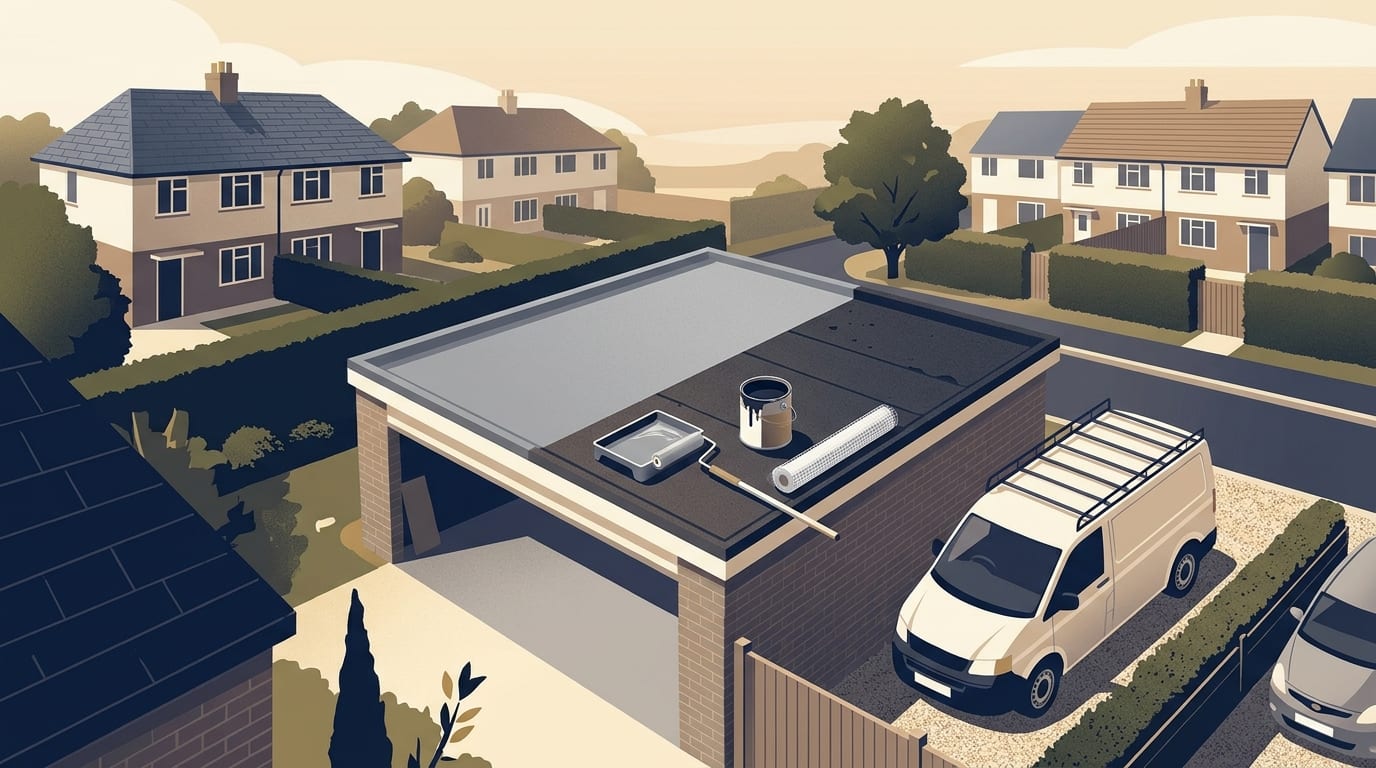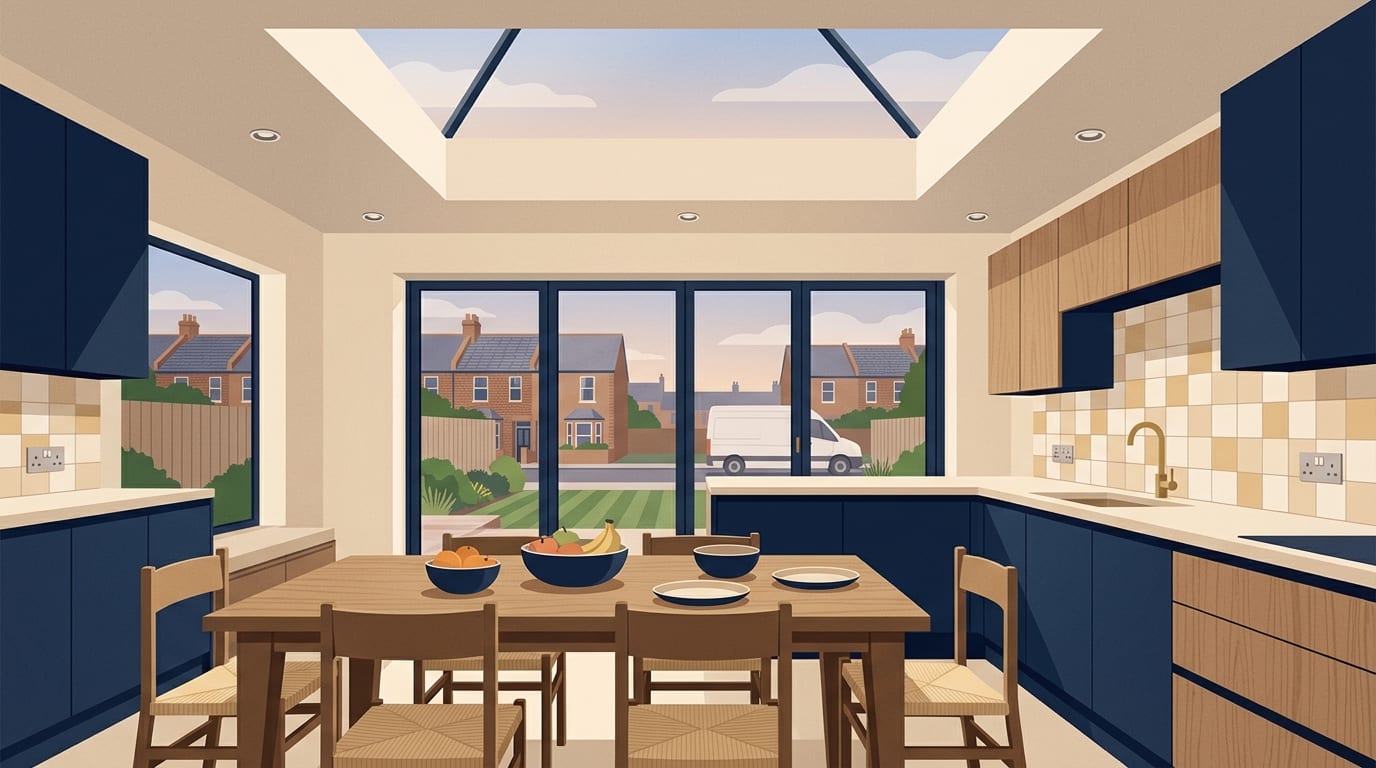
A roof lantern is a glazed architectural structure that sits on a flat roof, designed to pull natural light into the room below from all angles. Typical 2026 prices put the average cost of installing a roof lantern in the UK at around £2,250. Prices vary widely, from £1,100 for a small uPVC lantern up to £9,000 or more for a bespoke design, because the two sets of figures below use different size bands. The final bill depends heavily on the size of the glass unit, the frame material, and whether your roofer needs to cut a new structural opening in your roof deck.
What a roof lantern costs
When you start researching prices for a roof lantern, you will often see figures that look surprisingly low. This happens because many suppliers advertise the supply-only cost of the unit, which just covers the glass and the frame delivered to your door. A supply-only unit price is not the finished project cost. The true price of getting a lantern fitted includes the labour to install it, the timber work to support it, and the materials needed to make the surrounding roof watertight.
For example, typical 2026 prices put the unit price of a mid-size lantern (about 1.5m x 1m) at £1,200 to £2,200 and the fitted price at £2,500 to £4,000, so the unit is only part of the bill. Always check whether a quote is for the unit alone or for the complete job. A good roofer will give you a detailed written quote that breaks down the cost of the glass, the structural work, the access equipment and the finishing.
You also need to check how waste is handled. Waste removal and VAT may or may not be included in a standard quote, so you must ask the roofer to clarify this in writing before you agree to the work.
Costs by size and material
Roof lanterns are priced by their physical dimensions and what the frame is made from. Some figures price uPVC, aluminium and timber lanterns, while others price by size only.
The first table below shows installed prices (supply and fit) by material and size. Not every material is priced in every size.
Installed prices by material and size
|
Lantern |
Installed price |
|---|---|
|
uPVC small (850mm x 850mm) |
£1,100 to £1,500 |
|
uPVC medium (1,500mm x 2,000mm) |
£1,800 to £2,000 |
|
Aluminium small |
£1,300 to £1,600 |
|
Aluminium medium |
£1,900 to £2,300 |
|
Aluminium large (1,500mm and above, custom) |
£2,500 to £3,800 |
|
Timber medium |
£3,200 to £4,200 |
|
Average |
About £2,250 |
The second table uses different size bands and gives fitted prices onto an existing flat roof, with the unit price and the kerb price shown separately.
Fitted prices by lantern size, with unit and kerb shown separately
|
Lantern size |
Fitted price |
Unit price |
Kerb price |
|---|---|---|---|
|
Small (about 1m x 1m) |
£1,600 to £2,600 |
£700 to £1,300 |
£150 to £350 |
|
Mid-size (about 1.5m x 1m) |
£2,500 to £4,000 |
£1,200 to £2,200 |
£250 to £450 |
|
Large (about 2m x 1.5m) |
£3,800 to £5,500 |
£2,000 to £3,500 |
£350 to £600 |
|
Bespoke (2.5m and above, or double) |
£5,500 to £9,000 and above |
Not given |
£500 to £1,200 for steel |
The two sets of figures were compiled differently and do not agree, so do not add or average them. These are typical published prices for 2026 and local quotes will differ.
What the unit price leaves out
A roof lantern cannot just be dropped directly onto a flat roof covering. It requires a raised base, structural support in the roof deck, and finishing work both inside the room and outside on the roof. When you compare quotes from different companies, you must check exactly which of these extra elements are included in the total price.
Access to the roof is a major factor that pushes the price up. If your flat roof is high up, over a conservatory, or difficult to reach safely, the tradespeople will need proper access platforms. You should ask if the scaffolding cost for roof work is included in your quote. Scaffolding is often a separate and significant line on a bill, and typical 2026 prices are £500 to £1,500 for it.
You also need to think about ventilation. A large glass lantern can make the room below warm in summer, so ventilation is worth discussing. Adding automatic openers to the glass panels costs £265 to £320 per window. Trickle vents cost around £40 per vent.
If you are fitting a lantern to an older flat roof, you may also need to budget for the flat roof replacement cost. Nobody can see rotten timber until the old covering is off. If the timber deck or the joists are failing, it makes sense to replace the whole roof at the same time as fitting the new glass. A good quote will state clearly how any rotten timber or extra work will be priced.
Kerbs and structural work
Every roof lantern must sit on a raised upstand, which is known in the trade as a kerb. The kerb stops rainwater from pooling against the glass seals and causing a leak. It must be wrapped in a waterproof material that matches your flat roof. Flat roof systems are usually built-up felt (often called torch-on), EPDM rubber, GRP fibreglass, single-ply or liquid coatings. The roofer must dress this waterproof layer up the sides of the new kerb.
Building the kerb is priced according to the size of the lantern. Typical 2026 prices are £150 to £350 for a small lantern, £250 to £450 for a mid-size one and £350 to £600 for a large one, and £500 to £1,200 for steel on bespoke units.
If you do not already have a skylight or dome in place, the roofer will have to cut a brand new structural opening. This is structural work for a qualified roofer or builder. Cutting a new structural opening in timber or steel, with building control, adds £400 to £1,200, while roof modifications in general are put at £500 to £2,000. These are separate figures, so do not add them together. How the opening is formed also depends on the type of roof. For example, a warm roof has insulation above the deck, while a cold roof has it between the joists, which changes how the opening is formed and sealed.
How long installation takes
The time it takes to fit a roof lantern depends entirely on whether the hole is already there. If you are simply replacing an old polycarbonate dome or dropping a new lantern into an existing opening, the job is straightforward. Fitting a lantern into an existing opening takes about a day.
Forming a new opening, building the kerb and re-dressing the covering takes two to three days, which is longer.
Labour is normally charged by the day rather than by the hour. For a medium lantern, a typical estimate assumes a team of two at around £325 per day, with total labour of £650 to £975 over two to three days, and says the whole process should take two to three days. Ask whether plastering and decorating inside are included.
Planning permission for a roof lantern
A lantern may fall under permitted development if it projects no more than 150mm above the original roof surface. Planning permission is also usually not needed unless the property is listed or in a conservation area. Confirm the position with your council before work starts.
There are strict exceptions depending on the type of property you own. Listed buildings need listed building consent. Properties located in conservation areas may also have extra restrictions placed on them by the local authority. If you live in a protected area or you are unsure about your permitted development rights, you should confirm the details with your local council before you instruct a roofer to start work.
Building regulations and insulation
Building regulations are usually required for this kind of work. Forming an opening and fitting a lantern is notifiable work, and building control involvement is normal.
In England, a new lantern fitted to an existing home or extension must have a U-value of 2.2 W/m2K or lower. The U-value measures how easily heat escapes through the glass and the frame. A lower number means the lantern provides better insulation. Rules differ in Scotland and Northern Ireland, so if you live there, you must check with your local council rather than guessing.
CompetentRoofer is a government-authorised competent person scheme run by the National Federation of Roofing Contractors (NFRC), and registered roofers can self-certify roof refurbishment in England and Wales. Ask the roofer whether their registration covers forming a lantern opening, who deals with building control, and who will give you the paperwork. Keep any compliance certificate, because you may need it when you sell.
Consumer rights and avoiding scams
When you spend thousands of pounds on your home, it pays to know your legal rights. Under the Consumer Rights Act 2015, any work carried out on your property must be done with reasonable care and skill. If the installation is poor or the roof leaks, you have the right to ask for it to be put right or for your money back. A written quote is a fixed price that cannot be changed without your agreement, whereas an estimate is just a rough guess.
Contracts agreed at home, by phone or online normally carry a 14-day cooling-off period. However, if you ask the roofer to start work inside that period, you must pay for what has been done if you later change your mind. Paying for the materials or the deposit by credit card gives you Section 75 protection on purchases over £100 and up to £30,000. If you end up in a dispute with a tradesperson, Citizens Advice is the best place to go for independent guidance.
You should also be aware of common scams in the roofing trade. Never agree to buy a roof lantern from cold callers who knock on your door claiming they have spotted a loose tile or moss from the street. Avoid roofers who put pressure on you to decide today, those who demand cash only, or those who ask for huge deposits upfront while giving no fixed business address. A guarantee is completely worthless if the firm folds next year, unless it is an insurance-backed guarantee.
Regional price differences
The cost of hiring a roofing firm varies considerably depending on where you live in the UK. Prices are noticeably higher in London and the South East. The regional figures below show the same mid-size lantern costing more in London and the South East than in the other regions listed.
The figures below show how the total price of supplying and fitting a mid-size roof lantern changes by location.
This table shows mid-size roof lantern installation costs by UK region.
|
UK Region |
Typical installed cost |
|---|---|
|
London |
£3,600 to £4,800 |
|
South East |
£3,300 to £4,400 |
|
South West |
£2,950 to £3,950 |
|
Scotland |
£2,650 to £3,600 |
|
North West |
£2,600 to £3,500 |
|
Yorkshire |
£2,550 to £3,450 |
|
Midlands |
£2,750 to £3,700 |
These are typical published prices for 2026. Local quotes will differ based on the firm you choose and how easily they can access your roof.
Common questions
Will a roof lantern make my room too hot?
A large glazed roof can trap heat in summer. Ask about the glass specification, and consider trickle vents or automatic openers to let hot air escape.
Do I need to replace my whole flat roof?
You do not always need a full re-roof just to fit a lantern. If your flat roof covering is relatively new and in good condition, the roofer can cut the opening and safely dress the existing waterproof material up the new timber kerb. However, if the timber deck is soft or the covering is near the end of its life, ask the roofer whether replacing the whole roof at the same time makes sense.
How do I clean a roof lantern?
Ask the supplier or roofer how the glass should be cleaned and whether the glass specification includes a self-cleaning coating. Never climb onto a roof lantern or use ladders at height to reach one.
Can I put a roof lantern on a pitched roof?
This guide covers roof lanterns on flat roofs. If you have a pitched roof, ask a roofer whether a lantern is possible, or look at roof windows, which are made for pitched roofs.
Questions to ask before you book
Before you agree to a quote or hand over any money, you need to know exactly what the roofing firm is providing. A vague one-line quote that just says "supply and fit lantern" is a serious financial risk. You need to confirm the exact details so you are not hit with hidden charges for scaffolding or structural carpentry later on.
Ask your roofer these questions:
- Is the timber kerb and the waterproof dressing included in this price?
- Have you included the cost of scaffolding or do I pay the scaffolders directly?
- Who is responsible for plastering and decorating the ceiling inside once the opening is cut?
- Who is dealing with the building control application?
- What is the U-value of the glass you are supplying?
- Does the price include automatic openers or trickle vents?
- Are you a member of the CompetentRoofer scheme or registered with TrustMark?
- Do you provide an insurance-backed guarantee for the waterproofing around the kerb?
Next steps
Fitting a roof lantern can involve structural work and building control, so take these steps before work starts.
- Check with your local council to confirm if your home is listed or located in a conservation area.
- Decide on the size and material you want, remembering that prices differ by both size and material.
- Get three written quotes from local roofers, making sure each one itemises the kerb, the roof modifications and the glass.
- Ask to see proof of the firm's public liability insurance and check their registration on the TrustMark website, which is the government-endorsed quality scheme for work in and around the home. Membership is a good sign, though it is not a guarantee.
- Agree a staged payment plan in writing, and never pay the final balance until the building control compliance certificate is in your hand.
Taking the time to compare detailed quotes means you will know exactly what you are paying for and who is handling the important paperwork. When you are ready to start looking for quotes, you can find a roofer near you to discuss your flat roof and get an accurate price for the job.
Find a top rated roofer near you
3,861 roofers across the UK, each ranked on their Google rating and the number of reviews behind it. Start with your county: