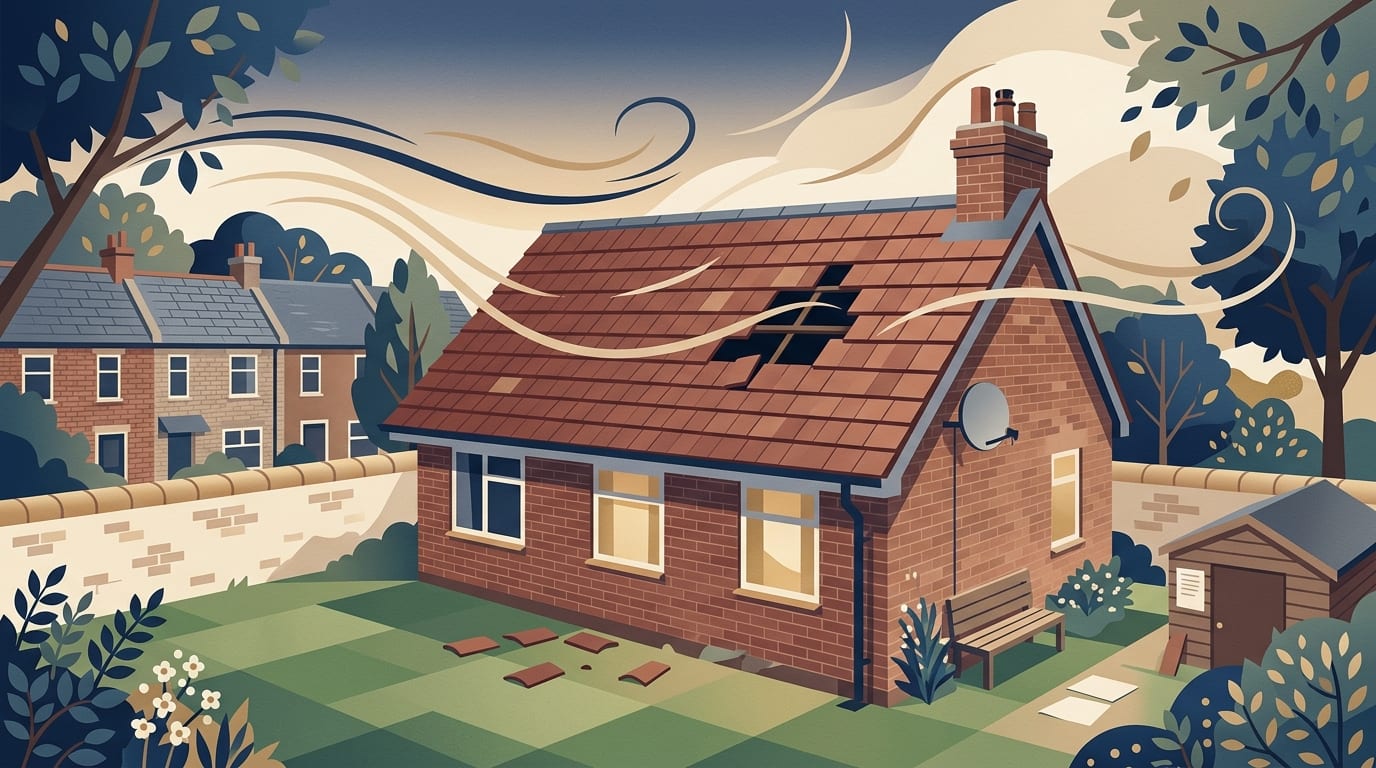
Replacing a few slipped or broken roof tiles normally costs between £170 and £450 in total. Most homeowners spend between £200 and £400 to have the job done properly once a minimum call-out and safe access are included. The tiles themselves only cost a few pounds each, so you are mostly paying for the roofer to travel to your property, set up equipment safely and find the fault.
This table shows the typical elements that make up a quote for replacing a few damaged pieces on a standard property.
|
Cost component |
Typical price range |
|---|---|
|
Minimum call-out charge |
£120 to £220 |
|
Replacement tiles |
£5 to £40 |
|
Access (tower or ladder) |
£40 to £150 |
|
Scaffold, only if needed (partial re-tile) |
£450 to £800 |
These are typical published prices for 2026, and local quotes will differ. Prices are generally higher in London and the South East. Small repairs are usually a fixed price or a day rate, while larger work is priced per square metre plus the cost of access.
If the damage across your property is extensive, a larger section re-tile costs between £400 and £1,000. You should always treat these figures as a budgeting guide and confirm the final total against written quotes from local tradespeople.
Why the visit costs more than the tiles
A single-tile visit realistically costs between £170 and £350 because the call-out and access costs dominate the final bill. The call-out and access make up most of the bill, and the tiles themselves are a small part of it.
A quote is a fixed price for the whole job, whereas an estimate is not binding and can increase. You should always ask for a fixed written quote before agreeing to any repairs so you know exactly what the final bill will be. Nobody can see rotten timber until the old covering is off, so a good quote says exactly how extras will be priced if hidden damage is found.
Under the Consumer Rights Act 2015, work must be done with reasonable care and skill. If it is not, the customer can ask for it to be put right or for money back. Having a fixed price in writing protects these consumer rights and gives you a clear baseline if the standard of work falls short.
Waste removal and VAT may or may not be included in the headline figure you are given. Ask the trader to confirm this in writing before the work begins.
Concrete and clay tile prices
If you are only paying for the materials, individual roof tiles are very cheap.
This table shows the raw material cost for single replacement units.
|
Tile material |
Price per tile |
|---|---|
|
Concrete tile |
£1 to £4 |
|
Clay tile |
£2 to £8 |
These are typical published prices for 2026, and local quotes will differ. Matching discontinued tiles can raise the price.
You can read more about the differences in our guide to clay, concrete and slate roof tiles if you are considering wider replacement work across the whole property.
Understanding your roof parts and materials
When you hire a professional to inspect your property, they will use specific industry names for different areas of the structure. Pitched roofs are the traditional sloped structures most common on UK houses, while flat roofs have a very slight incline to let rainwater drain. The surface of a pitched roof is usually covered in concrete and clay tiles, or natural and fibre cement slate.
Beneath those visible tiles, the structure relies on underlay, which is often called felt or membrane, to catch any blown rain. The tiles themselves are hooked or nailed onto battens, which are horizontal timber strips fixed across the roof. The very top horizontal peak of the structure is the ridge, while a hip is the sloping outer corner where two sides meet.
A valley is the internal angle created where two roof slopes join together, and this area channels a lot of water during heavy rain. The outer edge of the roof above a gable end is called the verge, and the bottom edge where water runs off is the eaves. Roofers use lead flashing, which consists of shaped metal strips, to seal the vulnerable joints where the roof covering meets brickwork or chimneys.
Along the lower edge of the roofline you will find fascias, the vertical boards at the eaves, and soffits, the boards tucked underneath them, which together support your guttering. Keeping these drainage channels clear is vital for protecting the brickwork below.
If your home also has a flat extension, the terminology changes entirely. The structural base is the timber deck on a flat roof, which supports the waterproofing layers above it. A warm roof has insulation above the deck, whereas a cold roof has it placed below between the joists. Flat roof systems include built-up felt, which is usually torch-on, EPDM rubber, GRP fibreglass, single-ply and liquid coatings.
When scaffold is needed
Most small repairs on a two-storey house can be done using temporary access. A scaffold tower or secure ladder setup costs between £40 and £150, which is usually enough for a roofer to replace a single slipped unit safely. Larger jobs, such as a partial re-tile or a whole pitch, need scaffold instead.
Scaffold for a partial re-tile is between £450 and £800. If the job grows and a whole pitch needs scaffold, the price rises to between £450 and £1,500. Scaffolding is often a separate and significant line on your final bill.
Hidden scaffold costs commonly cause disputes between homeowners and tradespeople. You should ensure that scaffolding is itemised separately in your written quote so you know exactly what you are paying for the structure versus the roofing work.
You can check typical scaffolding costs for roof work to understand how these access structures are priced if your project expands.
Common reasons tiles slip or break
Wind is a common cause of displaced tiles. Age and frost damage can cause older clay materials to crack or flake over time as water penetrates the surface and freezes. Tiles can also be broken by foot traffic on the roof.
Failed fixings are another cause, and a tile whose fixings have gone can slip out of place.
Loose or open-jointed ridge tiles do not indicate a failing roof covering, as the mortar holding them simply degrades over time and can be repointed. Isolated tile or slate damage on an otherwise sound roof is a case where repair makes sense, and you should not be pressured into a full replacement for a local fault.
What can wait and what cannot
A slipped tile can let water in and is worth fixing soon to prevent damp reaching your ceilings. However, a crack in a tile does not usually need an emergency call-out unless water is actually coming into the house. The waterproof underlay beneath the battens is designed to catch minor moisture and guide it safely down to the gutters.
If water is actively pouring in during a storm, an emergency tarpaulin or make-safe visit costs between £150 and £400. This secures the property temporarily until permanent repairs can be scheduled in dry weather.
You should always look at the damage from the ground or a window, and take photos with a camera zoom to show the roofer. Never climb on a roof, use ladders at height, or carry out leadwork, torch-on felting, structural or electrical work yourself.
Have a professional roofer check for further loose tiles on the same slope while they are up there. A thorough check from the safety of an access tower can spot failing fixings before the next storm hits.
Cold callers and tile scams
The roofing trade suffers from rogue operators who exploit homeowners over minor faults. Scams often begin with cold callers who have spotted a loose tile or moss from the street and knock on your door offering a quick fix. They rely on the fact that you cannot see your own roof properly and have to take their word for what is wrong.
Watch out for these common warning signs of a roofing scam:
- Cold callers pointing out minor damage from the street.
- High pressure to decide today or agree to immediate work.
- Requests for cash only payments or unusually big deposits.
- Traders operating with no fixed business address.
- Vague one-line quotes that lack any detail.
- Being shown photos of severe damage that do not match your roof.
- A small quoted job rapidly growing into a full re-roof.
You should also be wary of roof coating and painting claims. Pressure washing sold as maintenance is another tactic to be wary of.
Contracts agreed at home, by phone or online normally carry a 14-day cooling-off period. If you ask for work to start inside that period, you must pay for what has been done. Paying by credit card gives Section 75 protection on purchases over £100 and up to £30,000. If you find yourself in a dispute with a trader, Citizens Advice is the place to seek guidance.
Rules, schemes and proper paperwork
Building regulations in England mean that repairing or re-covering a roof does not normally need a building control application if less than 25 per cent of the building envelope and less than 50 per cent of the roof is affected. Small repairs like replacing a few tiles fall well below this threshold.
Above that limit, approval is needed and the insulation may have to be upgraded. Approval is also needed for structural alterations, where a new covering performs significantly differently in fire, or where it adds 15 per cent or more to the weight.
Rules differ in Scotland and Northern Ireland, so you should check with your council rather than guessing. CompetentRoofer is a government-authorised competent person scheme run by the National Federation of Roofing Contractors (NFRC). Registered roofers can self-certify roof refurbishment in England and Wales, and the customer should receive a building regulations compliance certificate.
Otherwise the work goes through council building control or a registered building control approver. Going without the building regulations certificate on major work is a mistake that will cause problems when you come to sell your home.
TrustMark is the government-endorsed quality scheme for work in and around the home. Membership of these schemes is a good sign, not a guarantee, and you should always verify a trader on the scheme's own register. A workmanship guarantee on roofing is typically 5 to 10 years, but beware of guarantees that are worthless if the firm folds because they are not insurance-backed.
Questions to ask before you book
Nobody can see rotten timber until the old covering is off, so a good quote says how extras will be priced. You must ask the trader to clarify all costs in writing before they climb onto your property. You can read more about typical roof repair costs to help you compare quotes accurately.
Ask these questions before agreeing to any work:
- Will you provide a written, itemised quote rather than an estimate?
- How will you price any extra work if you uncover rotten timber?
- Are waste removal and VAT included in your total price?
- Are scaffolding or access costs itemised separately?
- Can you show valid proof of your public liability insurance?
- Is your workmanship guarantee insurance-backed?
Getting clear answers to these questions separates professional tradespeople from rogue operators. A genuine roofer will be happy to provide this paperwork and explain their pricing structure.
Common questions
What is the typical cost for broken slates or tiles?
Published figures put the cost of broken slates or tiles at £150 to £500 in total, a little wider than the £170 to £450 above. The concrete or clay tile itself only costs a few pounds, but the minimum call-out charge and the cost of setting up safe access dominate the final bill.
Can one damaged tile cause a leak?
A slipped tile can let water in, but a simple crack does not usually need an emergency call-out unless water is actively dripping into the house. The underlay beneath the battens is designed to catch minor moisture and direct it safely into your guttering.
Do I need a whole new roof if several tiles slip?
Isolated tile or slate damage on an otherwise sound roof is a case where repair makes sense. You do not usually need a full replacement unless the underlying timber battens or fixings have completely failed across the entire pitch.
What if more than a few tiles need replacing?
If the damage is extensive, a larger section re-tile costs between £400 and £1,000. If a whole pitch needs fixed access, the scaffold alone costs between £450 and £1,500 before the labour and materials are added to the quote.
Next steps for your roof
Taking the correct steps before you hire a tradesperson ensures you get a fair price and proper paperwork.
- Inspect the damage from the ground or a window using a camera zoom.
- Get three written quotes from local firms to compare prices.
- Ensure scaffolding or safe access costs are itemised separately.
- Agree to staged payments for larger jobs, with a final payment only when the work is finished.
- Keep your itemised quotes, invoices and insurance-backed guarantees safely filed away.
Taking the time to check credentials and insist on proper paperwork protects you from rushed jobs and hidden costs. When you are ready to fix those slipped or broken tiles, you can find a roofer near you to inspect the damage safely and provide a fair, itemised quote.
Find a top rated roofer near you
3,861 roofers across the UK, each ranked on their Google rating and the number of reviews behind it. Start with your county: