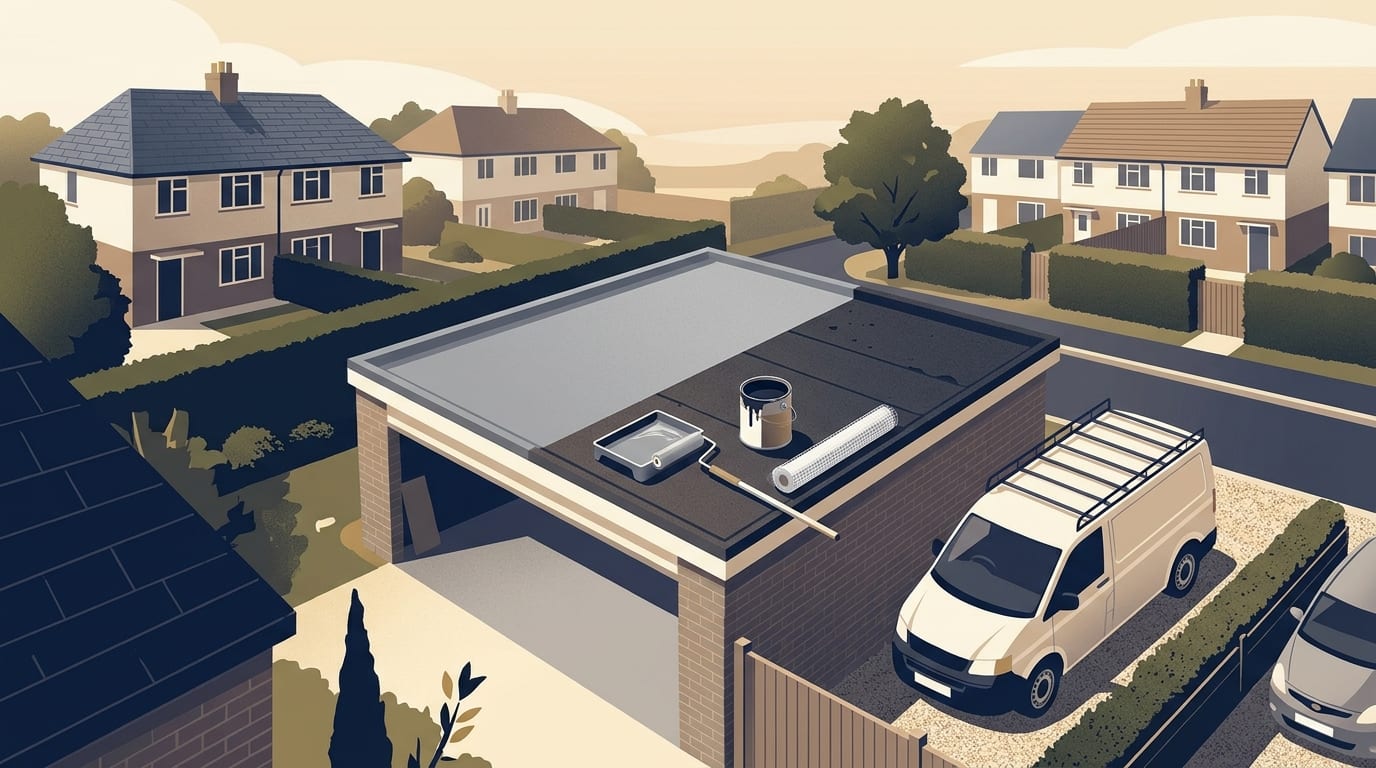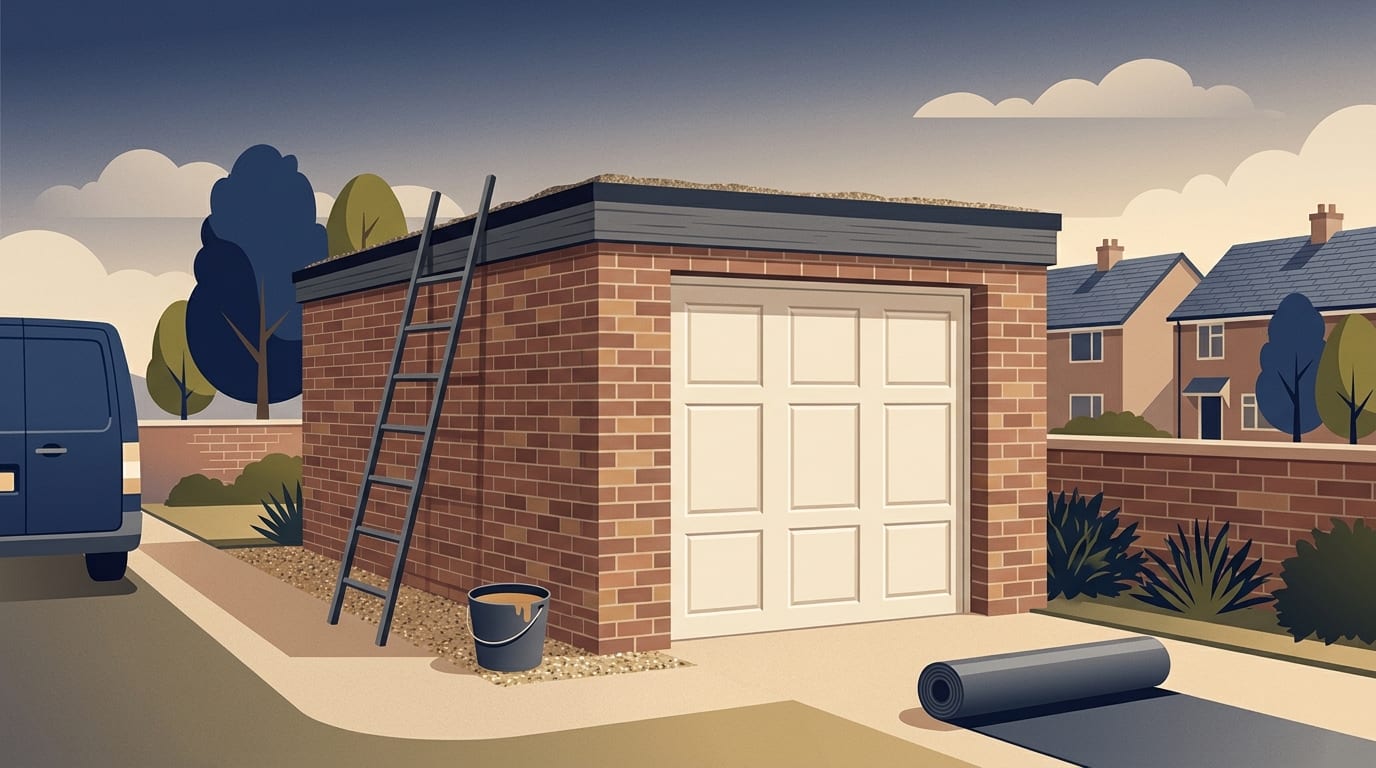
Re-covering an ageing garage roof is a common small roofing job. Typical 2026 prices put a single garage roof replacement at roughly £700 to £2,000, with flat felt and rubber roofs sitting at the lower end of that scale. The exact price you pay depends heavily on the size of your garage and the material you choose. Local quotes will always vary based on your location, the access to the site, and the condition of the timber underneath.
What a garage roof replacement costs
The cost of replacing a garage roof spans a wide range because garages vary from small single bays to large double units. The materials used also range from basic felt to heavy concrete tiles. Across all types and sizes, typical 2026 prices show an overall range of £750 to £3,500, with an average price of £1,500.
To give you a clearer idea of what to expect, the table below shows these figures broken down by garage size and roof covering.
|
Roof material |
Single garage |
Double garage |
|---|---|---|
|
Felt (flat) |
£750 to £1,000 |
£1,000 to £1,500 |
|
Rubber (flat) |
£1,000 to £1,400 |
£1,400 to £2,000 |
|
Tiles or slates (pitched) |
£1,500 to £2,000 |
£2,500 to £3,500 |
|
Metal sheets (pitched) |
£1,100 to £1,500 |
£1,800 to £2,500 |
These figures represent typical 2026 prices. The materials themselves differ in price, with felt typically costing £50 to £80 per square metre, EPDM rubber £80 to £120, tiles or slates £70 to £120, and metal sheets £40 to £90. Local quotes will differ based on your location, with prices generally higher in London and the South East.
Fully fitted garage roof prices including waste disposal
A second table gives fully fitted 2026 costs. These include all labour, materials and the cost of taking the old roof away. The two sets of figures were worked out differently, so read them separately.
These fully fitted figures price a single garage roof between £700 and £1,500 for traditional felt. Converting a flat single garage to a pitched tiled roof is a much bigger job than a like-for-like replacement, and can reach £6,000. For a larger double garage, a felt replacement costs between £1,200 and £2,600, whereas a pitched conversion can cost up to £10,000.
The table below shows these fully fitted prices. Keep in mind that a single garage is typically 15 to 18 square metres, while a double garage is around 28 to 36 square metres.
|
Roof system |
Single garage fully fitted |
Double garage fully fitted |
|---|---|---|
|
Felt (torch-on, 3-layer) |
£700 to £1,500 |
£1,200 to £2,600 |
|
EPDM rubber |
£1,200 to £2,500 |
£2,000 to £4,200 |
|
GRP fibreglass |
£1,500 to £3,000 |
£2,600 to £5,000 |
|
Pitched tiled conversion |
£2,500 to £6,000 |
£4,500 to £10,000 |
These figures are typical 2026 prices, and your local quotes will differ.
Flat or pitched roof types and how they change the price
The shape and covering of your garage roof dictate a large part of the final bill. Many garages have a flat roof. A flat roof is not completely flat, but has a slight slope to let rainwater run off into the guttering. Flat roof systems include built-up felt (usually applied with a blowtorch and called torch-on felt), EPDM rubber (a single sheet of flexible synthetic rubber), GRP fibreglass (a liquid resin mixed with glass fibres that hardens into a tough shell), single-ply membranes and liquid coatings.
When replacing a flat roof, you may also hear roofers talk about insulation. A warm roof has the insulation placed above the timber deck, whereas a cold roof has the insulation packed between the timber joists.
Pitched roofs have a visible slope and a central ridge, much like the main roof of a house. They are usually covered with concrete and clay tiles, natural and fibre cement slate, or corrugated metal sheets. Pitched roofs often involve more components than flat roofs, such as timber framing, a breathable underlay (often called felt or membrane) and timber battens to hold the tiles. They also require detailing around the ridge, the eaves, the verges and valleys. They may also need lead flashing to keep the joints watertight against adjoining walls.
If you currently have a flat roof that causes constant problems, you might consider upgrading to a pitched roof. Converting a flat garage roof to a pitched tiled roof is a major structural alteration. The existing timber deck is removed, new timber trusses are built to create the slope, and heavy tiles are added.
What the price includes and what adds to it
Small repairs are usually a fixed price or a day rate. Larger work is priced per square metre plus access. Scaffolding is often a separate and significant line on the bill. Waste removal and VAT may or may not be included, so you must ask the roofer to clarify this before you sign anything.
When you hire a roofer, nobody can see the condition of the timber structure underneath until the old covering is stripped off. If the roof has been leaking for a long time, the timber deck (the wooden boards that form the base of a flat roof) or the joists may be rotten. It is highly advisable to set aside an extra 10 to 15 per cent of your budget for hidden problems found once work starts.
If the timber deck on a single garage is rotten and needs completely replacing, typical 2026 prices show this adds between £300 and £700 to the bill. The fascias, soffits and guttering are often attached to the garage roof structure. Replacing the fascia on a single garage typically costs between £120 and £350. Fitting new guttering and a downpipe adds £100 to £300. A good quote always says how these extras will be priced.
How long the job takes
Most standard garage roof replacements take between one and two days to complete. Flat roofs are the quickest to replace, with a felt or EPDM rubber re-cover on a single garage often finished in just one day. Pitched roofs take longer due to the extra materials and detailing required, typically taking up to three days.
Stripping the old roof away is a fast process. Unless the old roof contains asbestos, removing the existing covering will not take more than half a day. Once the roof is stripped, the roofer will inspect the timber underneath and begin installing the new system.
If you are converting a flat garage roof to a pitched tiled roof, the job is much larger and typically takes between three and seven days. The weather also plays a role in how long the job takes. While felt and rubber can be laid in most dry conditions, GRP fibreglass needs dry, mild weather to cure properly.
Dealing with a suspected asbestos garage roof
Some older garages have roofs made from corrugated asbestos cement panels. Garages built or altered before the year 2000 may have asbestos roofing, and this changes how the replacement must be handled.
If you suspect your garage roof contains asbestos, do not touch it, do not attempt to clean it, and do not drill into it. Asbestos is highly dangerous when its fibres are released into the air and breathed in. You must tell the roofer that you suspect asbestos is present when you are getting quotes. Stripping an asbestos roof takes longer than the usual half a day and requires specialist handling and disposal, which adds to the cost of the job.
The safest approach is to use an accredited asbestos surveyor to test the material before any work begins. If the test comes back positive, the panels must be removed by trained professionals following strict safety regulations. You can read more about the rules and safety steps for dealing with asbestos garage roofs before you invite anyone to quote.
Building regulations and planning permission for garages
In England, repairing or re-covering a roof does not normally need a building control application if less than 25 per cent of the building envelope and less than 50 per cent of the roof is affected. Above that, approval is needed and the insulation may have to be upgraded. Approval is also needed for structural alterations, where a new covering performs significantly differently in fire, or where it adds 15 per cent or more to the weight. Replacing a glazed or polycarbonate conservatory roof with a solid one takes the conservatory out of its exemption, so building regulations apply to the new roof.
However, detached garages can fall under different rules. According to the Planning Portal guidelines for outbuildings, a detached garage with a floor area of less than 15 square metres would not normally need building regulations approval. A garage between 15 and 30 square metres would not normally need it if it is at least one metre from any boundary or is constructed substantially of non-combustible materials. These exemptions describe the garage building itself and do not specifically address replacing its roof, so check with your council if you are unsure. The National Federation of Roofing Contractors (NFRC) competent person scheme also notes that unless the garage has fixed heating (not portable heaters), there is no legal requirement to notify the work.
If your garage replacement did require approval, you would need a compliance certificate. CompetentRoofer is a government-authorised competent person scheme run by the NFRC. Registered roofers can self-certify roof refurbishment in England and Wales, and the customer should receive a building regulations compliance certificate. Otherwise the work goes through council building control or a registered building control approver. TrustMark is the government-endorsed quality scheme for work in and around the home. Check either scheme's own register. Membership is a good sign, not a guarantee. Going without the building regulations certificate when one is required can cause problems when you sell.
Planning permission is a separate set of rules. According to the Planning Portal rules for roofs, work to a roof that does not materially affect its external appearance generally does not need planning permission. Swapping old felt for new felt or rubber on a flat garage roof rarely changes the external appearance. These rules apply to England, and policy in Wales may differ. Rules also differ in Scotland and Northern Ireland, so you should check with your local council rather than guessing.
When to replace and when a repair is enough
Knowing when a repair is enough can save you money, but spending on patch repairs for a roof that is past its lifespan is a false economy. If your garage roof is relatively new and has suffered isolated damage, such as a single torn strip of felt from a falling branch, a repair is usually the honest answer.
You should consider a full replacement if the roof is leaking in multiple places, if the felt has become brittle and cracked across the whole surface, or if the timber deck underneath feels spongy when you press it from the inside. A spongy deck means water has been getting in for a long time and the wood is rotting. In this case, patching the surface will not solve the underlying structural problem and the leak will rapidly get worse while you wait.
If you have an old corrugated metal or plastic roof that has started to rust heavily or turn opaque and brittle, replacement may be the better option. Check the asbestos section above first, because corrugated panels on older garages can be asbestos cement. A good roofer will inspect the roof from the ground or from inside the garage and show you photos of the defect to help you make an informed decision.
What to put in your roofing quote
A professional roofing quote is a fixed price for the work, whereas an estimate is not. To protect yourself from unexpected bills and poorly defined work, you need a detailed, written quote. Vague one-line quotes that simply say replace garage roof leave you with no paperwork when you come to sell your house.
You should be extremely wary of common mistakes and scams in this trade. Avoid these warning signs:
- Cold callers who have spotted a loose tile or moss from the street.
- Traders who demand cash only, ask for big deposits, or provide no address.
- Sales tactics that pressure you to decide today.
- Being sold a whole new roof for a local fault.
- Traders selling pressure washing as maintenance or making roof coating and painting claims.
- Guarantees that are worthless if the firm folds because they are not insurance-backed.
- Going without the building regulations certificate when the job requires one.
A proper written quote for a garage roof replacement should include:
- The exact material being used, including the thickness or number of layers for a flat roof.
- A clear statement on whether the price includes stripping and disposing of the old roof.
- The cost of replacing the timber deck, fascia boards and guttering if they are found to be rotten.
- Confirmation of who is responsible for removing all waste from your property.
- Whether VAT and scaffolding costs are included in the final figure.
- A schedule of staged payments, with the final payment due only when the job is finished.
- Proof of the roofing firm's insurance cover.
If a dispute arises over the quality of the work, the Consumer Rights Act 2015 states that work must be done with reasonable care and skill. If it is not, you can ask for it to be put right or for money back. Contracts agreed at home, by phone or online normally carry a 14-day cooling-off period, but if the customer asks for work to start inside that period they must pay for what has been done. Paying by credit card gives Section 75 protection on purchases over £100 and up to £30,000. If you ever need help with a dispute, Citizens Advice is the place to go.
Common questions
Can I felt a garage roof myself?
Applying traditional torch-on felt to a garage roof involves working at height with a powerful blowtorch. It is a dangerous job that carries a high risk of fire and personal injury if you are not trained. For safety and a watertight finish, felt roofing on a garage should always be left to a professional roofer.
Is EPDM rubber better than felt for a garage?
EPDM rubber is a single sheet of flexible synthetic rubber, while felt is built up in layers. In both sets of figures on this page felt costs less than rubber for the same size of garage. Which is better for you depends on your garage, so ask each roofer to explain why they recommend a particular system and what guarantee comes with it.
What happens if a roofer damages my property?
Under the Consumer Rights Act 2015, any work you pay for must be done with reasonable care and skill. If work is not done with reasonable care and skill, you can ask for it to be put right or for your money back, and Citizens Advice can help if there is a dispute. This is why you must always ask to see proof of the firm's liability insurance before they start work.
Do I need building control approval to replace my garage roof?
Re-covering a roof does not normally need a building control application below the thresholds set out above. Separately, the Planning Portal says a detached garage under 15 square metres would not normally need building regulations approval, and nor would one between 15 and 30 square metres that is at least one metre from any boundary or built substantially of non-combustible materials. Those exemptions describe the garage building, not specifically a roof replacement, so check with your council if unsure. The NFRC competent person scheme says that if the garage has fixed heating, the work needs to be notified.
Your next steps
Replacing your garage roof will protect the building and whatever you store inside it. Before you hire anyone, follow these final checks to ensure the job goes smoothly.
- Get three written quotes from different roofing firms to compare prices and the materials they suggest.
- Ask the roofer to take photos of the existing roof and any rotten timber so you can see the problem for yourself.
- Check the quote clearly states the price for any extra timber work required once the old roof is removed.
- Tell the roofer immediately if your garage was built before the year 2000 and you suspect the roof panels contain asbestos.
- Never pay the full balance upfront, and avoid firms that demand cash only or pressure you to agree to a deal on the doorstep.
- Check the official TrustMark or CompetentRoofer registers to verify a roofer's credentials before you agree to any work.
Taking the time to gather itemised quotes and check the details will help you avoid hidden costs and poor workmanship. When you are ready to get accurate prices for your property, you can find a roofer near you to inspect your garage and provide a firm, written quote.
Find a top rated roofer near you
3,861 roofers across the UK, each ranked on their Google rating and the number of reviews behind it. Start with your county: