If you are wondering how many years your roof has left, the honest answer is that the covering material matters most. Pitched roofs are the traditional sloping roofs found on most UK houses, while flat roofs are typically found on extensions and garages. Every covering has a different expected lifespan. The figures below are design lifespans from trade sources, but real life depends heavily on the quality of the installation, exposure to the weather and general upkeep.
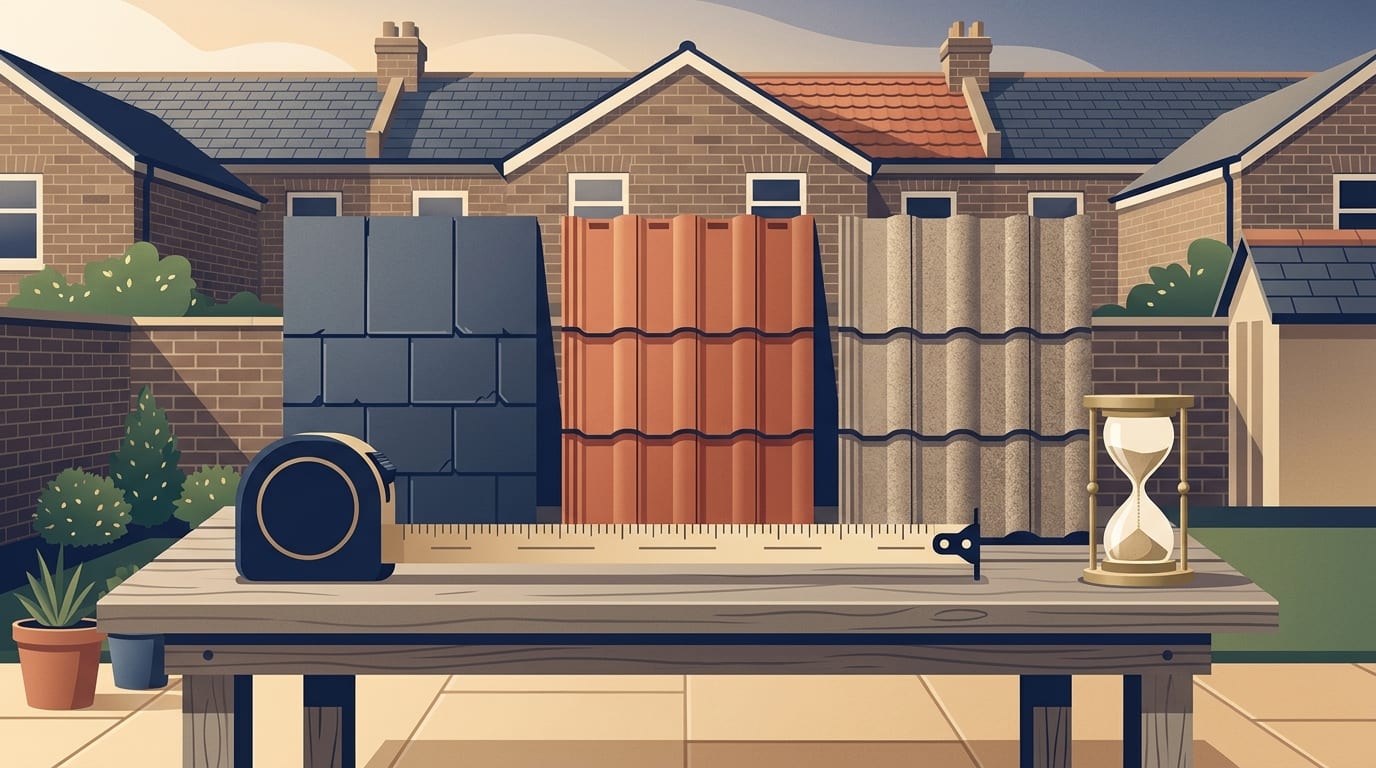
Because there are so many variables, a proper inspection always beats a guess. You cannot see your own roof properly from the ground, so you have to rely on professional advice to know its true condition. The table below shows the expected design lifespans for the most common roof coverings in the UK.
|
Roof covering |
Typical design lifespan |
|---|---|
|
Natural slate |
80 to 150 years |
|
Clay tiles |
60 to over 100 years |
|
Concrete tiles |
30 to 50 years |
|
Artificial slate |
30 to 50 years |
|
Single-ply membrane |
25 to 35 years |
|
GRP fibreglass |
25 years or more (30 to 40 when well executed) |
|
EPDM rubber |
40 to 50 years (based on commercial use) |
|
Built-up felt |
15 to 25 years (three-layer hot melt) |
These are typical published figures for 2026 and local estimates will differ based on your property. Estimates vary on exact numbers, so treat these ranges as a guide rather than a guarantee.
Natural slate and clay tiles
Natural slate lasts longer than any other roof covering. When properly fixed and holed, natural slate roofs reach 80 to 150 years of use. Roofs can last for decades, and 10 years is typical for guarantees, although your roof may last much longer. You should never assume that a manufacturer guarantee equals the life expectancy of the material.
Clay tiles routinely last 60 to 100 or more years without significant maintenance, according to trade estimates. Both slate and clay roofs rely on a system of different parts to stay watertight. The ridge is the horizontal peak of a pitched roof, while a hip is a sloping outer corner. A valley is an internal sloping corner where two roof sections meet and direct water downwards.
The verge is the edge of the roof at the gable end of a house. The eaves are the lowest overhanging edges where water drops into the gutter. Lead flashing is the metal strip used to seal joints, usually where the roof meets a brick wall or a chimney. If any of these secondary parts fail, the roof will leak even if the slate or clay tiles are in perfect condition.
Artificial slate is a modern alternative designed to look like natural slate. It is typically quoted at 30 to 50 years of life, well short of natural slate.
Concrete tiles
Concrete tiles are quoted at 30 to 50 years before noticeable deterioration, and other estimates give a design life of 50 to 60 years, so treat the range as approximate.
Concrete tiles fade and become porous over 20 to 30 years. A faded roof is a reason to ask for a professional opinion, not proof that it has failed.
Concrete is also very heavy. If you are thinking of replacing an old slate roof with concrete tiles, the new covering will add significant weight to the timber structure. In England, approval from building control is needed where a new covering adds 15 per cent or more to the weight of the roof. Rules differ in Scotland and Northern Ireland, so check with your council rather than guessing.
Flat roof coverings
Flat roof lifespan has varied widely, from about 6 to 35 years, depending heavily on covering quality and the timber structure beneath. The structure starts with the timber deck, which is the solid boarded base of a flat roof. A warm roof has its insulation installed above the deck, while a cold roof has the insulation placed between the timber joists beneath the deck.
Built-up felt is the traditional flat roof covering and is often laid as torch-on felt, which uses a naked flame and is work for a roofer. Estimates give 15 to 25 years for a three-layer hot melt felt roof, and around 10 to 20 years for felt depending on quality and drainage. EPDM rubber is a single sheet of synthetic rubber, with published figures from 20 to 30 years up to 40 to 50 years, the higher figures being based on commercial use.
GRP fibreglass stands for glass reinforced plastic, a hard liquid applied system. The industry standard claim is that it lasts over 25 years, with well-executed systems often reaching 30 to 40 years. Single-ply is a flexible plastic membrane, often made from PVC or TPO, which typically lasts 25 to 35 years.
What shortens a roof's life
Even the best materials will fail early if they are installed poorly. GRP fibreglass failures are a perfect example of this. They are commonly caused by using the wrong timber substrate, such as OSB2 or CLS timber instead of the required moisture resistant OSB3. Poor trim bonding that lets water in at the edges is another frequent installation fault, alongside a topcoat applied in cold conditions.
Lack of maintenance can also shorten a roof's life, but you must be careful about what counts as maintenance. Moss alone is not a sign that your roof is failing. However, pressure washing is often sold as maintenance by rogue traders, so be wary of it.
Cold callers often knock on doors claiming they have spotted a loose tile or moss from the street. They apply pressure to decide today, ask for cash only, demand big deposits and provide no fixed address. They might offer vague one-line quotes or try to sell a whole new roof for a minor local fault. Roof coating and painting claims are another common tactic to be wary of.
Underlay and the parts you cannot see
Your roof tiles are only the first line of defence. Beneath them is the underlay, often called felt or a breathable membrane, which acts as a secondary barrier against wind driven rain. The tiles themselves sit on battens, which are long strips of timber nailed across the roof structure. At the edges of the roof you have fascias, soffits and guttering, which hold the roofline together and carry water away.
There is a large difference in how long underlay lasts compared to the tiles above it. Estimates disagree on exact timelines for this hidden layer. Some 2026 figures say underlying felt typically degrades in 20 to 25 years, while others say felt underlay typically lasts 30 to 40 years, even when the tiles look sound.
Because these estimates differ significantly, you should not rely on either figure as a certainty for your own home. What is certain is that the tiles can easily outlive the felt beneath them. When the underlay rots away, wind and rain can reach your loft, meaning you might have to take a perfectly good set of tiles off just to replace the felt and battens underneath.
Signs a roof is nearing the end
You can look for signs of a failing roof without putting yourself in danger. Never climb on a roof, use ladders at height, or attempt to carry out leadwork, torch-on felting or structural work yourself. Checks from the ground or from inside the loft are fine. Photograph your roof from the ground using the zoom on your phone or camera to get a closer look at the details.
- Repeated leaks in different places during heavy rain.
- Many slipped, missing or cracked tiles across the whole roof.
- Visible sagging in the roofline when you look along the ridge.
- Daylight showing in the loft where it should not be.
- Damp patches on the ceiling upstairs that keep returning.
A roof approaching 30 years old with recurring problems is usually a better candidate for replacement than patching. Repeated patch repairs can add up to more than a full replacement. You can read more about how to decide whether to repair or replace your roof in our dedicated guide, which covers typical repair and replacement costs.
Getting an honest inspection
If your roof is over 20 years old, it may be beneficial to have it inspected by a professional. A good roofer will take photos of the damage to show you exactly what is wrong. You can check your loft from the hatch, but only if it is safe to do so. An inspection can help show whether the timber structure is sound and whether the underlay has degraded.
Nobody can see rotten timber until the old covering is off. Because of this, a good quote will always say how extra work will be priced if they find rot once the tiles are removed. You can read more about the types of roof survey and their costs to understand what a professional inspection involves.
When you get quotes, remember that small repairs are usually a fixed price or a day rate. Larger work is priced per square metre plus access. Scaffolding is often a separate and significant line on the bill. Waste removal and VAT may or may not be included, so you must ask the roofer to confirm. Prices are generally higher in London and the South East.
Questions to ask your roofer
When you have a roofer look at your property, ask them specific questions to judge their honesty. Ask for the age of the covering and the condition of the underlay and battens. Ask how much remaining life the roof has, and whether a repair is sensible or a waste of money. Always get three written quotes and ask for itemised prices so you can compare exactly what is included.
You should also ask about building regulations. In England, repairing or re-covering a roof does not normally need a building control application if less than 25 per cent of the building envelope and less than 50 per cent of the roof is affected. Above that, approval is needed and the insulation may have to be upgraded. Replacing a glazed or polycarbonate conservatory roof with a solid one takes the conservatory out of its exemption, so building regulations apply to the new roof.
CompetentRoofer is a government-authorised competent person scheme run by the National Federation of Roofing Contractors. Registered roofers can self-certify roof refurbishment in England and Wales, meaning you receive a building regulations compliance certificate directly. Otherwise the work must go through council building control or a registered building control approver. TrustMark is the government-endorsed quality scheme for work in and around the home. Membership is a good sign, but not a guarantee of perfect work.
Ask for proof of insurance and agree a staged payment plan, making the final payment only when the job is finished. Under the Consumer Rights Act 2015 work must be done with reasonable care and skill. If it is not, you can ask for it to be put right or for your money back. A quote is a fixed price, an estimate is not. Contracts agreed at home, by phone or online normally carry a 14-day cooling-off period. If you ask for work to start inside that period you must pay for what has been done. Paying by credit card gives Section 75 protection on purchases over £100 and up to £30,000. If you have a dispute, Citizens Advice is the place to go.
Common questions
Does a 10-year guarantee mean my roof will only last 10 years?
Not necessarily. A guarantee period is not the same as the expected life of the roof. Roofs can last for decades, and 10 years is typical for guarantees, although your roof may last much longer. Be aware that guarantees are worthless if the firm folds because they are not insurance-backed.
Can you keep the old tiles and just replace the felt?
Sometimes. Tiles can outlive the felt beneath them, so a roofer may be able to lift sound tiles, renew the battens and underlay, and refit the tiles. Whether that is sensible depends on the condition of the tiles and fixings, so ask the roofer for their view and a written price for each option.
Why do flat roofs have such varied lifespans?
Flat roof lifespan has varied widely, from about 6 to 35 years, because it depends on covering quality and structure. The covering material, the quality of the installation and the drainage all affect how long a flat roof lasts.
Is moss a sign that my roof needs replacing?
Moss alone is not a sign that your roof is failing. Be wary of anyone who offers to pressure wash it away as maintenance.
Next steps
Knowing how long your roof should last helps you plan ahead. If your roof is getting older and you are worried about its condition, take these practical steps to protect yourself and your money.
- Take photos of your roof from the ground to check for slipped tiles or sagging.
- Look inside your loft for daylight or damp patches on the underlay.
- Get three written, itemised quotes if you suspect work is needed.
- Check if the roofer is registered with CompetentRoofer or TrustMark.
- Ask if scaffolding, waste removal and VAT are included in the price.
- Never pay a large cash deposit upfront or agree to work from a cold caller.
If you are ready to get an honest opinion on your property, you can find a roofer near you to inspect the covering and provide a detailed written quote.
Find a top rated roofer near you
3,861 roofers across the UK, each ranked on their Google rating and the number of reviews behind it. Start with your county: